



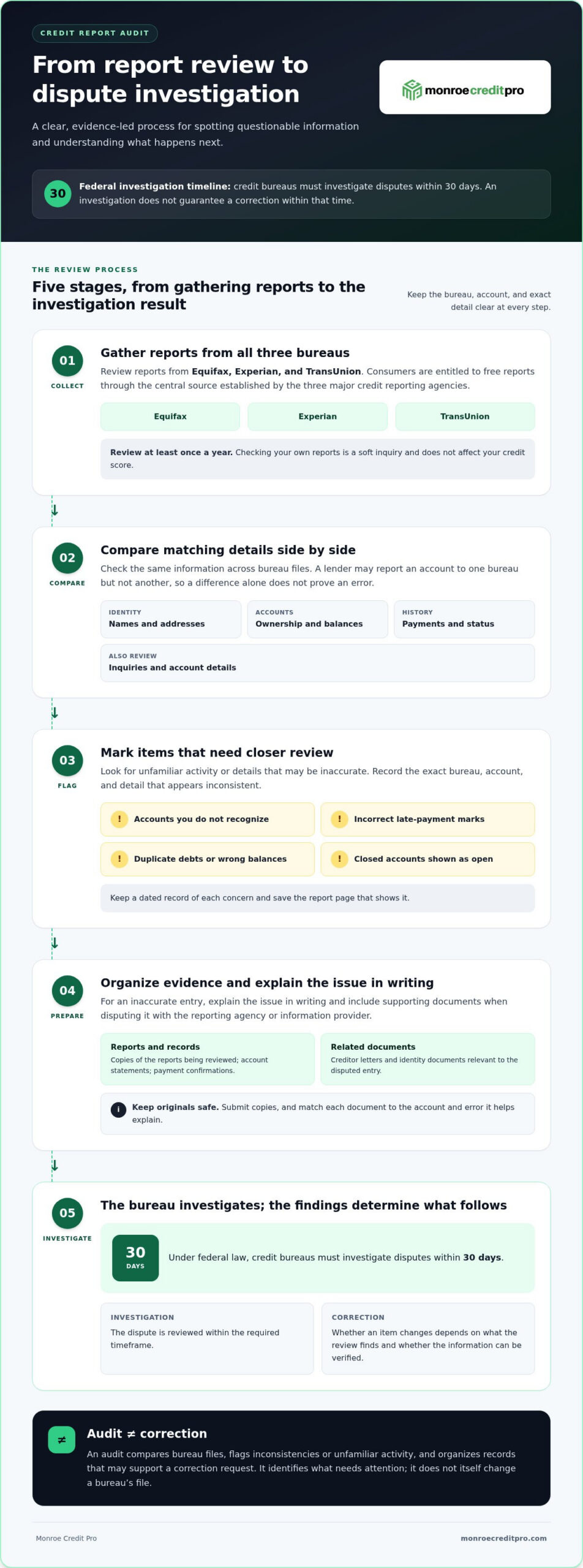
A credit report error can be challenged, but an investigation and a correction aren’t the same step. A comprehensive credit report audit reviews reports from all three major bureaus for inaccurate information and suspicious activity. Under federal law, credit bureaus must investigate disputes within 30 days.
It’s understandable to want a clear timeline when an incorrect account or unfamiliar inquiry appears on your report. The investigation period doesn’t guarantee that every item will be corrected within that time; the outcome depends on what the review finds and whether the information can be verified.
Learn how to compare reports across the bureaus, identify information that may need attention, and prepare a written dispute with supporting documents. This guide explains what happens during an investigation and how a credit report audit, credit correction, and professional guidance from Monroe Credit Pro can help you take an organized next step.
Key Takeaways
- Compare your reports from all three major bureaus to spot information that appears inconsistently or needs closer review.
- Review account details and inquiries for unfamiliar activity, and keep a clear record of anything you want to investigate.
- Check your credit reports at least once a year; consumers are entitled to free reports through the central source established by the three major credit reporting agencies.
- For inaccurate information, explain the issue in writing and include supporting documents when disputing it with the reporting agency or information provider.
- Track the investigation timeline: credit bureaus must investigate disputes within 30 days under federal law, while corrections depend on the investigation’s findings.
Credit report review across the three major bureaus
A careful review compares the information each bureau holds, then separates possible reporting errors from accurate account history. In Monroe, use a consistent process: collect the reports, compare matching details, and document anything that needs follow-up.
Comparing Reports Across Bureaus
Review reports from Equifax, Experian, and TransUnion side by side. Compare names, addresses, account ownership, balances, payment histories, account status, and inquiries. A lender may report an account to one bureau but not another, so differences alone don’t prove an error. Before taking action, note the exact bureau, account, and detail that appears inconsistent.
Finding Errors and Reviewing Reports Regularly
Check for accounts you don’t recognize, incorrect late-payment marks, duplicate debts, wrong balances, and closed accounts shown as open. Keep a dated record of each concern and save the report page that shows it. Consumers should review their reports at least once a year to catch errors that could affect financial decisions. A regular review also helps you notice changes between reports.
Audit Documents and Included Reviews
A credit report audit compares bureau files, identifies questionable entries, and organizes evidence for possible disputes. Gather copies of your reports, account statements, payment confirmations, creditor letters, and identity documents relevant to a disputed entry. Keep originals safe and submit copies with a dispute. Match each document to the account and error it helps explain.
What does a credit report audit include? It compares report details across the bureaus, flags inconsistencies or unfamiliar activity, and organizes records that may support a correction request. The review identifies what needs attention, but it does not itself change a bureau’s file.
What documents should I gather for a credit report audit? Collect the reports being reviewed, statements, payment records, and correspondence related to disputed accounts. Include identity documents when they help clarify incorrect personal information or account ownership.
How long do negative items stay on a credit report? The reporting period depends on the type of information and applicable reporting rules. Check the item’s category, dates, and status rather than assuming every negative entry follows the same timeline.
What are the risks of paying a company to audit or repair my credit? Federal law and Louisiana’s Credit Repair Services Organizations Act prohibit credit repair companies from charging upfront fees before work is completed. Louisiana’s act requires a $50,000 surety bond. Be cautious of upfront payment demands or promises that a company can remove accurate information.
Are there nonprofit credit counseling services near Monroe, Louisiana? Nonprofit credit counseling is a separate option for people seeking budgeting or debt-management guidance. It addresses financial planning, while a credit report audit focuses on the accuracy of reported information.
Whether checking reports affects credit scores
Checking your own credit is a soft inquiry and does not affect your credit score. A lender’s review connected to a credit application is different, so reviewing your reports is a practical way to monitor your financial information.
Consumers are entitled to free credit reports through the central source created by the three major credit reporting agencies. Check your reports at least once a year, then compare account details and report dates.
How can I check whether a credit repair company in Monroe is legitimate? Review its written agreement, the specific work it promises, and its billing terms. Louisiana’s Credit Repair Services Organizations Act requires a $50,000 surety bond, and federal CROA statutes and Louisiana’s act prohibit upfront fees before work is completed.
A credit report and a credit score serve different purposes. The report contains account and payment information, while the score summarizes credit risk using scoring systems that compare your report with consumers who have similar profiles. The Consumer Financial Protection Bureau says credit scores generally range from 300 to 850. A corrected report entry may affect a score if that information influences the scoring calculation.
Scores can change as reported information changes, but updates don’t all arrive at the same time. Creditors send account information to reporting companies, and the timing of those updates affects when a balance or payment history appears. Compare the report’s account details and dates before interpreting a score change.
- Pay bills on time to support a positive payment history.
- Avoid maxing out credit limits; keeping revolving utilization under 20% is a rebuilding strategy.
- Limit applications for new credit accounts in a short period.
- Avoid accumulating too many credit card accounts.
These steps address different parts of a credit profile. For example, paying on time won’t correct a balance reported inaccurately; the underlying report entry needs review. A credit report audit in Monroe, LA can help organize those findings, while a structured credit report audit can connect the review with the next correction steps.
Review your credit reports regularly for errors that could affect your scores, access to credit, or loan terms. A careful review can help you spot inaccurate information and decide whether it needs attention. Checking account details and dates shows what has been reported, while habits such as paying bills on time address how you manage credit.
Pay bills on time to improve or maintain your credit scores. Avoid maxing out your credit limits, applying for too many new credit accounts in a short period, and having too many credit card accounts; these are also steps consumers can take to improve or maintain their credit scores. Report review and account habits serve complementary purposes: checking can help identify errors, while responsible management supports your credit profile. Keeping both in view makes it easier to respond to report inaccuracies and maintain sound credit practices without treating a score as a substitute for checking the underlying information.
Credit dispute deadlines and investigation process
A clear dispute gives the reporting agency specific information to investigate. Federal law requires credit bureaus to investigate disputes within 30 days. Your written explanation, supporting records, and careful follow-up help keep the process organized.
Start by identifying the exact entry and bureau showing the issue. State what appears inaccurate, explain why, and include copies of relevant evidence. For example, if a payment is incorrectly marked late, attach a statement or payment confirmation that supports your account. Keep the original documents and a copy of everything you send.
You can dispute inaccurate information directly with the consumer reporting agency. You may also dispute the item with the information provider, such as the creditor that supplied the account data. Address each incorrect entry clearly. If the same account appears on more than one bureau report, identify each report and send a separate dispute to each relevant agency.
- Mark the inaccurate account, balance, payment history, or personal detail on the report.
- Write a concise explanation describing the error and the correction you believe is appropriate.
- Attach copies of documents that support your explanation, then keep a dated copy of the dispute.
- Review the investigation response and compare the updated report with your records.
The 30-day investigation period is the key initial deadline. During days 30-60, furnishers may verify, modify, or delete inaccurate tradelines. A bureau investigation and a furnisher’s response are related steps, but they aren’t the same action. Track the dates and responses for each disputed item so you can see which information changed and which remains unresolved.
What Louisiana and federal laws protect consumers during credit report disputes? Federal law governs credit bureau dispute investigations, including the 30-day investigation requirement. Louisiana’s Credit Repair Services Organizations Act and federal CROA statutes prohibit credit repair companies from charging upfront fees before work is completed; Louisiana’s act also requires a $50,000 surety bond.
A broad dispute campaign can involve several records, bureaus, and information providers. Comprehensive credit dispute campaigns in Louisiana are estimated to take 3 to 6 months for complete file auditing and resolution. Keep a simple timeline with the date sent, the disputed item, the recipient, and each response. That record makes follow-up more precise and helps distinguish an investigation result from a correction appearing on a report.
Detecting identity theft and suspicious activity
An unfamiliar account or credit inquiry deserves a closer look, but verify the details first. A lender’s name may differ from a store or service brand you recognize. Compare the account date, balance, and status across Equifax, Experian, and TransUnion. Look for patterns, such as several accounts you never opened or inquiries tied to applications you didn’t make.
Review personal information as carefully as account data. An address you never used, a misspelled name, or an unfamiliar phone number can point to mixed records or possible identity misuse. One outdated address alone doesn’t prove fraud. Record the exact detail, the bureau reporting it, and whether it appears on your other reports.
Keep a simple evidence log for each suspicious entry. Note the account name, opening date, balance, and any contact details shown. Save a dated copy of the report page and related creditor correspondence. Track inquiries separately, since an application you don’t recognize may require a different explanation from an account balance that looks wrong.
- Mark accounts you don’t recognize, including the reported creditor and account status.
- Compare inquiries with applications you remember submitting.
- Check whether unfamiliar addresses or names appear across multiple reports.
- Save statements, letters, and other records connected to each disputed item.
Next, contact the creditor associated with an account you don’t recognize, using contact information from a reliable statement or account record. Ask what information connects the account to you, and save the response with your evidence log. Don’t share sensitive information through an unexpected call or message. Verify who is contacting you before discussing an account.
If a report contains inaccurate information, dispute it directly with the consumer reporting agency. You may also dispute it with the company that supplied the information. Explain in writing which entry you believe is inaccurate, why, and what documents support your explanation. Send copies, retain the originals, and record when you submitted each dispute.
Check your reports at least once a year, and review them again when an account notice or collection letter surprises you. A single review gives you a snapshot; comparing later reports can reveal whether an unfamiliar item remains, changes, or appears elsewhere. Track each response alongside the original report so you can distinguish a verified account from an unresolved concern.
A suspicious entry calls for careful review, not an automatic conclusion. An unfamiliar inquiry without a new account still merits documentation, while an unknown account with matching personal details calls for prompt follow-up. Keep the steps orderly: identify the item, gather evidence, contact the relevant company, and dispute inaccurate reporting in writing.
Correcting credit report mistakes
Turn a report finding into a specific correction request. Identify the bureau, account, and exact detail you believe is inaccurate. Explain the discrepancy clearly, then connect it to records that support your account. A focused request helps distinguish a wrong balance from a disputed payment date or duplicate listing.
Compare the entry with your own records before writing. Match a reported balance against a recent statement, for example, or compare a late-payment mark with a payment confirmation. Check the account status and dates, too. A creditor may report an account differently across bureaus, so note each report where the same mistake appears.
Dispute inaccurate information directly with the consumer reporting agency. You may also dispute it with the information provider that supplied the entry. Write separately to each relevant recipient, identify the item precisely, and state what you believe should be corrected. Include copies of supporting documents, not originals, and keep a complete copy of each submission.
- Identify the bureau and the account or personal detail in question.
- Describe the specific error and the accurate information you believe belongs there.
- Attach relevant statements, payment records, or creditor correspondence.
- Keep copies and record the date and recipient for each dispute.
Keep each request focused. If one account has an incorrect balance and a separate payment-history issue, describe the issues distinctly. Attach evidence to the claim it supports. Organizing documents by bureau and account makes it easier to track responses and see which detail was addressed.
Credit bureaus must investigate disputes within 30 days under federal law. Information providers may verify, modify, or delete inaccurate tradelines during days 30-60. Review each response against your original request. If an updated report still shows the same discrepancy, compare the response with your documents and identify the unresolved detail for follow-up.
Separate factual errors from dissatisfaction with a score or an accurate account history. A request focused on a provable discrepancy, such as a payment recorded on the wrong date, gives the investigation a clear issue to examine. Avoid broad requests that don’t identify an entry or explain what evidence supports a correction.
For several errors, maintain a tracking sheet with the bureau, account, disputed detail, documents sent, submission date, and response. This helps prevent one bureau’s response from being mistaken for a correction across every report. A credit report audit can help organize the evidence and clarify which entries may need a dispute.
Monroe Credit Pro: Credit Restoration
Monroe Credit Pro offers Credit Restoration for people addressing report concerns and working to rebuild a clearer financial foundation. If inaccurate entries or other credit challenges feel difficult to manage alone, Professional Credit Repair and Credit Correction provide focused support through structured dispute cycles. Credit Counseling can also help you consider how financial habits and credit decisions fit into your broader goals.
Bring your questions and the report details you’ve organized, such as the bureau, account, and issue involved. That context can guide a practical discussion about possible next steps. Credit report reviews and corrections follow a process, so clear information matters.
For support with your credit concerns, contact Monroe Credit Pro.
Take the Next Step Toward Clearer Credit
Let your next move be guided by a clear understanding of your goals. A credit report audit in Monroe, LA can help you turn a confusing set of records into an organized plan for addressing concerns and building stronger financial habits. Focus on the outcome you want, whether that means pursuing a correction or creating a steadier path forward.
Monroe Credit Pro offers Credit Restoration, Professional Credit Repair, and Credit Correction for people working through credit challenges. The right starting point depends on what you want to address and the guidance you need. Bring your questions and take the conversation one practical step at a time.
Contact Monroe Credit Pro to discuss a constructive next step. Progress begins with a clear plan, and you can move forward with purpose.
Frequently Asked Questions
How quickly can dispute adjustments occur in LA?
Credit bureaus must investigate disputes within 30 days, while furnishers may verify, modify, or delete inaccurate tradelines during days 30-60. Comprehensive credit dispute campaigns in Louisiana may take 3 to 6 months for complete file auditing and resolution. An investigation response and a visible report adjustment are separate steps, so track both dates and compare the updated entry with your original records.
What credit report audit services are available?
Monroe Credit Pro offers a Credit Report Audit, Professional Credit Repair, Credit Correction, Credit Restoration, Credit Counseling, and Credit Monitoring. A three-bureau audit reviews information across Equifax, Experian, and TransUnion. If a review identifies a questionable collection or repossession, correction support can focus on that reporting issue, while counseling can help you consider credit-building habits alongside the report review.
How do I dispute errors on my credit report in Louisiana?
Write to the consumer reporting agency showing the error, identify the specific account or detail, explain what is inaccurate, and include copies of supporting records. You may also dispute the information with the company that supplied it. For example, if a payment appears under the wrong month, attach a dated payment confirmation and clearly identify the account and reporting entry.
How long do credit bureaus have to investigate a dispute?
Credit bureaus must investigate a dispute within 30 days under federal law. Keep the submission date and response together, then compare the decision with the item on your report. Report updates typically occur every 30-45 days, so a completed investigation and the change appearing on a report may not happen simultaneously. Review the next report for the specific account detail you challenged.