



What if the first step to buying a home isn’t chasing a higher credit score, but making sure your credit record is accurate? If you’re wondering how to fix credit to buy a house, it’s understandable to feel uncertain about what lenders will see, especially after past credit problems. Those setbacks don’t automatically close the door to homeownership, and a promised score jump isn’t a reliable plan.
Mortgage readiness starts with reviewing your credit reports for home loan approval and understanding what lenders may assess. This guide explains what to check before speaking with a lender, how to distinguish possible reporting errors from accurate negative information, and which legitimate steps may help you prepare. Results and timelines vary, so steady preparation matters more than shortcuts.
You’ll learn how payment history, balances, and other credit details may fit into a lender’s review, how to address potential inaccuracies, and when credit counseling or professional dispute support may be useful. Credit rebuilding can complement mortgage advice, but it can’t replace guidance tailored to your circumstances. Start with the records in front of you, then take the next step with a clearer plan.
Key Takeaways
- Mortgage readiness involves more than a credit score. Requirements can vary by loan program, lender, and applicant.
- Review your credit reports systematically: compare account details, document possible errors, and track follow-up.
- To fix credit to buy a house, focus on accurate reporting and steady preparation rather than trying to erase valid negative information.
- Treat credit review, correction efforts, and lender discussions as distinct steps. Share relevant concerns with your lender before making major changes.
- A three-bureau audit and structured dispute support can help organize potential inaccuracies, but they don’t guarantee a particular outcome or timeline.
Fix Credit to Buy a House: Start With What Mortgage Lenders Review
Mortgage credit readiness is broader than one number in a credit-monitoring app. Lenders review credit information as part of a larger application, alongside income, assets, debts, and other details. Requirements vary by loan program, lender, and applicant circumstances, so a score that seems encouraging in one context doesn’t guarantee the same result elsewhere.
Mortgage credit readiness means understanding your credit history and obligations before a lender evaluates your full application. Accuracy matters because a reporting mistake can give a misleading picture of how you’ve managed credit. Before deciding how to fix credit to buy a house, review what your records show and consider how those details may fit into a lender’s assessment.
Which parts of your credit profile may matter for a mortgage?
A credit report contains account and payment details. A credit score is a number calculated from information in a report. Lenders may consider patterns such as whether payments were made on time, how much of your available credit is in use, how long accounts have been established, and whether you’ve applied for credit recently. These details provide context, not a single standalone verdict.
- Payment history: Shows whether accounts were paid as agreed and may include reported late payments.
- Balances: Reflects amounts owed, including balances on revolving accounts.
- Account age: Indicates how long credit accounts have been open.
- Recent applications: Shows recent requests for credit, which may appear as inquiries.
Credit is only one part of the picture. Lenders also consider income, assets, debt obligations, and other application information. Two applicants with similar scores may have different financial circumstances, and the same applicant may receive different assessments under different lender or program criteria.
Why lender requirements and credit scores can differ
Scores can vary because scoring models and the information used to calculate them may differ. A score shown through a consumer-facing service may not be the score a mortgage lender uses. For a general overview of how scores work, see Understanding Credit Scores. Treat an app score as one reference point, not a promise of what a lender will see.
Loan programs may set their own requirements, and lenders can apply additional criteria. There isn’t one score that guarantees approval across all mortgages. Ask your mortgage lender which current program requirements and credit factors apply to your situation. That conversation can help you prioritize report accuracy and financial preparation without making major changes based on a score alone.
Start with your full profile, not a target number. A structured review can help separate credit-report concerns from broader questions about debts or application readiness, giving you a clearer basis for your next discussion with a lender.
Review Your Credit Reports Before Making Mortgage Plans
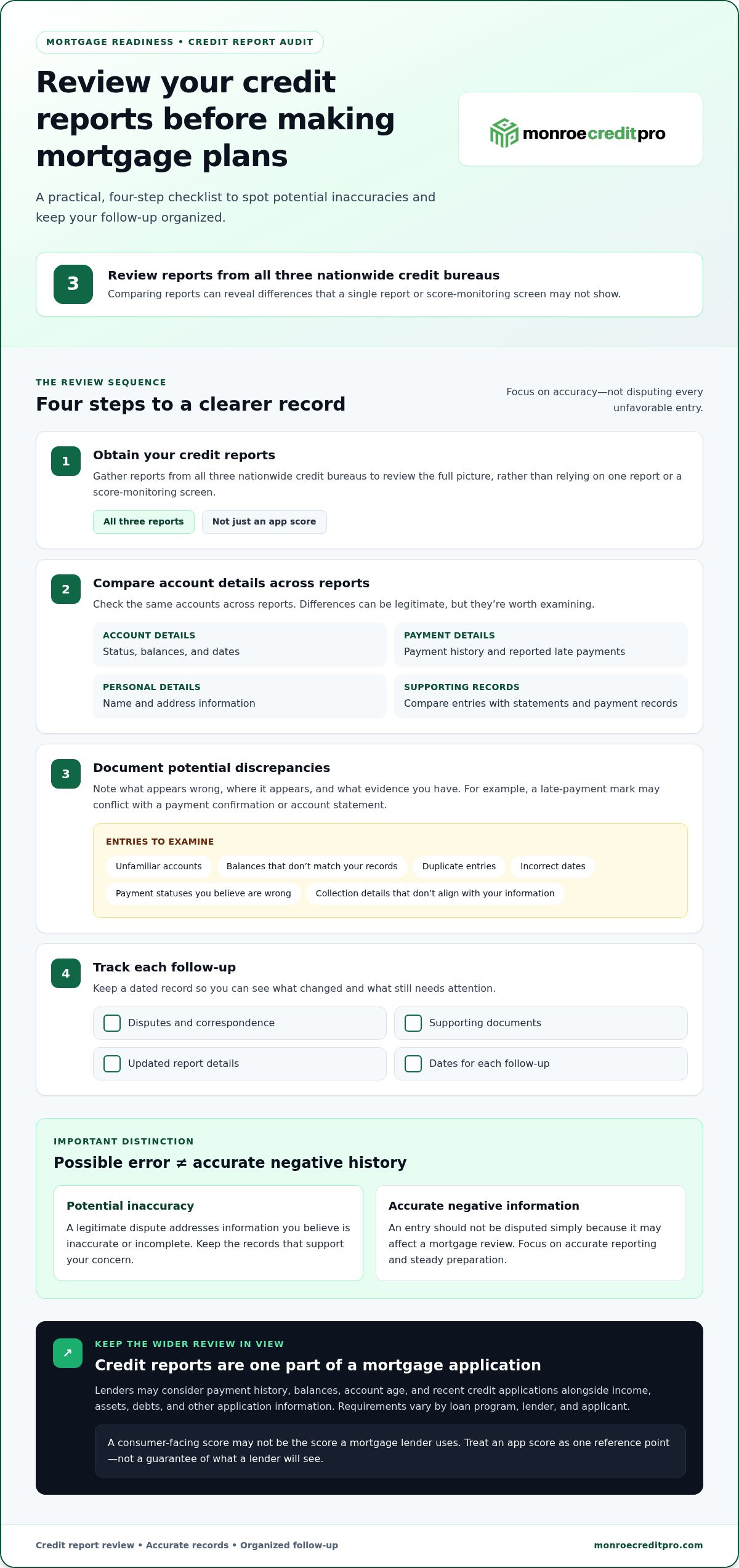
Before changing your credit habits or setting a mortgage application date, inspect the information lenders may review. Comparing reports from all three bureaus can reveal differences a single report may not show. The goal isn’t to dispute every unfavorable entry. It’s to identify information you reasonably believe is inaccurate or incomplete, then keep a clear record of your follow-up.
Use this sequence to make the review manageable:
- Obtain your credit reports. Gather reports from all three nationwide credit bureaus to review the full picture, rather than relying on one report or a score-monitoring screen.
- Compare the entries. Check the same accounts across reports. Review account status, balances, payment history, dates, and personal details such as your name and address. Differences can be legitimate, but they’re worth examining.
- Document potential discrepancies. Note what appears wrong, where it appears, and what evidence you have. For example, an account marked late may conflict with a payment confirmation or account statement.
- Track each follow-up. Keep a dated record of disputes, supporting documents, correspondence, and updated report details. This helps you see what has changed and what still needs attention.
How to identify information that may warrant a dispute
Compare account details with your statements and payment records. Flag unfamiliar accounts, balances that don’t match your records, duplicate entries, incorrect dates, or payment statuses you believe are wrong. Review collection accounts just as carefully, checking whether the reported details align with the information you have. The article “How to Remove Collections from Your Credit Report: A Practical Guide” offers a related reference for collection concerns.
Separate possible errors from accurate negative history before taking action. A legitimate dispute addresses information you believe is inaccurate or incomplete, not an entry simply because it may affect a mortgage review. “Three-Bureau Credit Report Review: How to Audit Yours in 2026” outlines a way to organize that comparison.
What to do after submitting a credit report dispute
Keep copies of the reports you reviewed, documents supporting your concern, and all dispute correspondence. Record the date you submitted each dispute and save any response or updated report. Investigation outcomes depend on the information reviewed by the credit reporting company and the company that supplied the account information. An item may be updated, remain, or require further review, so don’t assume a particular result or timing.
A structured three-bureau credit report audit can help organize potential inaccuracies and follow-up before mortgage discussions. If you’re preparing to fix credit to buy a house, focus on evidence and accurate reporting, then bring relevant questions to your mortgage lender.
Credit Setbacks, Disputes, and the Concern That It Is Too Late
A difficult credit history can make buying a home feel out of reach, but it doesn’t mean every negative entry is an error or that there’s nothing useful to do. Separate two tasks: correcting information you genuinely believe is inaccurate or incomplete, and building stronger financial habits from here. Each requires a different approach.
Legitimate credit correction addresses a specific reporting concern; it doesn’t promise deletion of accurate information or a particular mortgage outcome. A late payment reported correctly doesn’t become inaccurate because it affects borrowing. Disputing accurate information without a genuine concern isn’t a substitute for rebuilding your profile.
Can accurate negative information be removed just to improve mortgage chances?
Dispute an entry when you have a reasonable basis to believe it’s wrong or incomplete, such as a payment marked late despite records showing it was paid on time. Don’t dispute accurate information solely to try to improve mortgage eligibility. For current information about credit-report disputes and consumer rights, consult the Consumer Financial Protection Bureau’s credit-report guidance.
An investigation may not produce the result you want. No correction service can responsibly guarantee that accurate negative information will be deleted, that your score will rise by a set amount, or that a lender will approve an application. Focus on evidence and a clear explanation of the specific reporting concern.
Which habits support a stronger credit profile over time?
Consistent habits can support a stronger credit profile, even when past setbacks remain on a report. Prioritize paying current obligations on time and managing existing balances responsibly. Before taking on new credit, consider whether the application is necessary. Opening accounts or seeking several new lines of credit may complicate your financial picture before mortgage review.
Keep the process steady. Review due dates, use reminders or automatic payments if they fit your budget, and check account balances regularly so you can address changes early. These steps don’t guarantee a score increase or mortgage approval, but they can help you manage credit consistently while you prepare.
If you’re working to fix credit to buy a house, avoid quick-fix promises and pressure to challenge every negative entry. Match the action to the issue: document a genuine reporting error and use the appropriate dispute process; for accurate history, focus on responsible account management and discuss your broader readiness with a mortgage lender. Credit counseling or rebuilding guidance can also help you create a practical plan without treating valid reporting as something that can simply be erased.
Build a Practical Credit-Preparation Timeline Before Applying
Credit preparation works best as a sequence, not a last-minute push. Start early enough to understand what your reports show, address genuine concerns, and talk with a mortgage professional before making major financial changes. Dispute investigations and credit rebuilding have no guaranteed completion date, so treat each phase as preparation, not a countdown to a promised score or approval.
What to do well before a mortgage application
Begin by reviewing all three credit reports. Gather account statements, payment confirmations, and other records that may clarify reporting concerns. Create a simple inventory of debts, monthly payments, account balances, and questions for a lender. Then maintain consistent payment and balance-management habits. These steps help you prepare, but don’t produce instant or guaranteed score changes.
Use three practical phases to keep your preparation organized:
- Early review: Compare your reports, list entries that need attention, and collect relevant records. If a repossession appears and you have questions about its reporting, “How to Rebuild Credit After Repossession: A Practical Guide” may help you organize what to examine.
- Correction and rebuilding: Follow up on potential inaccuracies with clear documentation. Keep making payments on time and managing current balances responsibly while you wait for responses. Don’t assume an investigation or credit rebuilding will be complete by a particular date.
- Lender discussion: Share relevant concerns, including pending disputes, with a mortgage professional before making significant changes or relying on a general online score threshold.
What to discuss with a mortgage professional
Ask which loan options and current credit criteria may fit your circumstances. Explain relevant report issues and ask whether a pending dispute could affect application timing or underwriting review. Requirements depend on the program, lender, and details of your application, so ask for current guidance rather than treating a general online threshold as a decision.
Before the conversation, organize questions about your credit history, existing debts, and planned changes. For example, if you’re considering opening an account or paying down a balance, ask how that decision fits your application plan. A lender can provide mortgage-specific guidance; credit counseling and rebuilding support can help you organize report concerns and develop consistent habits alongside that advice.
Starting early gives you room to make informed choices, even if the process takes longer than expected. If you want help organizing a three-bureau review and potential reporting concerns, explore credit report audit and counseling support. A clear record and a lender-informed plan can make the next steps easier to manage as you work to fix credit to buy a house.
How Structured Credit Support Can Help You Prepare for Homeownership
You don’t have to sort through every credit concern alone. A structured review can turn a stack of reports into an organized picture: what appears consistent, what may need closer examination, and which questions are best directed to a mortgage lender. The purpose is clarity and informed follow-through, not a promised score change or mortgage result.
What professional credit review can contribute
A three-bureau audit brings reports together for a systematic review of account details and potential inaccuracies. Comparing information across bureaus can help identify entries that merit closer attention. Organized documentation and bureau correspondence also make dispute follow-up easier to track. Recurring dispute cycles provide a process for reviewing progress and responding to concerns over time, not a fixed timeline or guaranteed deletion.
Some information may be accurate and remain on your reports. Outcomes depend on the details reviewed and the information available to the reporting parties. Professional support should focus on potentially inaccurate or incomplete entries. Credit counseling and rebuilding coaching can help you consider practical habits for managing your profile. Credit monitoring can help you stay aware of reported changes, but it doesn’t determine mortgage eligibility.
How to choose your next step without pressure
Match the support to the question in front of you. If you’re comfortable reviewing reports yourself, organize your records and follow up on specific concerns. If you want help understanding your credit profile or building consistent habits, counseling or rebuilding coaching may help. If potential inaccuracies appear across reports, a structured audit and dispute support can bring order to the review.
Keep mortgage decisions with your lender. Credit support can help you understand reports and pursue possible corrections, while a mortgage professional can discuss loan options, current requirements, and how your circumstances fit an application. These forms of guidance can work alongside each other without confusing credit correction with underwriting advice.
As you work to fix credit to buy a house, use professional support to clarify what’s in your reports and which steps may be appropriate, not to chase a guaranteed outcome. Monroe Credit Pro offers three-bureau credit profile audits, personalized consulting, recurring dispute cycles with bureau correspondence and progress tracking, credit counseling, rebuilding coaching, and ongoing monitoring. These services can help structure the process while mortgage-specific questions remain with your lender.
If a more organized review would help you prepare, explore Monroe Credit Pro’s structured credit support.
Take the Next Step Toward Homeownership
Your next move doesn’t need to solve every credit concern at once. Choose one practical action you can maintain, then build from there. A clearer plan can replace uncertainty with purposeful progress, even if your path to a mortgage takes time.
If you’re working to fix credit to buy a house, keep your goal grounded in accurate information and steady preparation, not pressure to reach a particular score overnight. Professional credit guidance can help you understand your options and organize the work ahead, while your mortgage lender remains the right source for questions about loan eligibility and application requirements.
Explore support that fits your homebuying goals with Monroe Credit Pro’s three-bureau credit audit and credit counseling services. Get started with a clearer view of your credit profile and a practical plan for what to address next.
Frequently Asked Questions
How long before buying a house should I start working on my credit?
Start as early as practical. Reviewing reports, addressing possible inaccuracies, and establishing consistent habits can take time. If you hope to apply in a particular season, use that date to plan ahead, but don’t assume every concern can be resolved by then. Dispute investigations and lender requirements vary. Ask your mortgage professional when to begin based on your intended application date and account concerns.
Can I get a mortgage while disputing an item on my credit report?
Possibly, but a pending dispute may affect how a lender reviews your application. The impact depends on the lender, loan program, and your circumstances. Tell your mortgage professional about the dispute and ask whether it could affect timing or underwriting review. Explain which account is involved and what information you’re questioning. Get lender-specific guidance before deciding whether to apply or change your plans.
Does checking my own credit score lower it?
No. Checking your own credit score or report is generally treated as a soft inquiry and doesn’t lower your score. A lender’s inquiry connected to a credit application is typically a hard inquiry and may affect a score. Reviewing your own information is a sensible preparation step, especially if you spot unfamiliar accounts or changes. While preparing for a mortgage, avoid unnecessary applications for new credit.
Do mortgage lenders use the same credit score I see in an app?
Not necessarily. An app may show a consumer-facing score calculated with a model or report data that differs from what a mortgage lender uses. Lenders can use different scoring approaches and program requirements, so there isn’t one model that applies to every mortgage application. Ask your mortgage professional which credit information and scoring approach will be considered for your application, rather than planning around an app score alone.
Should I pay off collections before applying for a mortgage?
Discuss a collection account with your mortgage professional before deciding how to handle it. The effect of paying may depend on the account, its reporting details, the lender, and the loan program. First check that the account information is accurate and gather any related records. Don’t assume payment will raise your score or remove the entry. Ask how the account fits your application before making a major change.
Can I remove accurate late payments from my credit report before buying a house?
A dispute is appropriate when you believe information is inaccurate or incomplete, not simply because an accurate late payment is unfavorable. Review the account details and compare them with payment records, such as statements or confirmation notices. If the reporting appears correct, focus on making future payments consistently and managing current accounts responsibly. No service can promise deletion of accurate information or a specific effect on mortgage eligibility.
Will a credit repair service guarantee mortgage approval?
No credit repair service can guarantee a score increase, removal of accurate information, or mortgage approval. A professional report review may help identify potential inaccuracies and organize possible next steps, but approval depends on lender criteria and the full application, not credit alone. Use credit support for report and rebuilding guidance, and direct questions about eligibility, loan options, and underwriting to your mortgage lender.