



What if a difference between your Equifax, Experian, and TransUnion reports isn’t automatically an error? A useful three bureau credit report review starts with matching accounts, then checks whether differences need explanation. Not every creditor reports to all three bureaus, so some variations may have a straightforward cause.
Long reports and unfamiliar account details can make the comparison feel like a lot to manage. You don’t have to resolve every question at once. A consistent review can help you understand each section, identify details to verify, and keep findings organized.
In this guide, you’ll learn how to review each report side by side, distinguish ordinary reporting differences from potential inaccuracies, document concerns, and plan practical follow-up. If you’d like help interpreting what you find, a professional credit report audit can provide structured guidance without promising a particular outcome.
Key Takeaways
- A three bureau credit report review is easier when you check identity details, accounts, inquiries, and other sections in a consistent order.
- Compare matching accounts side by side, including status, balance, dates, and responsibility. Account for differences in reporting dates and bureau formatting.
- Use a secure workspace to record report dates, questions, and supporting documents as you review each file.
- Sort findings into information that appears accurate, details to verify, and potential inaccuracies supported by records.
- Check the relevant bureau’s procedures and contact the furnisher where appropriate. Professional guidance may help you organize complex findings.
What a Three-Bureau Credit Report Review Covers, and Why Review All Three?
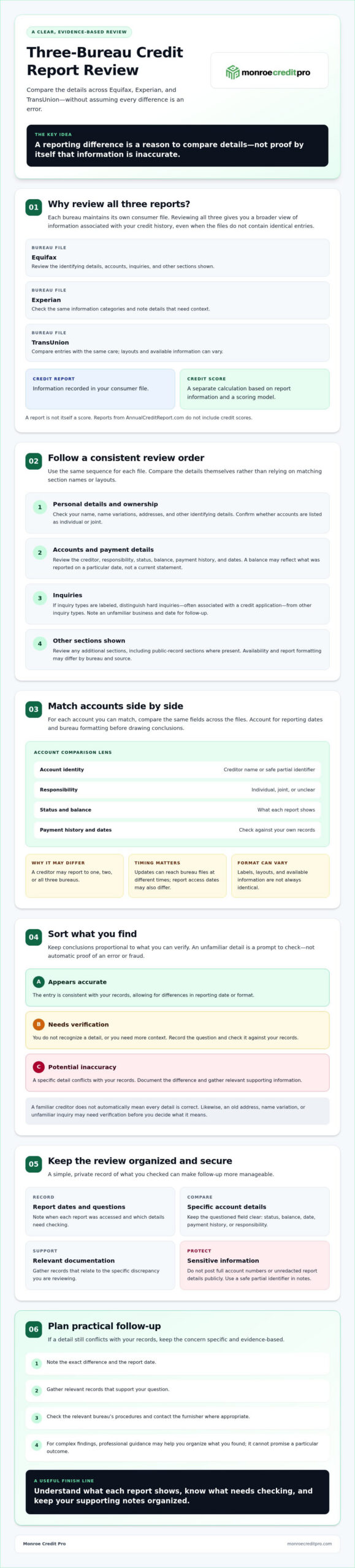
A three-bureau credit report review examines the consumer files maintained by Equifax, Experian, and TransUnion. It compares identifying details, account information, inquiries, and public-record sections where present. Reviewing all three gives you a broader view of the information associated with your credit history, although the files may not contain identical entries.
A credit report contains information recorded in your file. A credit score is a separate calculation based on report information and a scoring model. A report helps you understand what data is being considered, but it isn’t itself a score. For a foundational overview, see What is a credit history?
What information appears on a credit report?
Reports commonly include personal identifying details, account histories, inquiries, and other sections that may include public records. Account entries can show payment status, balances, and dates. Labels, available information, and layout vary by bureau and report source, so compare the details themselves rather than relying on matching section names.
Check unfamiliar entries carefully. A name variation or address you don’t recognize may need verification, but it isn’t automatically proof of an account error. Protect your information while taking notes: don’t post full account numbers or unredacted report details publicly.
Why can the three bureau reports differ?
Creditors may furnish account information to one, two, or all three bureaus, and updates may reach bureau files at different times. Reports accessed on different dates may therefore show different balances or payment statuses for the same account. Formatting can vary as well. A reporting difference is a reason to compare details, not proof by itself that something is inaccurate.
Check report dates and account details before deciding what needs follow-up. If an entry still conflicts with your records, note the specific difference and gather relevant documentation. To check current options for accessing your reports, use AnnualCreditReport.com, the authorized website identified by the federal government for requesting credit reports. Reports from that source don’t include credit scores, so treat any score as separate information.
The goal is a clear, evidence-based picture, not identical-looking files. Once you understand what each report contains and why entries can vary, you can examine individual sections and account details more closely.
How to Read the Main Sections of Your Three-Bureau Credit Reports
Read each report in the same order to make details easier to compare. In your three bureau credit report review, start with personal information, then check accounts, inquiries, and any other sections shown. The Consumer Financial Protection Bureau explains what a credit report contains, including identifying information and credit account details.
Review personal details and account ownership
Check your name, name variations, addresses, and other identifying details. An old address or spelling variation may be familiar. Pause over information you don’t recognize and record a question for follow-up. Never copy full account numbers or other sensitive identifiers into notes, screenshots, or documents you plan to share.
Next, confirm who is responsible for each account. A report may identify an account as individual or joint. Check whether that designation matches your records, and don’t assume that recognizing a creditor means every detail in its entry is correct.
Understand account status, balances, and inquiries
For each account, review its reported status, balance, payment history, dates, and responsibility. A balance may reflect the amount reported on a particular date, rather than the amount shown on a current account statement. For payment history, compare any status or date you question with your own records.
Review inquiries separately. If the report labels inquiry types, distinguish hard inquiries, often associated with an application for credit, from other inquiry types. An unfamiliar inquiry deserves a closer look, but its presence alone doesn’t confirm fraud or a reporting error. Note the listed business and date, then check what the inquiry relates to.
Use a short checklist for each account. Keep notes minimal and secure:
- Account: creditor name or a safe, partial identifier
- Ownership: individual, joint, or unclear
- Status and balance: what the report shows
- Dates and payment history: details to compare with records
- Next step: recognized, verify, or gather supporting documents
Work through one report at a time. Mark what you recognize and set aside questions rather than drawing quick conclusions. If you want structured help interpreting report details, consider a professional credit report audit.
How to Compare Equifax, Experian, and TransUnion Reports Without Misreading Differences
Compare matching accounts, not just page layouts. A side-by-side review helps you identify whether a difference concerns the account, the date information was reported, or simply the way a bureau presents it. Record the date you accessed each file so you know whether you’re comparing information from similar points in time.
Use a consistent set of fields for each account:
- Bureau and account: Equifax, Experian, or TransUnion, plus the creditor name or a safe partial identifier.
- Ownership and status: individual or joint, and the status shown.
- Balance and dates: reported balance, date reported, and relevant account dates.
- Verification notes: what differs and which statement or creditor correspondence may help clarify it.
For example, different balances may reflect reporting dates that don’t line up. A difference in status or ownership may need closer checking against your account records. The Federal Trade Commission explains how to get your free credit reports. Check its current guidance when arranging access to the files you want to compare.
Which account details should match across bureau files?
For accounts that appear in multiple files, compare creditor identity, ownership, status, reported balance, and key dates. Record the bureau beside each detail, along with the date you accessed that report. Use statements or creditor correspondence as supporting records when available. A creditor’s name may be shortened or formatted differently, so check the account context before treating a label variation as a mismatch.
When is a difference worth investigating?
Give priority to unfamiliar accounts, ownership that doesn’t match your records, payment details that appear inconsistent, or balances you can’t reconcile. First consider whether the files reflect different reporting dates or furnishing patterns. A missing account or date variation doesn’t automatically require a dispute. Gather relevant records and clarify what the entry represents before deciding on follow-up.
A bureau difference is a reason to verify an entry against reliable account records, not proof by itself that the report is wrong. Note the discrepancy, check its timing, and follow up only if the details still need an explanation.
A Practical Checklist for Completing Your Three-Bureau Credit Report Review
Set a clear order and a secure place to work. This checklist takes you from gathering reports to identifying details that need verification, without treating every variation as an error.
- Step 1: Obtain your reports. Use current access options from authoritative consumer resources or the relevant bureaus. Record the date you access each file so you can account for timing differences.
- Step 2: Confirm identity details. Check names, addresses, and other identifying information. Note what you recognize and set aside anything unfamiliar for review.
- Step 3: Review each report’s sections. Work through accounts, inquiries, and other sections shown. Mark questions as you go instead of trying to resolve every detail immediately.
- Step 4: Compare matching accounts. Use the same fields for each bureau, such as ownership, status, balance, and dates. Check whether differences may relate to reporting timing or formatting.
- Step 5: Record and prioritize questions. Separate familiar information from entries that need clarification, then identify which records or follow-up could help.
Choose a private workspace, digital or paper-based, and keep report dates, notes, and supporting documents together. Protect the files with appropriate access controls. Avoid putting full account numbers or sensitive identity details in general notes or shared documents.
How should you document potential inaccuracies?
For each item that needs a closer look, record the bureau, account, exact field, observed difference, and date reviewed. Keep relevant statements or creditor correspondence in a secure location, and refer to them in your notes rather than copying sensitive details unnecessarily. Label confirmed facts separately from open questions so an initial concern doesn’t become an assumed conclusion.
What should you verify before taking action?
Compare the entry with account records and creditor communications when available. An unfamiliar account, ownership designation, or payment detail may deserve priority, but verify the information before deciding it’s inaccurate. Don’t dispute information you recognize as accurate solely because another bureau’s file looks different.
Before submitting a dispute, review the current procedures of the bureau reporting the information and check current guidance from the Consumer Financial Protection Bureau (CFPB) and applicable Fair Credit Reporting Act (FCRA) resources. Requirements and instructions can depend on the issue, so confirm the relevant steps using authoritative sources. If you want a deeper walkthrough, see this guide on how to handle a credit report inaccuracies dispute. If organizing your findings feels difficult, a professional credit report audit may offer structured guidance for interpreting them.
What to Do After a Three-Bureau Credit Report Review
Turn your findings into a short, organized plan. After a three-bureau credit report review, sort each item into one of three groups: information that appears accurate, details that need verification, and potential inaccuracies supported by records. This prevents a difference from becoming an assumed error before you’ve checked the facts.
How can you organize next steps by finding type?
Keep accurate entries in your review notes, but don’t treat them as correction targets. For information you’re unsure about, compare the report with account records or creditor correspondence. If the records support a possible inaccuracy, follow the current instructions from the bureau reporting it and, where relevant, contact the furnisher of the information.
Keep a simple follow-up log. Record the bureau or furnisher contacted, the date, the item in question, and any response or next step. Save copies of submissions and relevant correspondence securely. This makes it easier to track what you’ve done and refer back to the evidence if you need to follow up.
When might professional report review help?
Consider additional guidance if you’re sorting through multiple accounts, unclear histories, or inconsistencies that are difficult to assess against your records. Monroe Credit Pro offers personalized assessments of three-bureau reports and credit consulting. A professional review can help organize complex findings, but it can’t guarantee a particular score change or that an item will be removed. Readers exploring credit restoration services should use the company’s existing strategic guide for further information.
Before taking action, check the relevant bureau’s current procedures and consult authoritative consumer resources for applicable Fair Credit Reporting Act (FCRA) information. Requirements and steps can depend on the issue, so verify current guidance rather than relying on an old checklist. Dispute only information you have a reason to question, and keep supporting records together.
If interpreting your findings still feels difficult, a professional profile review can be an optional source of structured guidance. The goal is a clear, evidence-based next step, whether you manage the follow-up yourself or seek support.
Make Your Next Credit-Report Step Clear and Organized
A thoughtful three bureau credit report review isn’t about making every file look identical. It’s about understanding what each report shows, comparing matching account details carefully, and separating accurate information from questions that deserve verification. Keep notes and supporting records organized, then use the relevant bureau’s current procedures when follow-up is appropriate.
You don’t have to interpret complex files alone. Monroe Credit Pro offers personalized three-bureau credit report assessments, along with credit counseling, rebuilding coaching, and ongoing credit monitoring. These services can help you organize report information and track changes, without promising a particular score outcome or item removal.
Explore a professional credit profile review if you’d like support organizing your findings. Whether you review your reports independently or seek guidance, a careful, evidence-based process can help you move forward with greater clarity.
Frequently Asked Questions
What is a three-bureau credit report review?
A three-bureau credit report review compares the consumer files maintained by Equifax, Experian, and TransUnion. It checks identifying details, accounts, inquiries, and other sections shown on each file. The goal is to understand what information is reported and identify details that may need verification, not to assume all three files should be identical. A credit report contains file information; a credit score is a separate calculation.
How do I get and review all three credit reports?
You can request reports from Equifax, Experian, and TransUnion through AnnualCreditReport.com, the federally authorized website. Free weekly reports are available from each bureau. Review each file in a secure setting, note its access date, and compare the same details across bureaus, such as account status and reported balance. Reports from AnnualCreditReport.com don’t include credit scores, so treat any score you see elsewhere as separate information.
Why are my Equifax, Experian, and TransUnion reports different?
The reports may differ because creditors don’t necessarily furnish information to all three bureaus, and updates may appear at different times. Bureau formats and labels can also vary. For instance, one file may show a newer reported balance than another. Compare account details and report dates before drawing a conclusion. A difference can be worth checking, but it isn’t by itself proof that a file is inaccurate.
Can the same account appear differently on each credit report?
Yes. An account reported to more than one bureau may show different balances, status details, or dates if the information was furnished or updated at different times. The account name or layout may also vary. Compare the creditor, ownership, status, balance, and dates, then check relevant statements or creditor correspondence. If a detail still seems inconsistent with your records, document the difference and verify it before deciding on next steps.
Does reviewing my credit report lower my credit score?
No. Checking your own credit report is generally treated as a soft inquiry and doesn’t lower your credit score. A lender’s hard inquiry when you apply for credit is different and may affect a score. Reviewing your reports helps you understand the information in your files, but reports themselves don’t include scores through AnnualCreditReport.com. If you see a score elsewhere, remember it may be calculated separately from the report.
What should I do if I find an error on one credit report?
First, compare the entry with account records or creditor correspondence. If the information appears inaccurate, document the bureau, account, specific detail, and evidence. Then check the bureau’s current dispute instructions and consider contacting the furnisher where relevant. Keep copies of submissions and responses. A mismatch alone doesn’t establish an error, so focus follow-up on details you can explain and support with records.
How often should I review my three credit reports?
Review them on a regular schedule that suits your needs. Free weekly reports from Equifax, Experian, and TransUnion are available through AnnualCreditReport.com, so you can check more often if you want to track changes. You may review all three together for a side-by-side comparison or check them at intervals. Keep access dates in your notes, since timing can help explain differences in reported information.
1 comment on “Three-Bureau Credit Report Review: How to Audit Yours in 2026”