



A score change doesn’t always tell the whole story. A sudden dip can feel confusing, especially when you’ve been making payments and can’t see an obvious cause. If you’re asking, “what is dragging down my credit score,” check the details behind the number rather than guessing. Reported balances, late payments, new credit applications, and inaccurate entries are all worth reviewing.
Start by confirming that your credit reports are accurate. Negative information that’s correct may affect your score, while an error deserves a closer look. The two can seem similar at first, so verify account details, payment history, balances, and dates before deciding what to address.
This checklist will help you identify factors that may be relevant and choose a manageable next step. You’ll learn what to review first, how to compare reports from Equifax, Experian, and TransUnion, and how to distinguish potential errors from accurate credit history. Then you can focus on what’s actionable, one item at a time.
Key Takeaways
- A lower score is a signal to investigate, not a judgment. Check which score model, bureau, and reporting date you’re looking at.
- To understand what is dragging down my credit score, review payment history, revolving balances, recent applications, and account status.
- Separate accurate negative history from information that may be incorrect. A score impact alone doesn’t make an item an error.
- Compare your reports from Equifax, Experian, and TransUnion. Verify account details and note what changed before choosing a next step.
- Address ongoing credit habits or investigate suspected errors with the relevant bureau or furnisher. Consider a structured report review if your file is complex.
What Can Drag Down a Credit Score? Start With These Core Factors
A lower score is a signal to investigate, not a judgment about you or your finances. A credit score is an estimate of credit risk calculated from information in a credit file. If you’re asking, “what is dragging down my credit score,” first identify the score model and report data behind the number. Different models weigh information differently, so the same account or behavior won’t affect every score in exactly the same way.
Which credit score factors usually matter most?
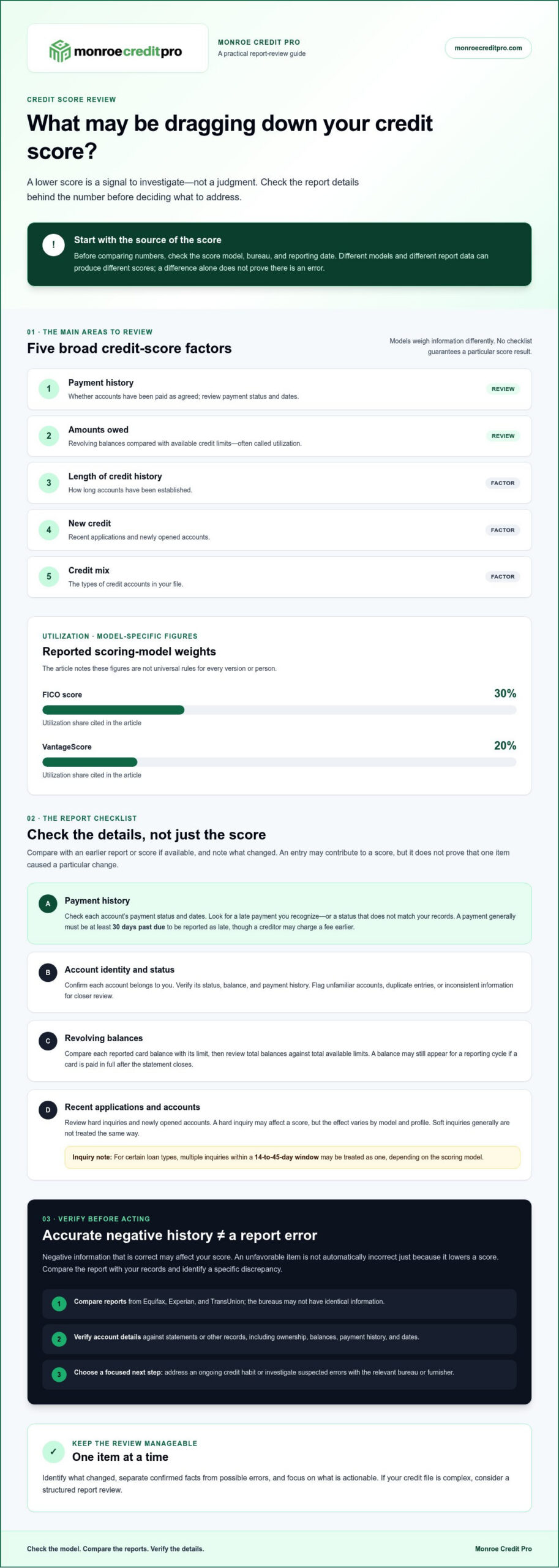
Most commonly used scoring models consider five broad areas: payment history, amounts owed, length of credit history, new credit, and credit mix. Payment history reflects whether accounts have been paid as agreed. Amounts owed includes revolving balances compared with available limits, often called credit utilization. Credit history length considers how long accounts have been established. New credit includes recent applications and accounts, while credit mix reflects the types of credit in your file.
Payment history and revolving utilization are often especially influential. Their specific weight depends on the model. Utilization accounts for 30% of a FICO score and 20% of a VantageScore. These figures aren’t universal rules for every version or person. Lenders may use different models and versions, and may also consider other information when making a decision.
In short: Payment patterns, balances, credit history, new applications, and account mix can all matter, but no checklist guarantees a particular score result.
Why can the same credit report produce different scores?
A credit report is the underlying record of accounts and payment information. A credit score is calculated from that information using a particular scoring model. The distinction matters: a different score doesn’t automatically mean the report contains an error.
Scores can vary because the bureaus may have different information on file, scores may be calculated on different dates, or models may evaluate the same details differently. A score shown in an app is useful for tracking, but it may not match the score a lender uses. Before comparing numbers, check the score source, model if disclosed, bureau, and date. For broader background on how U.S. scoring systems vary, see this overview of the credit score in the United States.
Credit Score Drag Checklist: Check Payments, Balances, and Recent Applications
Use this checklist to narrow down what is dragging down my credit score. A report entry may be a contributing factor, but it doesn’t prove that one item caused a particular score change. Compare the details with an earlier report or score, if available, and note what changed.
- Payment history: Check each account’s payment status and dates. Look for a missed or late payment you recognize, and note any status that doesn’t match your records. A payment generally must be at least 30 days past due to be reported as late, though a creditor may charge a fee earlier.
- Account identity and status: Confirm that each account belongs to you and that its status, balance, and payment history look correct. Flag unfamiliar accounts, duplicate entries, or inconsistent information for closer review.
- Revolving balances: Compare each reported credit card balance with that card’s limit, then review total balances against total available limits. Utilization is the balance-to-limit ratio. It can change as reported balances change, so a card paid in full after the statement closes may still show a higher balance for that reporting cycle.
- Recent applications and accounts: Review hard inquiries and newly opened accounts. A hard inquiry may affect a score, but the effect varies by model and profile. Soft inquiries, such as some account reviews, generally aren’t treated the same way. For certain loan types, multiple inquiries within a 14-to-45-day window may be treated as one, depending on the scoring model.
Are late payments or negative account statuses lowering your score?
Check the account name, ownership, payment status, and dates against statements or other records. Accurate negative information may affect a score, but it isn’t an error just because it’s unfavorable. Record specific discrepancies rather than assuming a valid entry can be removed. The Consumer Financial Protection Bureau offers resources for understanding your credit reports and scores.
Are credit card balances or new applications affecting your profile?
Review the reported balance and limit for every revolving account, not just the total. There’s no single utilization percentage that explains every score or guarantees a result. Then check the dates and types of recent inquiries, distinguishing applications you authorized from soft inquiries. A new account or inquiry is a clue to review, not proof of the cause of a score movement.
If comparing accounts across reports feels difficult, a professional credit report review may offer structured support in identifying potential inaccuracies.
Separate Score Factors From Credit Report Errors Before Taking Action
A report can contain accurate information that affects a score, details that may be wrong, and entries that are simply neutral. Keep those categories separate. A negative item isn’t automatically an error just because it may contribute to a lower score. The Federal Trade Commission explains common factors that can lower your score, but whether a report entry is accurate is a separate question.
| Type of information | What it may look like | How to approach it |
|---|---|---|
| Accurate negative information | A late payment or balance that matches your records. | Note it as a possible score factor. Don’t dispute it solely because it’s unfavorable. |
| Potentially inaccurate data | An account you don’t recognize, a payment marked late despite records showing it was on time, or a balance that appears incorrect. | Gather the details and supporting documents, then follow the bureau’s current dispute instructions. |
| Neutral report details | Information that appears consistent and isn’t an obvious error or negative event. | Keep it in context. Not every report entry explains a score change. |
What should you verify on each credit report?
Review reports from Equifax, Experian, and TransUnion. Their files may not contain identical information, so an account detail may be absent or different on one report. Check your name and addresses, account ownership, balances, payment status, and account dates. Look for unfamiliar or duplicate accounts, too.
For each concern, record the bureau, account, specific detail, and why it may be wrong. Save relevant statements or other supporting records. A three-bureau credit report review can help organize that comparison into a fuller audit.
When is a credit-report dispute appropriate?
A dispute is appropriate when you identify specific information you believe is inaccurate or incomplete. For example, if a report shows a payment as late but your records indicate it was paid on time, identify the account, date, and evidence supporting your concern. Then follow the bureau’s current dispute instructions and consider contacting the company that supplied the information, known as the furnisher. For a step-by-step walkthrough, see this guide on how to dispute credit report inaccuracies effectively.
A strong dispute points to a specific, supportable accuracy concern. It isn’t a request to remove information simply because it may affect your score. What is dragging down my credit score may involve accurate history, an error, or both. Focus on correcting verifiable inaccuracies, and treat accurate negative information as a separate issue to address through your financial habits over time.
Prioritize What to Check First With a Credit Score Review Checklist
A focused review is more manageable than trying to explain every score movement at once. Start with the score and report information you can compare, then follow the evidence. This process helps you investigate what is dragging down my credit score without assuming that one change caused the entire difference.
How do you investigate a score drop step by step?
- Confirm what you’re comparing. Note the score source, model if disclosed, bureau, and date. Compare it with an earlier score from the same source and model when possible. Different models, bureau files, or dates can produce different numbers.
- Review the reports. Check the available reports from Equifax, Experian, and TransUnion. Look for newly reported accounts, changed balances, payment-status updates, and hard inquiries. The reports may not match exactly.
- Identify what changed. Write down new or updated details and compare them with account statements, payment records, or other documents. A change may be accurate, potentially inaccurate, or simply a timing difference.
- Choose a next step. Follow up on specific accuracy concerns through the relevant bureau or information provider. For ongoing habits, choose a manageable routine rather than expecting an immediate score result.
Which credit habits can you review consistently?
Build a payment routine that fits your circumstances. Calendar reminders or automatic payments may help keep due dates visible, but choose a method you can monitor. Review revolving balances as they’re reported, and consider whether a new credit application is necessary before applying. Check reports periodically and keep track of any correction or dispute that remains unresolved.
Use this brief record to keep your review organized:
- Score source, model, bureau, date: ____________________
- Report change or account detail: ____________________
- Accurate, uncertain, or appears incorrect: ____________________
- Records to check or follow-up needed: ____________________
- Next review date: ____________________
Prioritize unresolved accuracy concerns and recurring patterns you can address. A documented review won’t guarantee a particular score change, but it can make your next decision clearer. If your score has stayed flat despite your efforts, this guide explains why your credit score is not improving and what to review next. For structured help reviewing your credit reports, explore Monroe Credit Pro’s credit report audit.
What to Do When You Find a Credit Score Problem
Let what you find guide your next move. If you spot a recurring balance or payment pattern, focus on a routine you can sustain. If a report detail appears inaccurate, gather records and follow the bureau’s current dispute instructions. If several reports or accounts are difficult to reconcile, a professional review may help organize the information. You can also review your reports and contact the bureaus or the companies that supplied the information yourself.
When can a professional credit review be useful?
A structured review can help you compare bureau reports, organize account details, and identify potential inaccuracies that may warrant closer attention. It’s optional support, not a required step. Consumers can review their own reports and dispute information they believe is inaccurate or incomplete.
Before enrolling in any credit service, understand what the provider will do and what it won’t do. Review the service scope, fees, cancellation terms, and written disclosures. Be cautious of promises of specific deletions or score increases. A legitimate review should distinguish between potential errors and accurate negative history, rather than treating every unfavorable item as disputable.
For an overview of structured support, read this credit restoration services guide. Monroe Credit Pro offers three-bureau report audits and assistance disputing items clients believe are erroneous. These services don’t guarantee that information will be removed or that a score will change.
How can you keep progress grounded in accurate information?
Track report changes and dispute responses alongside the score. Note the bureau, account, date, and any response you receive. This record can help you see whether a correction appears on one report or across multiple bureau files, and gives you a clearer basis for follow-up.
Keep expectations measured. Accurate negative information may remain on a report, and scores can fluctuate as reported details and scoring models vary. If you’re still asking what is dragging down my credit score, return to the underlying report and verify the facts rather than relying on one score reading alone.
If a personalized report review would help you organize what to check, consider exploring the guide above and deciding whether that kind of support fits your needs. Start with clear questions, accurate records, and a service scope you understand.
Take the Next Step With a Clear Credit Review
Finding what is dragging down my credit score starts with checking the information behind the number. Review the score’s source and date, compare your credit reports, and note changes in payment history, balances, inquiries, or account details. Then separate accurate negative information from details you believe may be incorrect. A score change can point to something worth investigating, but it doesn’t prove that one item caused it.
Address ongoing habits with practical routines, and follow up on specific report inaccuracies with supporting records. If you’d prefer structured guidance, Monroe Credit Pro offers a three-bureau credit report assessment, identifies potential inaccuracies, and supports disputes of erroneous items. Credit progress tracking and rebuilding guidance are also available. No review can guarantee a deletion or a particular score outcome, so keep your expectations grounded in verified information.
Explore a structured credit report review and decide whether professional support fits your needs. Each accurate check gives you a clearer basis for your next step. Move forward steadily, one finding at a time.
Frequently Asked Questions
What is the biggest thing that drags down a credit score?
Payment history is often one of the most influential factors, though no single factor is biggest for every person or scoring model. A reported late payment may matter, as can high revolving balances, recent credit applications, and other details in your file. Check the score model and report behind the number, then look for changes you can verify. A possible factor is a place to investigate, not proof of the cause.
Can one late payment lower your credit score?
Yes, one reported late payment can lower a score, but the effect varies by scoring model and credit history. A single payment reported as 30 days late can lower a score by over 100 points in some cases. Check the account, payment status, and dates against your records. If the information appears inaccurate, document the discrepancy. If it’s accurate, focus on preventing future missed payments.
How much does credit utilization affect your credit score?
Credit utilization can be an important factor, but its effect depends on the scoring model and the rest of your credit file. Utilization accounts for 30% of a FICO score and 20% of a VantageScore. It’s the revolving balance compared with available credit, calculated for individual accounts and overall. Because reported balances can change between cycles, a later payment may not change the balance already shown on a report.
Why did my credit score drop when nothing changed?
A score can change even if you haven’t opened an account or missed a payment. A creditor may have reported a different balance, a bureau file may have updated, or the score may use a different model, bureau, or date than the one you checked before. Compare the source, model if disclosed, bureau, and date first. Then review reports for changed balances, account statuses, inquiries, or other new information.
Do collections always drag down your credit score?
No, a collection entry doesn’t affect every score in the same way. Its effect can depend on the scoring model, the details reported, and the rest of your credit file. First verify that the account is yours and that its status and balance are accurate. Paid medical collections and medical debts under $500 are being removed from credit reports; check your current reports to see what’s listed.
Can checking my own credit report lower my credit score?
No, checking your own credit report doesn’t lower your score. A personal check is generally treated as a soft inquiry, unlike a hard inquiry associated with applying for credit. Reviewing reports can help you spot unfamiliar accounts, incorrect payment details, or changes in balances. Check reports from Equifax, Experian, and TransUnion, since their files may differ, and keep a record of any item you need to investigate.
What should I check first if my credit score is dropping?
First, confirm the score source, model if disclosed, bureau, and date so you’re comparing like with like. Then review the corresponding credit report for recent balance changes, late-payment statuses, new accounts, and inquiries. Verify any concerning detail against your records before taking action. If you’re asking what is dragging down my credit score, prioritize specific inaccuracies and recurring habits, and track what you find rather than assuming one entry explains the change.