



A past setback matters, but your next credit decisions still count. To rebuild credit after financial hardship, review your credit reports, dispute inaccurate entries, pay current bills on time, lower card balances, and limit new applications. According to the Consumer Financial Protection Bureau, late or missed payments can remain on a credit report for up to seven years, so consistent habits can help you build a stronger record over time.
A difficult financial period can leave a lasting mark on your credit history. To rebuild credit after financial hardship, start with practical steps you can sustain and focus on the information and habits that affect your credit profile.
This guide shows you how to review your reports, manage credit card balances, approach new applications carefully, and understand why scores can differ. Use it to create a clear, manageable plan for moving forward.
Key Takeaways
- Review your credit reports to spot inaccurate information and understand which past events may still affect your history.
- Learn how to calculate credit utilization and identify practical ways to keep balances manageable.
- Approach new credit applications selectively, and see how payment history and other scoring factors shape your progress.
- Recognize when professional credit guidance may help you organize next steps and address report concerns.
How long does negative information generally stay on your credit report?
Start by reviewing your credit reports to see which accounts and entries may be affecting your history. Check whether the information is accurate, then focus on current payment habits and monitor report updates.
-
Check Negative Information Timelines
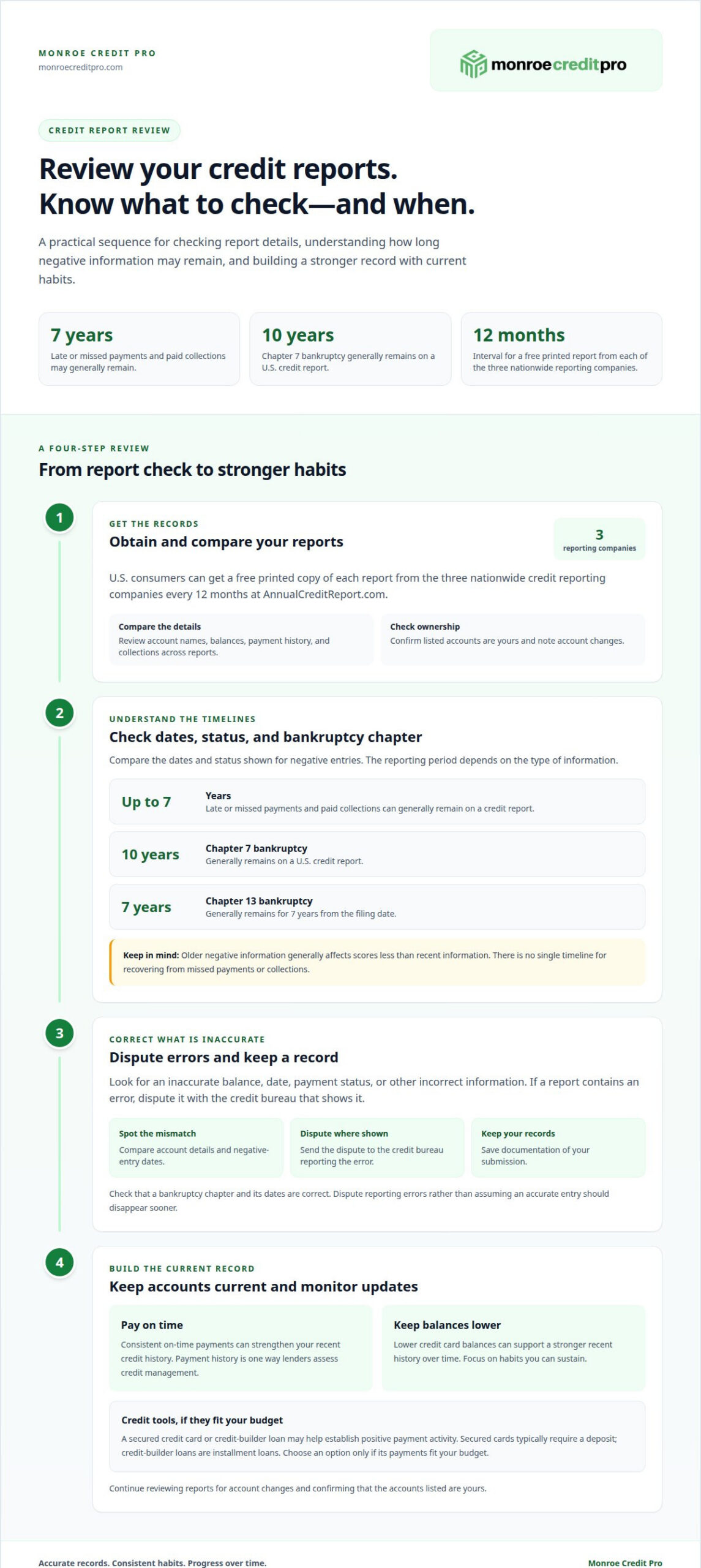
Check the dates and status of negative entries. Late or missed payments and paid collections can generally remain on a credit report for up to seven years. Compare the information across reports and note any inaccurate balance, date, or payment status. Older negative information generally affects scores less than recent information.
-
Check Bankruptcy Reporting Periods
Identify the bankruptcy chapter and filing date shown in your reports. According to the Consumer Financial Protection Bureau, Chapter 7 bankruptcy generally remains on a U.S. credit report for 10 years. Chapter 13 generally remains for 7 years from the filing date. Check that the chapter and dates are correct, and dispute reporting errors rather than assuming an accurate entry should disappear sooner.
- Obtain and compare your reports. According to the Federal Trade Commission, U.S. consumers can get a free printed copy of each report from the three nationwide credit reporting companies every 12 months at AnnualCreditReport.com. Review account names, balances, payment history, and collections. If information is wrong, dispute it with the credit bureaus that show the error, and keep records of your submission.
- Review your reports for account changes and confirm that the accounts listed are yours. Keep eligible bills current, since payment history is one way lenders assess credit management. A secured credit card or credit-builder loan may help establish positive payment activity if the payments fit your budget. Secured cards typically require a deposit, while credit-builder loans are installment loans. When evaluating personal borrowing or installment options, visiting iloveyourloans.com can help you explore loan products and compare terms to see what fits your current budget.
There is no single timeline for recovering from missed payments or collections. Consistent on-time payments and lower credit card balances can strengthen your recent credit history, while older negative entries generally carry less weight over time.
What Is a Credit Utilization Ratio?
Credit utilization compares your credit card balances with your available credit limits. Aim below 30%; some experts recommend staying under 10%. Pay the full statement balance by its due date to help avoid interest charges, and make an earlier payment if a balance is nearing your target.
-
Understand Utilization Targets and Payment Timing
Calculate utilization by dividing the balance by the card’s limit, then multiplying by 100. For example, a $1,000 balance against a $5,000 combined limit equals 20% utilization. With a $2,000 limit, keeping the balance under $600 stays below 30%. Add balances across cards for your overall ratio, and assess each card separately too. A low overall figure can hide one card with high utilization.
-
Manage and Reduce Credit Utilization
Track card balances against their limits and direct extra payments toward the account with the highest utilization. If utilization reaches 30% or more overall or on an individual account, paying balances down can reduce it. Avoid adding purchases you can’t repay. Carrying a balance does not build credit more effectively, and interest rates can make debt harder to manage.
- Pay bills on time and work to lower balances. Payment history and credit utilization both influence scores. Prioritize at least the minimum payment by its due date, then pay more when your budget allows. Paying a statement balance in full can help avoid interest charges. Set reminders or automatic payments for at least the minimum, and check statements for unexpected charges or errors.
- Choose credit tools carefully. A secured credit card may support a positive payment record, but its deposit and limit affect how much available credit you have. Don’t spend simply to create activity; use the card for planned purchases and pay them promptly. Protect savings for essential expenses instead of using every available dollar to lower balances. For structured guidance, credit counseling for managing utilization can help you organize your repayment priorities.
Limiting new credit applications
Be selective about new credit. An application can lead to a hard inquiry, and new credit is one factor in scoring. Waiting until your budget is ready can help you avoid taking on debt you may struggle to repay.
- Apply only when a credit product serves a clear purpose. A hard inquiry can briefly lower a credit score by a few points, and new credit accounts for 10% of a score. Before applying, consider whether you need the account and can manage its payments, interest, and credit limit. Don’t submit applications simply to see which lender might approve you.
- Before applying, compare the interest rate, fees, payment requirements, and credit limit with your budget. A high credit limit does not prevent costly interest if you carry a balance. If the payment could compete with rent or essential bills, hold off until it fits your finances.
- Consider the cost of secured credit before applying. A secured card requires a deposit, so make sure setting that money aside is manageable. If you are exploring other collateral-backed financing, platforms such as V8Loans offer access to secured vehicle loans, where carefully evaluating terms and interest rates is essential. Check that any credit account fits your financial plan, apply only if you can pay on time, and keep balances within what you can afford to repay.
- Be cautious of credit repair claims that promise a specific score increase or guaranteed removal of accurate negative information. A legitimate credit counseling service should explain its process, costs, and limits clearly, review your budget, and help you understand your choices. Nonprofit status alone doesn’t establish that a service is suitable, so assess its actual terms and guidance.
- After a denial, avoid applying repeatedly without a plan. Read the lender’s explanation, address the issue it identifies, and consider whether another account suits your budget and priorities. Multiple applications can add inquiries, and unaffordable accounts can increase debt. Focus on paying current obligations on time before deciding whether to apply again.
Credit score ranges and scoring factors
Use scoring factors to prioritize habits you can control. U.S. credit scores generally range from 300 to 850, but the number alone doesn’t explain what needs attention.
- Check which scoring model you’re viewing before comparing scores. FICO and VantageScore are different models and may assess credit report information differently. A lender may see a different score because the model or report data differs. Compare the model and bureau as well as the score.
- Prioritize payment history, the largest listed scoring factor at 35%. Set reminders or automatic payments for at least the minimum due, and contact a lender promptly if a payment may be late. A consistent repayment record adds positive information over time. A savings account can help create a buffer for bills, but it doesn’t directly establish repayment history.
- Keep balances manageable because credit utilization accounts for 30% of a score. Credit history accounts for 15%, while credit mix and new credit each account for 10%. These percentages show why paying on time and controlling balances deserve attention before pursuing a new account solely to diversify credit.
- Look for changes across your reports instead of reacting to every score movement. If a bureau shows an unfamiliar account or an incorrect payment status, address the possible reporting error. If the information is accurate, focus on current payments and balances rather than expecting an immediate score change. Credit rebuilding reflects patterns across your history.
- Choose a practical next step based on the factor causing the most pressure. If payment timing or repayment planning is difficult, get help organizing your credit-building steps. A clear routine can help you rebuild your credit through consistent actions, not repeated applications or short-term score chasing.
Monroe Credit Pro
When credit reports or rebuilding priorities feel difficult to manage, Monroe Credit Pro offers Credit Restoration, Professional Credit Repair, Credit Correction, and Credit Counseling / Credit Rebuild Coaching. The service includes a three-bureau review of your Experian, Equifax, and TransUnion reports, which you provide. Monroe Credit Pro identifies potentially inaccurate, outdated, or unverifiable information and uses structured dispute cycles to address it. A personalized action plan can also help you understand practical credit-building steps. Accurate, verified negative information cannot be removed through credit repair, and results vary. Contact Monroe Credit Pro for a free initial credit consultation and three-bureau credit audit.
Build a steadier path forward
To rebuild credit after financial hardship, create a routine you can maintain instead of trying to address everything at once. Choose a next step that fits your circumstances and build on it as your financial picture becomes clearer. A setback can affect your history without defining the choices you make from here.
If you need help turning credit concerns into an organized plan, Monroe Credit Pro provides Credit Restoration, Professional Credit Repair, and Credit Correction. These services can help you review report concerns and set a structured course for building healthier credit habits. Choose a next step based on your needs, without expecting a shortcut or overlooking the importance of consistent effort.
Contact Monroe Credit Pro to discuss support for your credit rebuilding goals. Keep moving forward with patience and purpose; consistent decisions can help create a more stable financial foundation.
Frequently Asked Questions
How Do I Rebuild My Credit After Financial Setbacks?
Start with financial habits you can sustain, rather than trying to resolve every past account at once. Track upcoming bills, prioritize required payments, and avoid new borrowing that strains your budget. Review your progress regularly. A stable routine can support positive recent credit activity while you address report concerns separately.
What steps should I take to rebuild credit after financial hardship?
To rebuild credit after financial hardship, organize bills by due date, protect essential expenses, and direct available funds toward required payments. Keep notes on creditor conversations and account changes. Before opening another account, consider whether its payment fits your budget. This approach helps you make deliberate decisions instead of reacting to each score change.
How do payment history, credit utilization, and account age affect credit scores?
Payment history reflects whether you meet repayment obligations, while utilization compares revolving balances with available credit. Account age shows how long you’ve managed credit, so avoid closing an older account solely because you use it infrequently. Scoring models weigh report details differently. A savings account can help with budgeting, but it does not itself create credit history.
How can I check my credit reports and dispute inaccurate information for free?
You can obtain free printed credit reports through AnnualCreditReport.com. Compare account names, balances, and payment statuses across your reports. If you find an error, identify the bureau showing it, gather documents supporting your position, and submit a clear dispute to that bureau. Keep copies of your reports, evidence, and dispute records.
How do I negotiate or settle past-due debts, and what are the credit score risks?
Before agreeing to a payment arrangement, confirm the account details and ask the creditor to provide the terms in writing. Clarify how payments and any settlement will be reported. A settlement does not automatically erase accurate past payment information or ensure a score increase. Keep copies of agreements and payment records, then review the reported account status for accuracy.
How can I rebuild credit after bankruptcy, foreclosure, or repossession?
Check how each event and related account appears across your credit reports. Dispute inaccurate dates, balances, or statuses, and keep current obligations distinct from resolved accounts in your records. Then establish a manageable payment routine for accounts that remain open, and avoid taking on credit you cannot repay. Consistent recent account management gives lenders new information to assess.