



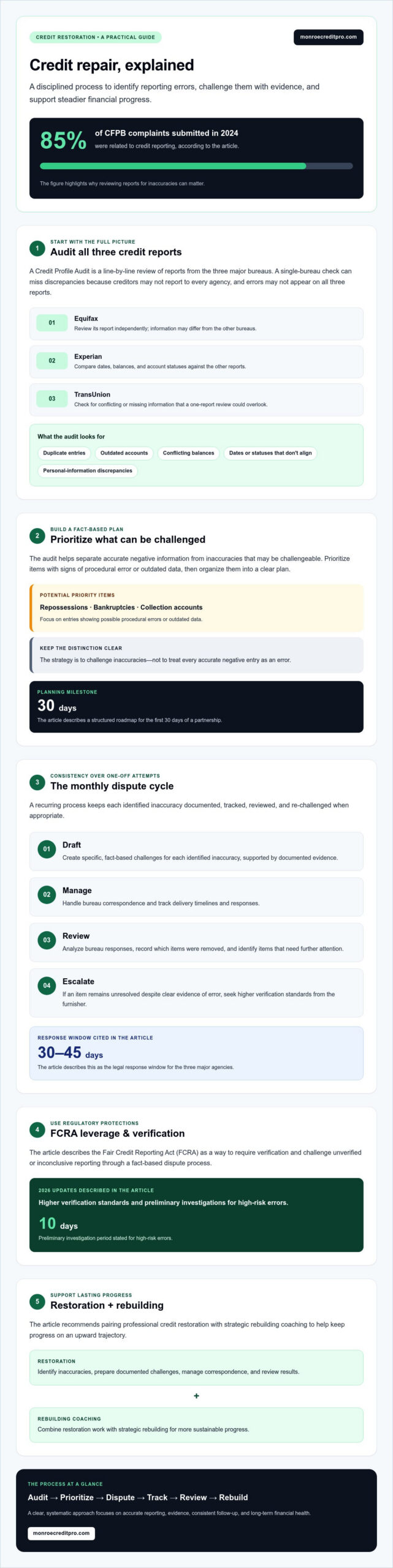
Did you know that 85% of complaints submitted to the Consumer Financial Protection Bureau in 2024 were related to credit reporting? It’s a staggering figure that highlights a common reality: the system is prone to errors that can stall your financial progress. If you’ve felt the frustration of a stagnant score despite making every payment on time, you aren’t alone. Having the credit repair process explained in a clear, systematic way is the first step toward regaining control. You deserve a credit profile that accurately reflects your financial responsibility, not one cluttered with outdated or inconclusive data.
Experience a clear roadmap for your financial renewal. Discover the mechanics of professional restoration and learn how a disciplined approach resolves inaccuracies using current regulatory protections. Under the 2026 FCRA updates, bureaus must now adhere to higher verification standards and conduct 10-day preliminary investigations for high-risk errors. We will examine the essential audit phase, break down the strategic dispute cycles, and detail how to leverage your rights to secure future lending opportunities. Move past the institutional friction and start building a stable, empowered financial future today.
Key Takeaways
- Perform a comprehensive Credit Profile Audit across all three major bureaus to uncover every inaccuracy that may be affecting your score.
- Understand the credit repair process explained as a disciplined, monthly cycle that prioritizes consistent, fact-based challenges over one-off attempts.
- Leverage the Fair Credit Reporting Act (FCRA) to shift the burden of proof onto bureaus, ensuring that unverified or inconclusive data is removed.
- Combine professional credit restoration with strategic rebuilding coaching to ensure your score remains on a steady, upward trajectory.
- Partner with a dedicated advocate to manage the administrative burden of bureau correspondence and identify technical errors that a layperson might miss.
The Foundation: Identifying Obstacles via the Credit Profile Audit
Every successful journey begins with a map. In professional credit restoration, that map is the Credit Profile Audit. This isn’t just a casual glance at a score; it’s a line-by-line, forensic examination of reports from all three major bureaus. By having the credit repair process explained through this initial lens, you can see exactly where the institutional friction lies. A single-bureau check is never enough. Creditors don’t always report to every agency, and data entry errors rarely happen across all three platforms simultaneously. A thorough audit uncovers items you might have overlooked, like duplicate entries or accounts that should’ve aged off your report years ago. It identifies “hidden” inaccuracies by cross-referencing dates, balances, and account statuses that don’t align. This clarity allows us to set realistic expectations, providing a transparent view of the restoration timeline based on the volume of errors found.
Analyzing the Three-Bureau Landscape
Equifax, Experian, and TransUnion are independent credit bureaus that rarely share data with one another. This independence often results in conflicting information that creates unnecessary hurdles for consumers. You might find a paid collection on one report that still shows an open balance on another. Small discrepancies in personal information, like a misspelled name or an old address, can trigger identity verification issues that block your progress. Fragmented reporting creates a distorted view of your financial health, making a three-bureau analysis essential for a complete recovery. We transform a confusing stack of paperwork into a prioritized list of actionable items, ensuring no error is left unchallenged.
Categorizing Derogatory Entries for Strategy
Effective restoration requires a disciplined strategy. We differentiate between accurate negatives and challengeable inaccuracies to build a legitimate, regulatory-driven path forward. Our team prioritizes high-impact items such as repossessions, bankruptcies, and collection accounts that show signs of procedural error or outdated data. We look for high-risk errors that, under 2026 regulations, require a mandatory 10-day preliminary investigation by the bureaus. This categorization allows us to create a structured roadmap for the first 30 days of our partnership. By focusing on these priorities, we ensure the credit repair process explained to you translates into tactical, orderly steps. We don’t just send letters; we build a case based on the specific compliance failures of each furnisher. This methodical approach strips away the confusion of conflicting data and replaces it with a steady, forward-looking plan for your financial renewal.
The Monthly Dispute Cycle: A Systematic Approach to Restoration
Consistency is your greatest asset when correcting a damaged financial profile. While many assume that a single letter can fix years of reporting errors, the credit repair process explained by industry professionals reveals a more disciplined reality. We utilize a Monthly Credit Repair Service Retainer model because systematic persistence outperforms one-off efforts every time. This structured partnership ensures that every inaccuracy is addressed, tracked, and re-challenged if the bureau fails to meet its legal obligations. Restoration is a marathon of administrative precision, not a sprint of generic complaints.
Our monthly cycle follows a rigorous four-step methodology to maintain momentum:
- Step 1: Drafting. We create specific, fact-based challenges for every identified inaccuracy, ensuring each dispute is rooted in documented evidence rather than vague hearsay.
- Step 2: Management. Our team handles all bureau correspondence, meticulously tracking delivery timelines to ensure the three major agencies respond within the 30 to 45-day legal windows.
- Step 3: Review. We analyze every bureau response to update your strategic plan, noting which items were removed and which require further pressure.
- Step 4: Escalation. If an item remains unresolved despite clear evidence of error, we escalate the challenge by demanding higher verification standards from the furnisher.
The Anatomy of a Professional Dispute Letter
Effective challenges avoid the “frivolous” designation that bureaus often use to ignore generic, template-based requests. We rely on regulatory-backed arguments that force bureaus to perform their due diligence under the law. The ‘Reason for Dispute’ is the specific legal or factual anchor that defines why a line item is inaccurate and must be corrected. By focusing on technical details like incorrect dates or unverified balances, we ensure your rights remain protected throughout the credit repair process explained in our strategy sessions.
Tracking Progress through Structured Cycles
Patience is vital during the investigation window. Once a dispute is filed, bureaus generally have 30 days to verify the data with the original creditor. You’ll eventually receive a ‘Notice of Result,’ which we review together to confirm deletions or corrections. It’s also a critical time to rebuild your credit by managing your current accounts responsibly. We maintain continuous monitoring to ensure that once a negative item is removed, it doesn’t reappear due to fragmented reporting systems. If you’re ready to move past the confusion of conflicting reports, a structured credit restoration partnership can provide the steady guidance you need to succeed.
Regulatory Leverage: Utilizing the FCRA and Bureau Correspondence
Empowerment comes from understanding the legal framework that governs your financial identity. The Fair Credit Reporting Act (FCRA) isn’t just a set of rules; it’s a powerful shield designed to protect you from inaccurate or obsolete data. One of the most critical aspects of the credit repair process explained by professional strategists is the concept of the “Burden of Proof.” Under federal law, the credit bureaus bear the responsibility of ensuring every line item is accurate, complete, and verifiable. If they can’t meet this standard, the law requires them to remove the data. This puts the pressure on “furnishers”, the banks, lenders, and collection agencies, to maintain impeccable records. Our role as your advocate is to handle the institutional friction that occurs when these entities fail to comply, using strategic correspondence to hold them accountable.
The 30-Day Investigation Rule
Federal law establishes strict statutory timelines that bureaus must follow to remain compliant. Once a dispute is received, the agency generally has 30 days to conduct a thorough investigation. This window may extend to 45 days only if you submit new evidence during the process. If a bureau fails to provide a response within these legal timeframes, the disputed item is legally required to be deleted. We manage this administrative burden by meticulously tracking every letter and response date. This disciplined oversight ensures that bureaus don’t let your case fall through the cracks or ignore their mandatory obligations.
Challenging the ‘Verified’ Status
Persistence is the only way to overcome the common hurdle of an item being marked as “verified” despite remaining inaccurate. A bureau might claim they’ve confirmed the data, but they often do so through automated systems that lack human oversight. When this happens, we deploy the “Method of Verification” request. This secondary tool demands that the bureau disclose exactly how they verified the information and identify the individual at the furnisher’s office who provided the proof. Under the 2026 FCRA updates, verification standards are higher than ever, requiring furnishers to provide actual documentation of accuracy. We refuse to accept inconclusive results. By maintaining steady pressure and demanding high-level compliance, we ensure the credit repair process explained in your roadmap delivers tangible, regulatory-backed results. You don’t have to accept a flawed report when the law demands precision.
Sustainable Progress: Integrating Rebuilding with Restoration
Clearing inaccuracies from your report is a vital milestone, but it represents only 50% of the total equation. Having the credit repair process explained often focuses heavily on deletions; however, a report devoid of positive history still appears risky to future lenders. Restoration removes the obstacles, while rebuilding provides the foundation for growth. Professional credit restoration includes strategic rebuilding coaching because a clean report needs a history of responsible behavior to generate a competitive score. We prioritize managing your credit utilization ratios, as this is the fastest lever to influence your standing. Keeping your revolving balances below 10% to 30% of your total limits signals stability and discipline to creditors. Along with this, we guide you through strategic account opening, ensuring you add positive tradelines at the right time without triggering excessive hard inquiries.
Optimizing the Credit Mix
Lenders prefer to see a healthy mix of revolving and installment credit. Revolving credit, such as traditional credit cards, demonstrates your ability to manage ongoing access to funds. Installment credit, like a car loan or a credit-builder loan, shows you can handle a fixed repayment schedule over time. We often recommend secured cards or specific credit-builder products as accessible tools for those starting fresh. You must be careful to avoid common pitfalls like closing old accounts, which can inadvertently lower your “Average Age of Accounts” and hurt your score. A balanced, aged profile is the hallmark of a sophisticated borrower.
Behavioral Coaching for Long-Term Success
Developing a sustainable payment routine is the ultimate protection for your hard-earned progress. Even one missed payment during the restoration cycle can set your efforts back significantly. You should prepare for a “Score Lag,” as it often takes 30 to 60 days for bureaus and scoring models to reflect the deletions and new positive data we’ve implemented. We invite you to set up automated alerts and monitoring to prevent new derogatory marks from appearing unexpectedly. This proactive engagement ensures your path to financial renewal remains clear and unobstructed. Secure your financial future by starting a professional credit restoration and rebuilding partnership today. Our systematic approach handles the institutional friction so you can focus on building a legacy of stability.
The Professional Advantage: Why Strategic Guidance Wins
While federal law empowers you to handle disputes yourself, the sheer administrative volume often becomes an exhausting second full-time job. Managing dozens of letters, tracking certified mail receipts, and analyzing technical responses requires a level of persistence that most busy professionals simply can’t maintain. Having the credit repair process explained by an expert reveals that success isn’t just about sending a letter; it’s about identifying the technical inaccuracies that a layperson might miss. A professional strategist looks beyond simple errors to find compliance failures in how data is reported, archived, and verified. We handle the heavy lifting, ensuring that every bureaucratic hurdle is met with a disciplined, fact-based response.
Beyond the paperwork, there is a significant emotional benefit to having a non-judgmental advocate in your corner. Financial setbacks often carry a heavy weight of shame, but we view these as temporary obstacles with systematic solutions. We handle the institutional friction on your behalf, allowing you to transition from the stress of “Credit Repair” to the proactive pursuit of “Credit Health.” This shift is essential for achieving life goals like homeownership or securing a reliable vehicle at a fair interest rate. You aren’t just fixing the past; you’re building a stable foundation for your future.
Institutional Knowledge and Persistence
Bureaus often utilize stalling tactics, such as sending generic letters claiming a dispute is “frivolous” or using automated systems to rubber-stamp inaccurate data. A professional firm understands these maneuvers and knows exactly how to counter them with regulatory-backed evidence. We provide a structured process that doesn’t rely on your limited free time, ensuring your restoration journey continues with steady, dependable momentum. Strategic consulting prepares you for the scrutiny of high-stakes lenders, ensuring your profile is robust enough to withstand deep manual underwriting. We bridge the gap between where you are and where you need to be to qualify for the best opportunities.
Taking the Next Step Toward Renewal
Finding a reputable restoration partner is the final piece of the puzzle. Look for transparency, a focus on compliance, and a clear explanation of their methodology. You deserve a partner who acts as both an orderly strategist and an empowering guide. Start your journey today by identifying the specific errors holding you back. Schedule your credit audit with Monroe Credit Pro today to gain a clear, professional perspective on your path to renewal. By having the credit repair process explained in a way that prioritizes your long-term progress, you can move forward with confidence and stability. Let’s clear the path for your financial progress together.
Take Command of Your Financial Future
Navigating the path to financial recovery requires more than just hope; it demands a disciplined, regulatory-driven strategy. You’ve seen the credit repair process explained as a series of deliberate steps, starting with comprehensive three-bureau audits to identify every reporting obstacle. By leveraging federal protections and engaging in systematic monthly dispute cycles, you can resolve inaccuracies that have held you back for far too long. This methodical approach ensures no detail is overlooked and no bureau deadline is missed.
True renewal happens when you pair professional restoration with strategic rebuilding coaching. You don’t have to face institutional friction alone. Our team provides empowering, non-judgmental advocacy to handle the administrative burden while you focus on your long-term life goals. Whether you’re preparing for a mortgage or simply seeking peace of mind, a structured partnership offers the stability you need. Start your path to credit renewal with Monroe Credit Pro. Your past financial difficulties are merely temporary hurdles. Start building a stronger, more resilient profile today.
Frequently Asked Questions
Is the credit repair process legal under federal law?
Yes, the process is fully protected by the Fair Credit Reporting Act (FCRA) and the Credit Repair Organizations Act (CROA). These federal laws guarantee your right to an accurate and verifiable credit profile. The 2026 FCRA updates further empower consumers by requiring higher verification standards for data furnishers. Professional restoration agencies operate within these regulatory frameworks to ensure that credit bureaus remain compliant and accountable for the information they report.
How long does it realistically take to see results from credit repair?
Most clients begin to observe initial changes within 30 to 45 days, which corresponds to the standard investigation window for credit bureaus. However, a comprehensive restoration typically requires several monthly cycles to address multiple or complex inaccuracies. The total duration depends on your specific profile and the responsiveness of your creditors. We use structured monthly cycles to maintain steady momentum, ensuring that each phase of the process moves you toward financial renewal.
Can a credit repair company remove accurate negative information?
No, legally reported and accurate information generally remains on your report until it ages off naturally. However, many derogatory entries contain technical errors or lack the documentation required by law. If a bureau cannot verify an item’s accuracy under the current 2026 standards, they are legally required to delete it. Having the credit repair process explained through this lens helps you understand that the focus is on challenging unverified or erroneous data.
What is the difference between credit repair and credit counseling?
Credit repair focuses on identifying and disputing inaccuracies on your credit report to improve data integrity. Credit counseling provides strategic guidance on managing debt, budgeting, and developing sustainable financial habits. While repair addresses the technical data reported by bureaus, counseling addresses behavioral finance. We integrate both approaches by offering credit rebuilding coaching alongside our monthly restoration cycles to ensure your progress is both structural and sustainable for long-term success.
How much does professional credit repair usually cost?
Professional restoration is typically structured through monthly service retainers and initial audit fees rather than one-time payments. This model ensures ongoing advocacy and consistent monitoring throughout multiple dispute cycles. While costs across the industry vary based on the level of strategic guidance provided, reputable firms avoid charging upfront fees before services are rendered. You should focus on the value of a structured partnership that handles complex institutional friction and bureau correspondence on your behalf.
Will my credit score drop during the repair process?
Temporary fluctuations are common as your profile undergoes systemic analysis and rebuilding. When a dispute is initiated or a new account is opened for rebuilding, your score might experience a minor lag before reflecting positive changes. Removing inaccuracies and managing credit utilization ratios are designed to drive long-term improvement. We provide steady reassurance during these rhythmic phases, helping you stay focused on the ultimate goal of improved lending opportunities and lasting financial stability.
Can I dispute items on my credit report myself?
You have the legal right to handle disputes yourself, but managing the administrative burden is often overwhelming for a layperson. The credit repair process explained in professional circles involves managing dozens of letters and tracking specific regulatory deadlines that are easily missed. Partnering with an advocate provides you with institutional knowledge and strategic persistence. We handle the complex correspondence with bureaus, allowing you to reclaim your time while we pursue disciplined, fact-based corrections.