



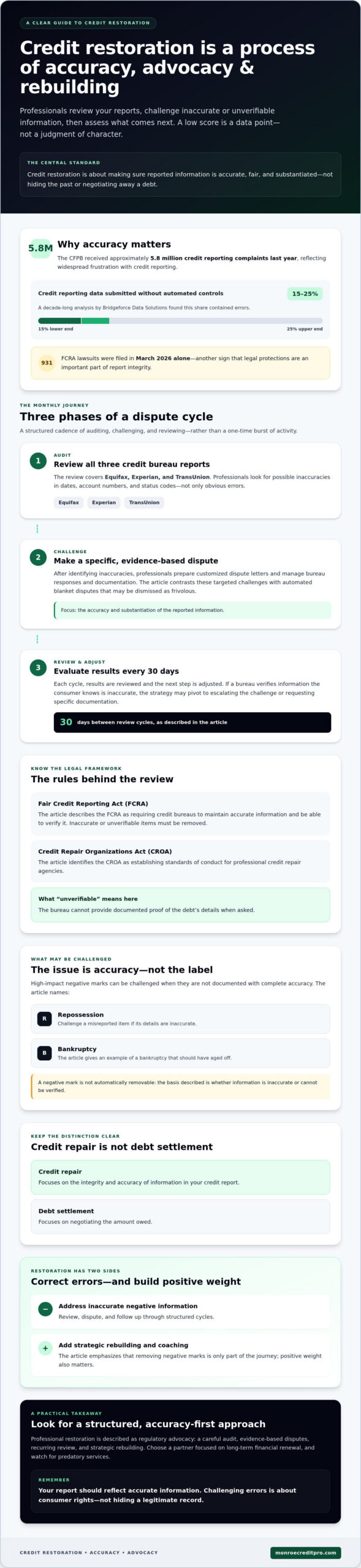
Did you know that the CFPB received approximately 5.8 million credit reporting complaints last year? This staggering volume reflects a growing national frustration with the institutional friction that keeps many qualified people from reaching their financial goals. If you feel anxious about an upcoming mortgage application or confused by complex consumer laws, your frustration is valid. You might be asking, what does a credit repair company do to resolve these issues? It’s important to recognize that a low score isn’t a reflection of your character; it’s a data point that can be corrected through systematic analysis and regulatory advocacy.
We’ll show you how professional restoration agencies challenge inaccuracies and help you rebuild your standing. This guide outlines the structured journey from initial audit to strategic renewal. You’ll learn how monthly dispute cycles work, discover the latest 2026 regulatory protections, and gain a clear plan to move forward with confidence. Your financial situation is temporary, but the strategic steps you take today create a foundation for long-term progress. Let’s explore the methodical process of clearing your path to financial renewal.
Key Takeaways
- Understand how professional restoration agencies act as regulatory advocates to ensure your credit profile meets federal accuracy standards.
- Learn exactly what does a credit repair company do during systematic monthly cycles to address errors across all three major credit bureaus.
- Identify high-impact items like repossessions and bankruptcies that can be challenged if they aren’t documented with 100% accuracy.
- Discover why removing negative marks is only half of the journey and how strategic coaching adds necessary positive weight to your profile.
- Recognize the red flags of predatory services to ensure you choose a partner focused on structured, long-term financial renewal.
Defining Credit Restoration as Professional Regulatory Advocacy
Your credit report is a legal document, not a permanent report card on your character. When you ask, what does a credit repair company do, the answer centers on professional advocacy. Professional credit restoration isn’t about hiding the past or using loopholes. It’s a systematic process of ensuring that every piece of data reported about you is 100% accurate, fair, and substantiated. This shift from simple fixing to comprehensive restoration moves the focus away from shame and toward your legal rights as a consumer. Agencies handle the institutional friction of communicating with massive credit bureaus, allowing you to focus on your financial future while experts manage the administrative burden.
The Legal Foundation: Understanding the FCRA
The Fair Credit Reporting Act (FCRA) serves as your primary shield. It mandates that credit bureaus must maintain accurate information and, crucially, they must be able to verify it. If an item is inaccurate or unverifiable, the law requires its removal. Beyond the FCRA, the Credit Repair Organizations Act (CROA) establishes the standards of conduct for professional agencies. In a regulatory context, ‘unverifiable’ means the bureau cannot provide documented proof of the debt’s details upon request. A decade-long analysis by Bridgeforce Data Solutions indicates that 15 to 25% of credit reporting data submitted without automated controls contain errors. This high error rate makes the right to dispute essential. With 931 FCRA lawsuits filed in March 2026 alone, it’s clear that the legal system is a necessary tool for maintaining report integrity.
Credit Repair vs. Debt Settlement
It’s easy to confuse credit correction with debt settlement, but they serve vastly different purposes. Credit repair focuses on the integrity of your report rather than negotiating the amount you owe. While a debt collector wants your money, a credit consultant wants your data to be correct. You don’t have to accept an inaccurate record just because you once faced financial strain. Removing a single high-impact inaccuracy, like a misreported repossession or a bankruptcy that should have aged off, often does more for your score than simply paying off a small balance. By prioritizing accuracy over negotiation, you ensure that your financial profile reflects the truth of your current standing. Understanding what does a credit repair company do helps you distinguish between paying for a mistake and advocating for the truth.
The Three-Phased Dispute Cycle: How the Process Works
Professional credit restoration operates through a disciplined, monthly cadence. It’s not a chaotic burst of activity; it’s a structured journey designed to produce measurable progress. So, what does a credit repair company do to keep this momentum? They manage recurring cycles of auditing, challenging, and reviewing that ensure no detail is overlooked. This methodical approach handles the institutional friction of bureau communication so you don’t have to, providing a clear path forward while you focus on your financial goals.
Step 1: The Multi-Bureau Credit Profile Audit
The journey begins with a comprehensive analysis of your reports from Equifax, Experian, and TransUnion. Professionals look for more than just obvious errors; they spot subtle discrepancies in dates, account numbers, and status codes that the average consumer often misses. A Credit Profile Audit is a strategic assessment that identifies every potential inaccuracy before the first challenge is drafted, ensuring the foundation of your case is rock solid.
Step 2: Strategic Dispute Execution
Once inaccuracies are identified, the focus shifts to regulatory advocacy. Professionals draft customized dispute letters based on specific codes and standards maintained by the Federal Trade Commission. Unlike automated blanket disputes that bureaus might dismiss as frivolous, these are surgical, evidence-based challenges. This phase requires meticulous management of bureau responses and documentation to hold reporting agencies accountable. If you’re ready to see how these errors impact your standing, you can begin with a professional credit report audit to uncover the facts.
Step 3: Analysis and Cycle Adjustment
Every 30 days, the results are reviewed to determine the next move. If a bureau verifies an item that you know is inaccurate, the strategy pivots immediately. This might involve escalating the challenge or requesting specific method-of-verification details. What does a credit repair company do when they hit a wall? They adapt. By reviewing results from each cycle, an advocate ensures the process never stalls, maintaining steady momentum toward a final resolution. This structured loop continues until every item is either verified as 100% accurate or corrected on your profile.
Identifying and Challenging Inaccurate Derogatory Marks
The standard for credit reporting is absolute perfection. If an entry isn’t 100% accurate, fair, and substantiated, federal law mandates its removal. This is where the systematic restoration process becomes vital. Many consumers feel stuck with repossessions or collections, but these entries are often riddled with technical flaws. A professional advocate audits these marks against federal standards to ensure your profile reflects the truth. For a deeper look at your rights and how data should be handled, you can review this CFPB guide to credit reports. Understanding these rules is the first step toward reclaiming your financial standing.
Addressing Complex Items: Repossessions and Bankruptcies
Repossessions involve a specific chain of legal events that must be documented perfectly. Lenders are required to report precise dates of seizure, the exact sale price at auction, and the final deficiency balance. If any of these numbers differ by even a small margin, the entire entry is legally questionable. Bankruptcies are similarly complex. While they remain on a report for seven to ten years, they must be reported with absolute precision regarding the discharge date and account status. Outdated bankruptcy information can be strategically challenged when the reporting agency fails to verify the specific court details. These marks are temporary obstacles; they aren’t permanent labels of your character.
The Problem with Inaccurate Collection Accounts
Collection agencies are notorious for poor record-keeping and administrative errors. They frequently buy and sell debt portfolios, which often leads to duplicate reporting for a single balance. This double-dipping artificially suppresses your score and creates unnecessary confusion for lenders. When you ask, what does a credit repair company do in these cases, the answer is rigorous documentation verification. They demand that collectors prove they have the legal authority and correct data to report the account. Challenging collection accounts restores report integrity by ensuring only substantiated, unique debts remain on your profile.
You should also be aware of “zombie debt” and the nuance of paid collections. Even after you pay a collection account, the negative mark can continue to weigh down your score on older credit models. Professional restoration addresses these entries, alongside debt that has legally aged past the seven-year reporting window. By identifying these technical failures, an advocate clears the path for your financial renewal. What does a credit repair company do? They act as a shield against institutional errors, ensuring your past mistakes don’t follow you longer than the law allows.
Beyond Disputes: Strategic Credit Rebuilding and Coaching
Correcting the past is a vital first step, but it’s only half the battle. If you remove derogatory marks without adding positive data, your credit profile remains hollow. When asking, what does a credit repair company do, it’s essential to look beyond the dispute letters. A professional agency provides strategic guidance to add “positive weight” to your score. This balanced approach ensures that as inaccuracies vanish, a strong foundation of healthy credit takes their place. It’s about moving from a defensive posture to a proactive strategy for financial renewal.
Creating a Strategic Improvement Plan
Your financial goals dictate the path of your recovery. If you’re preparing for a mortgage, your needs differ from someone seeking a lower interest rate on an auto loan. An orderly strategist helps you tailor your actions to these specific outcomes. This often includes guidance on opening new credit-builder accounts safely to establish a fresh payment history. You’ll learn to manage the “ingredients” of a high score, such as maintaining credit utilization below 30% and ensuring every payment is reported on time. A 2026 FICO survey revealed that 67% of consumers incorrectly believed that income is a direct factor in credit scores, highlighting the need for accurate education. By teaching you how these factors interact, a coach empowers you to take control of your trajectory. You can start this journey today by engaging with professional credit rebuilding coaching to align your habits with your goals.
The Role of Professional Monitoring
Progress requires protection. Once you’ve cleared paths for progress, you must guard them against new errors or potential identity theft. Real-time monitoring acts as an early warning system, alerting you to changes across all three bureaus immediately. This oversight prevents new inaccuracies from taking root and undoing months of hard work. Beyond the technical benefits, there is a significant psychological advantage to seeing steady, modular progress via a monitoring app. It transforms an abstract process into a visible, rhythmic series of wins. By combining systemic analysis with constant vigilance, you ensure your financial renewal is permanent rather than temporary. What does a credit repair company do to keep you safe? They provide the tools to monitor your profile, ensuring you’re never caught off guard by institutional friction again.
Choosing a Professional Partner for Your Financial Renewal
Identifying a capable ally is the final step in your journey toward financial renewal. A reputable firm acts as an orderly strategist, handling the complex administrative burden of bureau correspondence while you focus on your future. When you evaluate what does a credit repair company do, look for a firm that prioritizes regulatory compliance over flashy marketing. Avoid red flags like guarantees of “instant” score increases or advice to create “new identities” through CPNs. The FTC’s August 2026 enforcement action against a massive $200 million credit repair scheme serves as a reminder to avoid providers that demand illegal upfront fees. Legitimate restoration is about accuracy and advocacy, not shortcuts.
The Advantage of Monthly Retainers
Professional restoration is a marathon, not a sprint. Monthly retainers reflect this reality, providing a transparent structure where you pay for ongoing work rather than a vague promise. This recurring cycle ensures bureaus remain accountable over time, as advocates can pivot strategies if a dispute is initially rejected. It’s a disciplined approach that keeps your progress moving forward without the risk of large, unearned upfront payments. By maintaining a steady, modular rhythm, a professional firm ensures that every 30-day cycle is maximized for your benefit.
Preparing for Your Credit Profile Audit
To begin your journey, gather your essential documents. You’ll need valid identification, proof of address, and recent access to your three-bureau reports. Set realistic expectations for the first 90 days; this period is typically dedicated to the deep-dive audit and the first two dispute cycles. During this initial phase, your advocate builds the evidence needed for long-term success. Understanding what does a credit repair company do during these early stages helps you stay patient while the systematic process unfolds. If you’re ready to clear the path for your progress, Start your strategic credit audit today with Monroe Credit Pro.
Your Path to Financial Renewal
Understanding what does a credit repair company do is the first step toward reclaiming your financial agency. You’ve learned that professional restoration isn’t just about sending letters; it’s a disciplined journey involving strategic three-bureau analysis and expert regulatory advocacy. By focusing on the accuracy mandate and adding positive weight to your profile through coaching, you transform a temporary setback into a foundation for long-term progress. Past mistakes don’t define your future when you have an orderly strategist handling the institutional friction on your behalf.
Move forward with confidence by choosing a partner dedicated to transparency and systematic monthly dispute cycles. You don’t have to navigate complex credit laws alone or feel judged for past difficulties. Take the first step toward a clearer financial profile today. Schedule your professional credit profile audit now and begin the structured process of renewal. Your progress is within reach, and a strategic plan is the key to clearing your path.
Frequently Asked Questions
Is credit repair legal under federal law?
Yes, credit restoration is a legal right protected under federal statutes like the Fair Credit Reporting Act. These laws mandate that all information on your report must be accurate, fair, and substantiated. Professional agencies act as regulatory advocates to ensure bureaus comply with these requirements. While the Ending Scam Credit Repair Act is pending in 2026 to increase consumer protections, your right to challenge inaccuracies remains a cornerstone of financial law.
How long does a credit repair company take to see results?
Every credit profile is unique, but most clients begin to see documented progress within the first 90 days. Professional credit restoration operates in monthly service cycles to maintain steady momentum. While some simple inaccuracies are resolved quickly, complex derogatory marks like repossessions may require multiple rounds of advocacy. It’s a structured journey rather than a quick fix, focusing on sustainable long-term renewal rather than temporary score spikes.
Can I repair my credit myself for free?
You have the legal right to dispute errors on your own at no cost. You can access free reports annually through AnnualCreditReport.com or get six free reports from Equifax through 2026. However, many consumers choose professional assistance to handle the administrative burden and institutional friction. When asking what does a credit repair company do, the value lies in their systemic analysis and ability to navigate complex regulatory codes effectively.
What items can a credit repair company actually remove?
Agencies focus on removing items that are inaccurate, unverifiable, or outdated. This includes misreported late payments, duplicate collection accounts, and repossessions with technical errors. In 2025, the CFPB received 5.8 million complaints, highlighting how common these errors are. If a mark is 100% accurate and timely, it generally stays. However, a professional audit often reveals hidden discrepancies in documentation that make an entry legally unverifiable.
Will my credit score go up immediately after a dispute?
Credit scores don’t always jump immediately after a successful dispute. Once a bureau removes an inaccuracy, it can take one or two billing cycles for the change to reflect across all scoring models. Additionally, removing a negative item is only half the battle. You must also focus on strategic rebuilding, such as managing utilization and payment history, to see a significant upward trend in your overall standing.
How much does professional credit repair typically cost?
Professional services are typically structured as monthly service retainers paired with an initial credit profile audit fee. This model ensures you only pay for ongoing advocacy and monthly dispute cycles as they occur. Avoid companies that demand large, upfront payments before performing any work, as this violates federal standards. Transparent pricing allows you to invest in your financial renewal with a clear understanding of the structured journey ahead.
What happens if a bureau verifies a negative item I know is wrong?
If a bureau verifies an inaccurate item, the strategy immediately pivots. Your advocate may request a “method of verification” to see exactly how the bureau confirmed the data. If they still fail to correct the error, the process escalates through secondary disputes or formal complaints to regulatory bodies like the CFPB. This persistent follow-up is a key part of what does a credit repair company do to overcome institutional friction.
Do credit repair companies offer a guarantee on score increases?
Legitimate firms never guarantee a specific score increase or the removal of accurate information. Under the Credit Repair Organizations Act, making such promises is illegal because no one can predict exactly how a bureau or scoring model will react. Instead of hype, look for a partner who offers a systematic process and strategic guidance. Success is built on methodical analysis and regulatory compliance rather than empty promises or aggressive sales tactics.