



What if the right credit counseling services depend less on your score and more on what’s behind it? If you’re unsure whether you need help understanding debt, reviewing report errors, or rebuilding credit, that uncertainty is understandable. Each concern calls for a different kind of guidance, and a focused review can help clarify where to begin.
This guide explains what credit counseling can and can’t help with, how debt-focused counseling differs from credit-report reviews and rebuilding guidance, and what to prepare for an initial conversation. You’ll also learn how to evaluate the process, fees, and claims being made without expecting an instant change to your credit profile.
Monroe Credit Pro offers credit counseling, personalized three-bureau report reviews, support identifying inaccurate information, and credit-rebuilding coaching. The right next step starts with understanding your profile and goals. Read on to see how these forms of support fit together and how to approach your next step with a clearer plan.
Key Takeaways
- Identify whether your main concern is debt, credit-report accuracy, or rebuilding so you can focus on relevant guidance.
- Credit counseling services can address different needs; distinguish debt-management guidance from report reviews and credit-profile support.
- A structured review of information from Equifax, Experian, and TransUnion can help clarify which concerns to prioritize.
- Prepare your credit reports, questions, goals, and a brief timeline of relevant events to make an initial review more productive.
- Understand how report audits and ongoing dispute support work, and why accurate information or credit scores can’t be guaranteed to change.
What credit counseling services can, and cannot, help you address
Credit counseling helps you review a financial or credit-related concern and identify practical next steps. Depending on the issue, that may mean understanding debt, organizing repayment questions, reviewing credit reports, or setting rebuilding priorities. The term covers different kinds of guidance, so the useful first step is to identify the specific problem you want to address.
Credit counseling services help people assess financial or credit concerns and identify appropriate next steps. A focused conversation separates the issue from the type of support that may address it. Questions about debt and questions about credit-report accuracy can overlap, but they are not the same problem.
Credit counseling, credit repair, and debt management are not interchangeable
Debt counseling focuses on what you owe and how to manage repayments. Guidance may help you review debts, consider repayment approaches, and organize questions about your accounts. A Debt Management Plan, or DMP, is a particular debt-repayment arrangement. It is not a credit-score guarantee, and it does not make accurate negative history disappear.
Credit repair focuses on credit reports. A review can help identify information that appears inaccurate or incomplete, while dispute support can help challenge items believed to be wrong. A credit-report audit is especially relevant if you see an unfamiliar account, an incorrect balance, or another entry that doesn’t match your records. Credit counseling can include different forms of support, including debt-management planning, but the focus depends on the service.
Keep expectations grounded. No counseling or repair process can promise a particular score or outcome, and accurate information isn’t erased simply because it’s unfavorable. The practical goal is to understand what’s in your profile and identify next steps that fit the issue.
Which concerns can a credit counseling conversation clarify?
Bring the questions that concern you most, even if you’re not sure how to categorize them. You may have spotted a collection account you don’t recognize, found different account details across reports, or want to understand how to approach rebuilding after missed payments. Each concern calls for a clear review, not a judgment about how you got there.
A counselor can help organize your questions, distinguish a debt-management concern from a possible reporting inaccuracy, and identify what information may clarify the situation. If you’re unsure whether an item is wrong, note what you recognize, what seems inconsistent, and which records may help explain it. That gives the review a more focused starting point.
Financial setbacks are not a reason for shame. Start with the facts you have, then clarify what you need to learn. Monroe Credit Pro’s credit counseling can include a personalized review of reports from Equifax, Experian, and TransUnion, with attention to potential inaccuracies and practical credit-profile next steps. This structure can make a confusing concern easier to assess and help you decide what action makes sense.
How credit counseling services review your situation and set priorities
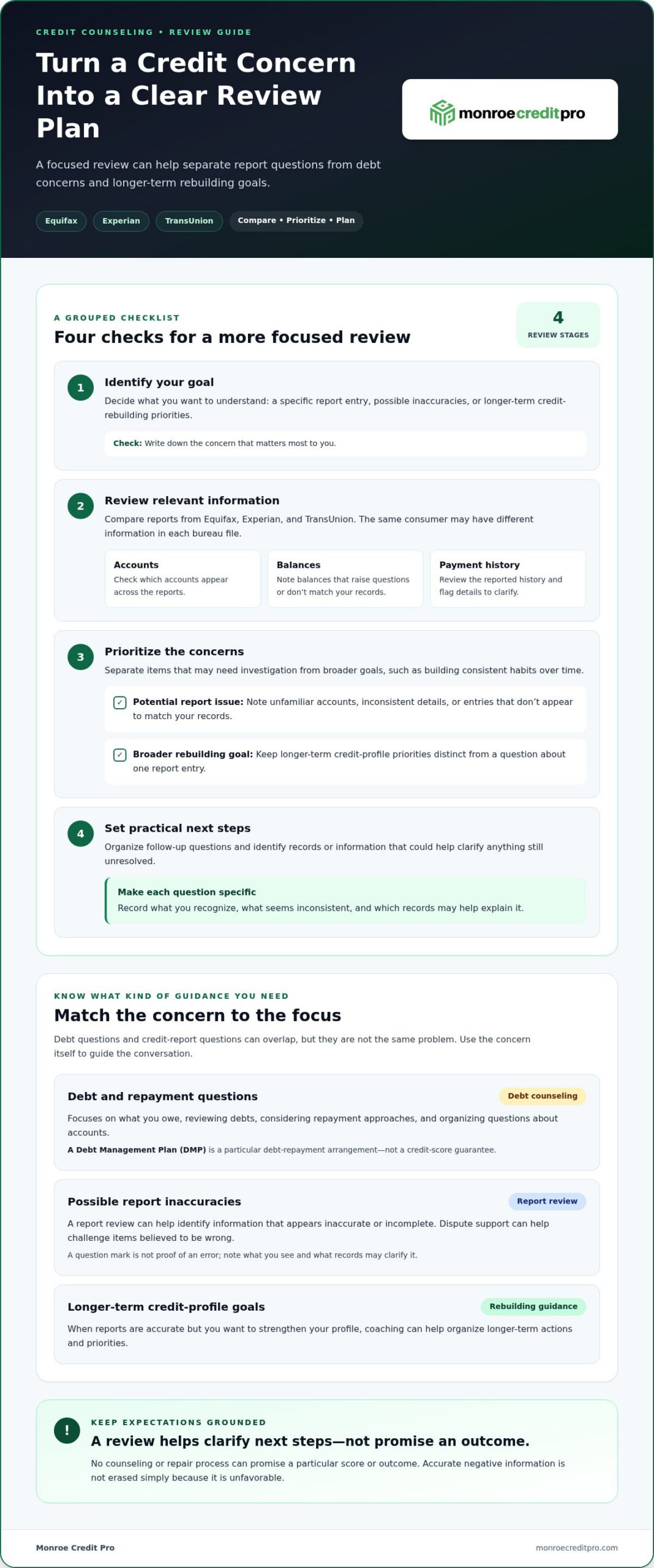
A useful review turns scattered concerns into a clearer picture. It starts with your goals, examines relevant credit information, identifies questions that need attention, and organizes practical next steps. Credit counseling services can include a personalized credit-profile review, with the details shaped by your needs and the type of support involved.
Each credit bureau may hold different information about the same consumer. Comparing reports from Equifax, Experian, and TransUnion can show whether an account or detail appears consistently across files, appears on only one, or needs closer examination.
A structured review often moves through these stages:
- Identify your goals. Clarify whether you want to understand a specific report entry, look for potential inaccuracies, or set longer-term rebuilding priorities.
- Review relevant information. Compare the three reports and note accounts, balances, payment history, and entries that raise questions.
- Prioritize concerns. Separate items that may need investigation from broader goals, such as establishing consistent habits over time.
- Set practical next steps. Organize follow-up actions and identify records or information that could clarify unresolved questions.
What information may be reviewed during a credit profile audit?
A three-bureau audit can examine account details, balances, payment histories, and entries that may be inaccurate. Collections, repossessions, and bankruptcy entries can require careful review when reported details don’t appear to match your records. For a deeper walkthrough of the review process, consult the article “Three-Bureau Credit Report Review: How to Audit Yours in 2026.”
Write down the specific detail that concerns you, such as an unfamiliar account or a balance you can’t reconcile. A question mark isn’t proof of an error, but recording what you see makes it easier to focus the review.
How counseling turns findings into a practical plan
A personalized assessment can distinguish report-specific questions from rebuilding goals. An entry that appears inconsistent may call for focused review. If your reports are accurate but you want to strengthen your profile, coaching can help organize longer-term actions. Priorities depend on your circumstances, rather than following one fixed sequence for everyone.
Progress tracking gives you a way to follow changes over time and keep attention on agreed priorities. It doesn’t promise a particular score or result. Instead, it helps you see what has changed, what still needs review, and which next step remains relevant.
Monroe Credit Pro combines three-bureau report audits with personalized credit guidance and progress tracking. Learn how credit counseling and report review support can help organize your next steps.
Which credit counseling service fits your concern?
Choose a starting point based on the question you need answered. Debt guidance focuses on obligations and repayment planning; report-focused support examines credit-file information and rebuilding goals. These areas can overlap, so a review may identify more than one concern to address. Use the comparison below to frame your first question and clarify what kind of support is relevant.
| Concern | Relevant service focus | Useful first question |
|---|---|---|
| I’m unsure how to manage several debts. | Debt-management guidance | What repayment options could help me organize these obligations? |
| An account or balance on my report seems wrong. | Credit-report audit | What details should I compare with my records? |
| I believe an entry is inaccurate. | Inaccurate-item dispute support | What information may help support a review of this item? |
| I want a clearer path to rebuild my credit profile. | Credit-rebuilding coaching | Which actions should I focus on, and how can I track progress? |
Credit counseling services can address different needs, but a service label alone doesn’t explain what a review covers. A report audit may surface an account question that needs dispute support, while rebuilding coaching can help organize steps alongside report-specific work. Match the support to the concern, then clarify what comes next.
When the main concern is debt and repayment
If your main question is how to manage what you owe, debt-focused counseling can help you understand your obligations and consider structured repayment options. A Debt Management Plan is one possible arrangement in this broader category, but it is distinct from reviewing credit-report accuracy and does not guarantee a score change. Start by identifying whether you need help organizing repayment or understanding information on your credit file. For a closer look at how these types of guidance differ, see Credit Repair vs. Credit Counseling: Choosing Wisely.
Be specific about the problem you want to solve. “I need to understand my monthly obligations” points toward repayment guidance; “I don’t recognize this account” points toward a report review. If both describe your situation, address each concern as part of a coordinated plan.
When the main concern is report accuracy or rebuilding
Consider a credit-report audit when an account, balance, or payment detail appears inconsistent with your records. Dispute support is relevant for information you believe is inaccurate, not for removing accurate negative history. If a collection entry is your main concern, How to Remove Collections from Your Credit Report: A Practical Guide offers collection-specific detail to help you understand the issue.
For rebuilding goals, coaching can help turn a broad aim into organized actions and progress tracking. You don’t have to resolve every question at once. Identify what seems incorrect, what you want to strengthen, and what information could clarify your next step. A personalized review can help connect those priorities without promising a particular result.
How to prepare for credit counseling and evaluate the guidance
A little preparation can make a credit counseling conversation more focused. You don’t need to have every answer or organize a perfect file. Bring the information you have, identify what you’re unsure about, and use the review to clarify next steps that fit your goals.
Documents and questions to organize before a session
Gather available credit reports from Equifax, Experian, and TransUnion, along with account records that may help explain a question. Write down your goals and the specific entries or concerns you want to discuss. A short timeline of relevant events, such as when you noticed an unfamiliar account, can keep the conversation grounded in details.
- Current reports: Note when you accessed each report and mark entries you want reviewed.
- Account questions: List concerns such as an unfamiliar account, a balance that seems inconsistent, or a collection entry you don’t understand.
- Your goals: Identify whether you want help understanding your reports, addressing possible inaccuracies, or organizing rebuilding priorities.
- Relevant timeline: Briefly record events connected to your questions, including when you first noticed a discrepancy or began rebuilding.
Separate what you know from what you need clarified. For example, write “I don’t recognize this account” rather than assuming how it appeared. This distinction helps focus the review without treating a question as proof of an error. Keep sensitive account details private; don’t post personal financial information in public comments or forums.
How to recognize clear, responsible credit guidance
Clear guidance explains what information is being reviewed, how findings will be discussed, what the service can and can’t do, and what practical next steps may follow. Before enrolling, understand the service scope, applicable fees, follow-up process, and how progress is tracked. That makes it easier to decide whether the service fits your needs.
Be cautious of claims that promise a specific score change or guaranteed removal of entries. A responsible review distinguishes between information that may warrant further examination and accurate history that cannot simply be erased. Understand how a disputed item will be reviewed, what updates are part of the process, and how you can track what has been addressed. The aim is clarity, not certainty about an outcome no one can promise.
Credit counseling services vary in focus, so match the discussion to your concern. If you’re unsure whether you need a report audit, dispute support, or rebuilding coaching, identify how the proposed review connects to your goal.
For an organized review of your credit profile and guidance on practical next steps, explore Monroe Credit Pro’s credit-profile support.
How Monroe Credit Pro supports credit counseling and rebuilding
Credit guidance is most useful when it connects what appears in your reports with a practical plan. Monroe Credit Pro provides credit counseling, three-bureau report audits, credit repair support, rebuilding coaching, and credit monitoring. The process focuses on understanding your credit profile, identifying questions that merit attention, and organizing next steps without promising a particular score or outcome.
A report-focused review can help if you’re unsure whether a concern involves inaccurate information, a longer-term rebuilding goal, or both. The review provides a structured starting point, while coaching helps translate findings into actions you can follow over time.
What Monroe Credit Pro’s credit-profile support involves
A personalized assessment reviews reports from Equifax, Experian, and TransUnion alongside the concerns you want to address. If information appears inaccurate, Monroe Credit Pro supports recurring dispute cycles and correspondence with the credit bureaus. Credit-rebuilding coaching helps you understand the broader profile and plan practical steps alongside report-specific work.
This approach keeps the focus on the details in your file rather than relying on a general score target. It also separates potential reporting inaccuracies from accurate information, which cannot simply be removed because it is unfavorable.
The work can include several connected activities:
- Reviewing reports: Compare information across the three bureaus and note entries that need closer attention.
- Identifying inaccuracies: Examine details that appear inconsistent or may not belong on your reports.
- Managing dispute correspondence: Support recurring dispute cycles and communication with credit bureaus about items under review.
- Organizing progress: Use tracking and credit monitoring to follow changes and keep rebuilding priorities visible.
What to expect from a structured next step
A report review and any related dispute process take place over time; not every entry will change, and neither deletion nor score improvement is guaranteed. The purpose is to examine the information, address potential inaccuracies through an organized process, and maintain a clearer view of progress. Tracking can help you follow developments without treating any single update as a promised result.
Rebuilding is also more than responding to a report entry. Coaching can help you keep longer-term goals in view while a specific concern is being reviewed. Monitoring and progress tracking provide a way to observe changes in your credit profile, while next actions remain grounded in your individual information and priorities.
Bring report review and rebuilding guidance into one organized process with credit counseling and credit repair support.
Take the next step with a clearer plan
You don’t need to solve every credit concern at once. Choose one question to bring into your next review, such as what you want to understand about your reports or which rebuilding goal matters most right now. A focused starting point can help turn uncertainty into a practical plan.
Credit counseling services provide structure, but progress comes through informed decisions and steady follow-through, not instant promises. Monroe Credit Pro’s personalized three-bureau assessments, dispute correspondence, and progress tracking can help keep your credit-profile questions organized as you move forward.
Start with Monroe Credit Pro’s credit counseling and credit repair support to take a practical next step toward understanding your credit profile and setting a clearer direction.
Frequently Asked Questions
What do credit counseling services do?
Credit counseling services help people understand a financial or credit concern and decide what practical step to take next. For example, if a collection account is unfamiliar but you’re also struggling to keep up with bills, you can clarify which issue needs attention first. The focus depends on the service. Monroe Credit Pro’s credit counseling includes credit-profile guidance, report review, and support with rebuilding priorities.
Is credit counseling the same as credit repair?
No. Credit counseling is a broad category of guidance, while credit repair generally centers on reviewing credit reports and addressing information believed to be inaccurate. Someone managing bills and questioning an account entry may need to consider both kinds of support. Neither approach can promise that accurate negative history will disappear.
Can credit counseling help improve my credit score?
Credit counseling may help you understand factors in your credit profile and identify actions relevant to your goals, but no specific score increase can be guaranteed. A review might clarify that an unfamiliar entry needs closer examination, while coaching may help you create a consistent plan. Focus on whether the guidance fits your circumstances and whether the recommended steps are clear, rather than relying on a promised score or deadline.
Does credit counseling hurt your credit?
Seeking guidance alone doesn’t automatically change your credit report. Any effect depends on a decision you make afterward, such as applying for a financial product or entering a repayment arrangement. Before authorizing an application or agreeing to terms, understand what action will be taken and whether it could affect your credit file. This helps distinguish the counseling conversation from the separate choices that may follow.
How much do credit counseling services cost?
There’s no single price for credit counseling services because costs depend on the organization and service. Monroe Credit Pro offers credit-profile audits and ongoing monthly credit repair services. Review the applicable fee structure and service scope before enrolling, including which report reviews, bureau correspondence, or progress services are included.
What should I bring to a credit counseling session?
Bring the reports and account information you have, plus a short list of questions and one or two goals. If a balance looks unfamiliar, note the account name, where you saw it, and what you’re uncertain about. A brief timeline can also help explain when you noticed a change. You can still begin with the information you have and identify what remains unclear.
Can a credit counselor remove accurate negative information from my report?
No. Accurate negative information isn’t eligible for removal simply because it affects your profile, and a counselor can’t guarantee that it will be deleted. If an entry seems wrong, gather records that help explain the discrepancy, such as account statements or correspondence. A report-focused review can help identify questions to investigate, but the outcome depends on the information and review process.
What is the difference between credit counseling and a Debt Management Plan?
Credit counseling is guidance; a Debt Management Plan is one possible structured approach to repaying eligible debts. A DMP doesn’t serve the same purpose as reviewing a report entry or receiving rebuilding coaching. If you’re considering a DMP, understand which debts it covers, what payment arrangement it involves, and how participation may affect your accounts. Those details help you decide whether the plan addresses your main concern.