


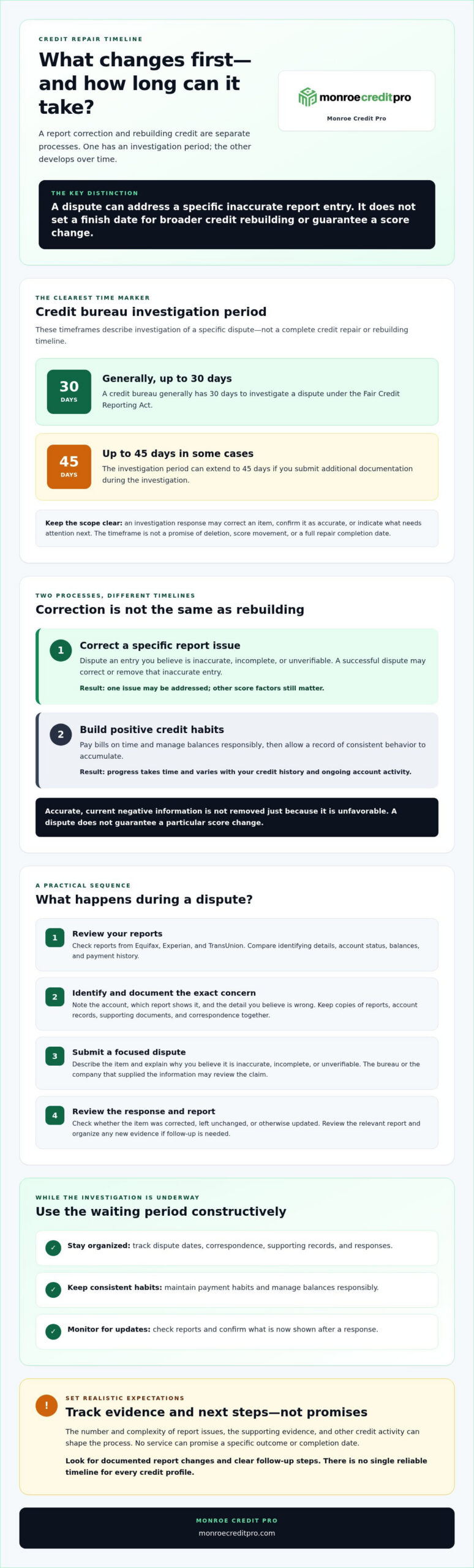
What if the first sign of credit repair isn’t a higher score, but a correction on your report? If you’re asking how long does credit repair take, the answer depends on what needs attention and whether the information is inaccurate. Credit bureau investigations generally take up to 30 days, or up to 45 days if you submit additional documentation during the investigation.
It’s understandable to want a clear date for when your report or score will change. But correcting inaccurate information and rebuilding credit are separate processes, and neither follows the same schedule for everyone. A successful dispute may correct an error, but it won’t remove accurate, current negative information. Positive credit habits, meanwhile, take time to build a record of consistent behavior.
This guide explains the stages that shape the timeline, what may change sooner, and why score movement can take longer. You’ll also learn what to do while disputes are underway and how to recognize promises of guaranteed results. With realistic expectations and an organized approach, you can track progress without relying on a fixed completion date.
Key Takeaways
- There’s no single answer to how long does credit repair take. The number and complexity of report issues shape the process.
- Organize account details and supporting records before disputing, and keep them handy in case more information is needed.
- Track dispute dates, correspondence, and responses so you can identify follow-up steps and stay organized.
- Use the waiting period to maintain consistent payment habits and monitor your reports for updates.
- Assess progress by checking report changes and follow-up steps, not by relying on promises of guaranteed removals or score increases.
How long does credit repair take, and what does that timeline include?
There is no single reliable timeline for every credit profile. If you’re asking how long does credit repair take, separate the time a credit bureau takes to investigate a specific dispute from the longer process of rebuilding credit. The first is a response period for a particular item. The second depends on your credit history and the habits you maintain over time.
Progress can depend on what you’re disputing, how clearly the evidence supports your claim, whether the information is updated across reports, and what else is affecting your credit. A dispute result may correct or remove an inaccurate entry, but it doesn’t guarantee a particular score change. Other report information and ongoing account activity still matter.
Credit report correction and credit rebuilding are different timelines
Correction means asking for a specific report entry to be investigated because you believe it’s inaccurate, incomplete, or unverifiable. Rebuilding means developing positive credit behaviors, such as paying bills on time and managing balances responsibly, then allowing their effects to accumulate. Correcting one error may address one issue, but it won’t resolve every factor that influences a score or erase accurate negative information.
What a bureau investigation timeframe can and cannot tell you
Under the Fair Credit Reporting Act, a credit bureau generally has 30 days to investigate a dispute. The period can extend to 45 days if you submit additional documentation during the investigation. These figures describe the bureau’s investigation, not the time required for a full credit repair engagement or broader credit rebuilding.
A response may lead to a correction, confirmation that the information is accurate, or a need to consider what to do next. Keep relevant records together: account details, supporting documents, submission dates, and bureau responses. If information is missing or a response raises new questions, follow-up may be needed. Professional credit repair services may include report review and ongoing dispute follow-up, but no service can promise a specific outcome or completion date. For a general overview of the rules governing credit repair organizations, see the Credit Repair Organizations Act.
What happens during each stage of the credit repair timeline?
Credit repair moves through a sequence: review the reports, identify specific issues, gather relevant records, submit disputes, and assess the responses. The process is not identical for every item. A straightforward account detail error may call for different evidence and follow-up than an account you don’t recognize or information that appears differently across reports.
Report review, issue identification, and documentation
Start by reviewing your reports from Equifax, Experian, and TransUnion. The same account may appear differently, or an entry may show up on one report but not another. Check identifying details, account status, balances, and payment history. Compare questionable entries with account statements or other records you have. Note exactly what seems inaccurate rather than disputing information simply because it’s unfavorable.
Keep a clear file with copies of your reports, supporting documents, and correspondence. For each concern, record the account, the report where it appears, and the detail you believe is wrong. If a detail is unclear, such as which account a record relates to, resolve that before submitting a dispute. Focused documentation makes the issue easier to understand for whoever reviews it.
Dispute submission, investigation, and response review
Once you’ve identified an error, submit a dispute that describes the item and explains why you believe it’s inaccurate, incomplete, or unverifiable. Depending on the process, the credit bureau or the company that supplied the information may review the claim. You may need to provide additional records or clarify account details if the information doesn’t match what’s in your file.
Read the response carefully. Check whether the item was corrected, left unchanged, or otherwise updated, then review the relevant report to confirm what’s now shown. A dispute doesn’t always lead to deletion. The information may be verified or corrected instead. If the response doesn’t address the issue, organize any new evidence and consider the appropriate next step, such as following up with the bureau or information furnisher. The Federal Trade Commission explains your rights under federal law concerning credit repair organizations.
A dispute cycle addresses a specific report issue. Rebuilding credit is the longer process of establishing positive habits over time. That distinction helps set expectations: a response about one item is a checkpoint, not a promised finish line for your overall credit progress.
Structured report review and progress monitoring can help you keep records and next steps in order. If you’d like support assessing potential inaccuracies, explore credit report review and audit services.
Which factors make credit repair faster or slower?
The answer to “how long does credit repair take” depends partly on how clearly an issue can be identified and supported. A single reporting error with clear records may be more straightforward to review than several accounts with conflicting details. Even a well-documented dispute can take time, and no general timeline can predict the result for every credit profile.
How report complexity and documentation affect progress
Start with the scope of the issue. An incorrect balance on one account is different from multiple entries that appear inconsistently across Equifax, Experian, and TransUnion. Each report may need its own review, and an item’s status or details may not match across bureaus. That can mean tracking separate responses and checking each relevant report for updates.
Clear account information helps keep a dispute focused. If you’re questioning an account you don’t recognize, for example, details about identity or ownership may need to be clarified before the issue can be fully assessed. Missing statements, incomplete account numbers, or records that don’t explain the discrepancy can lead to requests for more information or additional follow-up. Delayed responses from you or another party can also extend the process.
Keep a simple record of what’s in question, which report it appears on, what evidence supports your concern, and when you receive updates. This won’t control another party’s response time, but it can help you see what’s outstanding and respond without searching through scattered paperwork.
Why score changes may lag behind a dispute result
A dispute outcome and a credit score change are related only in some cases. Scores reflect multiple parts of a credit file, including payment history, balances, length of credit history, new credit activity, and credit mix. A correction may address one entry while other factors continue to influence the score.
For instance, correcting a reported balance may not immediately resolve the effect of high balances elsewhere. Likewise, a corrected payment record doesn’t replace the value of making future payments on time. New account activity or changes in reported balances may also affect later score updates. The timing of report updates can matter, too.
A corrected entry can improve the accuracy of your report, but it doesn’t guarantee a fixed score increase. Focus on confirming that the report reflects the investigation result, then keep building steady habits. Review report updates and track your balances and payment activity so you can distinguish dispute progress from broader credit progress.
Can credit repair remove accurate negative information?
No. Legitimate credit repair disputes information that may be inaccurate, incomplete, or unverifiable. It isn’t a way to erase accurate, current negative information simply because it affects your credit. A service can review reports, identify potential errors, and help address disputed entries, but it can’t guarantee that an item will be removed or that your score will increase.
This distinction also helps set expectations about how long does credit repair take. The timeline depends in part on whether there’s a supportable reporting error to investigate. If an entry is accurate, focus on the parts of your credit profile you can influence rather than repeatedly disputing the same correct information.
When disputing a report entry may be appropriate
Review a negative entry against your records before deciding whether to dispute it. For example, a payment may be marked late even though your account documentation shows it was paid on time, or an account may appear that you don’t recognize. Compare the report’s account details, dates, and status with original statements or other records. Then describe the specific discrepancy and provide relevant supporting information. A negative item isn’t automatically an error, and an investigation may confirm the entry as reported.
What to expect when an item is accurate
If information is accurate, it may remain on your report while it is reportable under applicable rules. Credit repair doesn’t make accurate information disappear on demand. Instead, direct your effort toward steady habits that support long-term progress: make payments on time, manage balances carefully, and avoid unnecessary new credit applications. Those actions won’t guarantee a particular score result, but they help address factors beyond a single disputed entry.
Before enrolling with a credit repair company, ask what it will review, how it handles disputes, what your responsibilities are, and what the service terms say. Treat promises of guaranteed deletions or score increases as a warning sign. A clear explanation of the process is more useful than a promised outcome.
For a broader look at the difference between correcting report errors and strengthening your credit over time, read this guide to credit restoration services. If you want help reviewing your reports for potential inaccuracies, explore credit report audit support.
How can you make steady progress while credit repair is underway?
Keep moving on two tracks: follow the disputed information and maintain the habits that support your credit profile. If you’re wondering how long does credit repair take, a clear record of submissions, responses, and report changes can help you see what’s progressing and what still needs attention. It won’t control investigation timing or guarantee a score change, but it can make your next step easier to identify.
A practical progress checklist for the next review cycle
Use a simple checklist to keep your follow-up focused:
- Review your reports. Check the relevant entries across Equifax, Experian, and TransUnion. Mark information that appears inaccurate or incomplete, and note which report shows it.
- Organize your evidence. Save copies of account records that support your concern, along with each report and any documents you submit.
- Log every contact. Record submission dates, the bureau or information furnisher contacted, correspondence, and responses. Keep the dates together so you can tell what has been answered and what may need follow-up.
- Check for updates. Review the response and the updated report carefully. If the issue remains unresolved, decide whether additional documentation or a focused follow-up may help clarify it.
- Maintain positive habits. Continue making payments on time, review balances regularly, and avoid applying for credit you don’t need. These steps support ongoing credit rebuilding, even while a dispute is under review.
Stay consistent, but avoid checking for an immediate score change after every update. A corrected entry and broader credit progress are different measures. Reviewing the report itself helps you confirm whether the information changed.
When structured professional support may help
If your reports contain several potential inaccuracies or it’s difficult to keep records organized, a credit report audit can help structure the review. Ongoing dispute tracking can also help you follow submissions, responses, and next steps. Treat that support as a way to stay organized, not as a promise of faster investigations, removed items, or a particular score result.
Before choosing a service, make sure you understand what it reviews, how follow-up is handled, what information you’ll need to provide, and what the service terms say. Clear expectations make it easier to assess progress without relying on a guaranteed timeline.
If you’d like structured help reviewing potential inaccuracies and tracking dispute progress, explore credit repair support with realistic expectations about the process and its possible outcomes.
Take the next step with a clear plan
There’s no universal finish date for credit repair. A bureau investigation addresses a specific disputed entry, while rebuilding credit depends on the habits you sustain over time. Keep those timelines distinct, document each response, and measure progress by accurate report updates and consistent financial routines, not by a promised score increase.
Accurate negative information isn’t automatically removable, and no legitimate service can guarantee a specific result. An organized review can help you identify potential inaccuracies and understand what follow-up may be appropriate. Monroe Credit Pro offers credit report review and audit services, ongoing dispute cycles with progress tracking, and credit counseling with rebuilding guidance.
If structured support would help you stay organized, explore credit repair support and review the process and expectations before deciding. Each careful step can help you move forward with greater clarity and confidence.
Frequently Asked Questions
How long does credit repair usually take?
There’s no reliable standard timeline for every credit profile. How long does credit repair take depends on what information is being reviewed, how complex the disputed items are, and whether supporting records are available. A bureau investigation is only one part of the process. Correcting an error doesn’t necessarily rebuild credit immediately, since score changes can also depend on other report details and ongoing account activity.
Can credit repair fix my credit in 30 days?
Credit repair may not fix an entire credit profile in 30 days. A bureau generally has 30 days to investigate a dispute, but that timeframe covers the investigation, not broader credit rebuilding or a guaranteed score change. A clearly documented error might be addressed during an investigation, while other issues may need follow-up. Be cautious of any company promising that your credit will be fixed by a specific date.
How long does it take for a credit bureau to investigate a dispute?
A credit bureau generally has 30 days to investigate a dispute. The period can extend to 45 days if you submit additional documentation during the investigation. Keep a copy of what you sent and note the submission date so you can track the response. The investigation timeframe doesn’t mean every dispute will result in a correction or deletion. The bureau may determine that the information is accurate.
Will my credit score go up as soon as an error is removed?
Not necessarily. Removing or correcting an error can improve the accuracy of your credit report, but it doesn’t guarantee an immediate score increase. Scores reflect the broader information in your credit file, including payment history, balances, and other account activity. Check the updated report to confirm the disputed entry changed, then give other positive credit habits time to contribute. Avoid relying on a particular point increase as proof of success.
Can accurate negative information be removed through credit repair?
Credit repair can’t automatically remove accurate, current negative information. Disputes are appropriate for information that may be inaccurate, incomplete, or unverifiable, such as a payment marked late despite records showing it was paid on time. Compare an entry with your account documents before challenging it. If the information is accurate, focus instead on managing current accounts responsibly and allowing your positive payment history to develop.
What can delay the credit repair process?
Missing records, unclear account details, and several inconsistent entries can make review and follow-up more involved. For example, an unfamiliar account may require you to clarify whether it belongs to you, while differing information across reports may need separate attention. Delayed responses or requests for additional documentation can also extend follow-up. Keep records organized and respond carefully to requests, but remember that preparation can’t control another party’s investigation schedule.
Should I keep rebuilding credit while a dispute is pending?
Yes. Continue making payments on time, review your balances, and avoid applying for credit you don’t need while the dispute is being investigated. These steps support broader credit rebuilding, though they don’t guarantee quick score gains or determine how the dispute will be resolved. Also keep monitoring your reports and save responses as they arrive. That way, you can track the correction process while maintaining habits that support future progress.