


What if the first step toward feeling less stressed about debt isn’t solving everything, but sorting out what needs attention now? When bills, balances, and credit worries blur together, it can be hard to know where to begin. A search for “fix bad credit Monroe” may lead to credit support, but credit repair doesn’t pay down debt or replace a plan for managing urgent bills.
Debt stress can affect sleep, focus, and relationships, but it doesn’t mean you’ve failed. Make progress by separating immediate obligations from longer-term credit goals and choosing one practical next step. This guide will help you organize bills, outline a manageable debt plan, and understand when financial or emotional support may be useful.
You’ll also learn where credit-report support fits. A report audit can help identify possible inaccuracies that may be disputed, but accurate negative information generally can’t be removed through credit repair. Start with what’s most urgent, then build a clear path forward.
Key Takeaways
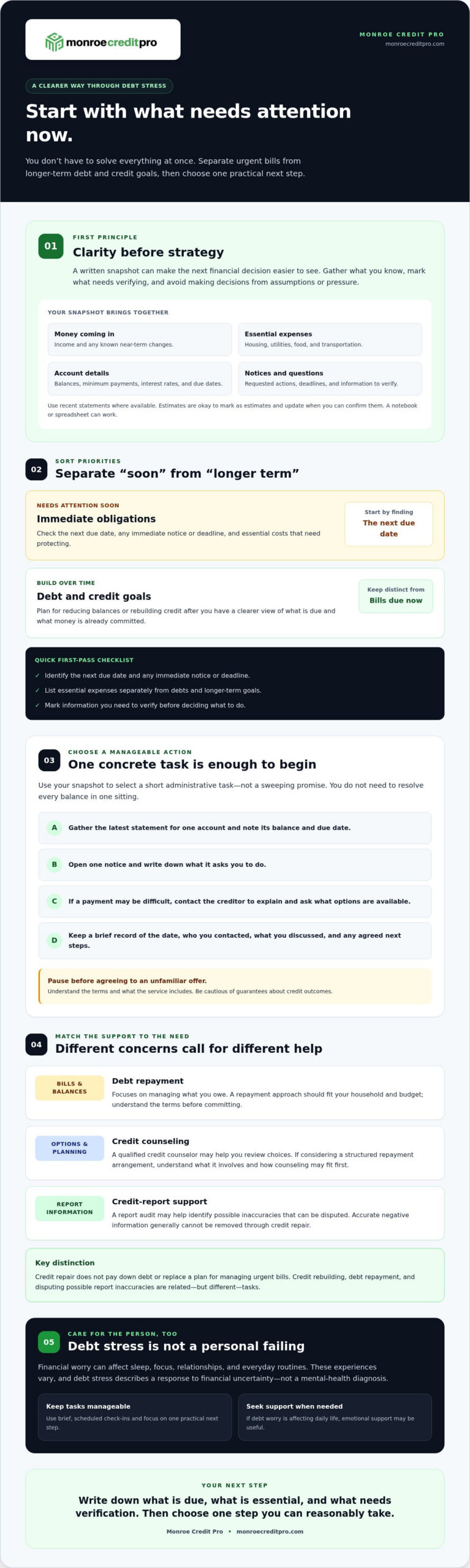
- Put income, essential expenses, balances, and due dates in one written snapshot to clarify your next financial decision.
- Separate immediate bill priorities from longer-term debt repayment and credit goals, then choose a plan that fits your household.
- Understand how debt repayment, credit counseling, and credit-report disputes address different needs so you can seek relevant support.
- If you’re searching for “fix bad credit Monroe,” consider whether a credit-report audit could help identify information that may be inaccurate.
- Use brief, scheduled check-ins to keep financial tasks manageable, and seek emotional support if debt worry is affecting daily life.
Why debt stress can feel overwhelming, and what you can control first
Financial difficulty isn’t a personal failing. When several bills compete for attention and the full picture feels uncertain, it can be hard to decide what to handle first. Repeatedly checking balances may add pressure without clarifying your next step. Debt stress is the strain that can build when financial obligations feel difficult to understand, prioritize, or manage. It describes a common response to financial uncertainty, not a mental-health diagnosis.
How financial uncertainty can affect everyday decisions
For some people, money worries lead to putting off unopened notices; for others, they make it harder to focus or keep ordinary routines. These experiences vary, and none means you’ve failed. Choose one short, concrete task: gather the latest statement for a single account, note its due date, or open one notice and record what it asks you to do. A small action can turn an unclear worry into a question you can address.
What you can control when the full picture feels unclear
Start with information, not assumptions. Gather recent account statements, bills, and collection notices. For each, note the balance, due date, and any requested action. Separate essentials that need attention soon, such as housing, utilities, food, or transportation, from longer-term goals like reducing balances or rebuilding credit. If you’re searching “fix bad credit Monroe,” remember that credit-report concerns and bills requiring payment are different issues and may call for different support.
Use this quick first-pass checklist:
- Identify the next due date and any immediate notice or deadline.
- List essential expenses separately from debts and longer-term goals.
- Mark information you need to verify before deciding what to do.
Don’t agree to an unfamiliar offer simply because you feel pressured. Take time to understand the terms, ask what the service includes, and be cautious of guarantees about credit outcomes. If the next step involves a structured repayment arrangement, learn what a Debt Management Plan (DMP) involves and how credit counseling may fit before making a decision.
Some actions are within reach today: organizing documents, identifying an urgent bill, or noting a question for a creditor or counselor. Other issues may take time or require outside help. You don’t have to resolve everything in one sitting. First establish what’s known, what needs attention soon, and what belongs in a longer-term plan.
How to make a calm, step-by-step plan for debt stress
A useful plan creates clarity without assuming every household has the same income, obligations, or options. Start with a written snapshot, identify the next decision that needs attention, and ask for qualified help if you’re concerned about making a payment. You don’t need to solve every balance today. You need a reliable view of what’s due and what you can reasonably address.
Write down what comes in, protect essential expenses, and confirm the next due dates before choosing a strategy. This first pass can replace guesswork with a clearer set of choices.
Build a clear snapshot before choosing a strategy
Make one list of your accounts. For each, record the balance, minimum payment, interest rate, and due date, using a recent statement when available. Add income, essential expenses, and known near-term changes, such as a shift in work hours or an upcoming bill. If you don’t have an exact figure, mark it as an estimate and update it when you can verify the amount.
Keep the record simple enough to maintain. A notebook or spreadsheet works. Separate essential costs from debt payments so you can see what money is already committed before making decisions. If you’re reviewing your credit as part of a longer-term goal, the Consumer Financial Protection Bureau explains what is a credit score and why it matters. Credit rebuilding and paying down balances are related goals, but they aren’t the same task.
Choose one manageable action and follow through
Use your snapshot to pick a short administrative task, not a sweeping promise. You might confirm an account balance, check a due date, or contact a creditor to explain that a payment may be difficult and ask what options are available. If you’re unsure which steps fit your situation, a qualified credit counselor may help you review your choices. Avoid committing to a repayment method before you understand its terms and how it fits your budget.
Keep a brief record of each call or message: the date, who you contacted, what you discussed, and any agreed next steps. This makes follow-through easier and reduces the need to rely on memory. If your search for “fix bad credit Monroe” reflects concern about errors in your credit file, a credit report audit may help identify information that could warrant review.
Progress can mean completing the next clear task, even if the larger situation takes time to address. Update your notes as details become clearer, then choose your next step based on your circumstances rather than pressure or a one-size-fits-all rule.
Debt management, credit rebuilding, and credit repair: what is different?
These forms of support address different problems. Debt repayment focuses on what you owe; credit rebuilding focuses on habits that may support future credit health; credit repair focuses on potentially inaccurate information in your credit file. A search for “fix bad credit Monroe” may bring up these terms together, but they aren’t interchangeable.
| Type of support | Main purpose | What it doesn’t do |
|---|---|---|
| Debt repayment or management | Organizes payments toward balances, based on your circumstances and any arrangement you choose. | Doesn’t correct inaccurate credit-report information by itself. |
| Credit counseling | Helps you review your finances, understand options, and consider a debt-management approach. | Doesn’t guarantee that debts or credit-report entries will be removed. |
| Credit-report disputes | Requests a review of specific information you believe is inaccurate. | Doesn’t pay down a balance or erase accurate negative information simply because it is disputed. |
Credit-report correction addresses inaccurate file information; debt reduction addresses the amount you owe. Credit rebuilding is a longer-term goal, and progress can depend on factors beyond any one service. The Consumer Financial Protection Bureau explains how to understand the difference between credit counseling and credit repair.
When the main issue is debt or monthly cash flow
If payments are difficult to manage, a qualified nonprofit credit counseling agency may help you review your budget and understand possible approaches. Before agreeing to any service or plan, ask what it includes, what it costs, and what terms apply. Review the details carefully. Credit counseling and debt settlement are not the same, so make sure you understand exactly what support is being offered.
When a credit report may contain inaccurate information
Review your reports from Equifax, Experian, and TransUnion, then compare specific entries for possible errors, such as an account or balance you don’t recognize. If you dispute an item, identify the information you believe is inaccurate and explain why. Keep relevant records. Accurate negative information generally isn’t removed just because you challenge it; a dispute is meant to address information you believe is wrong.
A credit-report audit can help you review your files and identify potential inaccuracies. Monroe Credit Pro offers report audits and support with disputes of identified inaccuracies, which may form one part of a broader financial plan. This service doesn’t reduce debt balances or guarantee a particular credit outcome.
How to manage debt-related worry while you work through the numbers
Practical financial steps can create structure, but they don’t necessarily resolve worry on their own. Make room for both: take manageable action on money concerns and use supportive routines to care for your wellbeing. You don’t have to monitor every account throughout the day to stay responsible.
Create boundaries around financial tasks
Choose a regular time for money check-ins, such as a brief review on a day that works for you. Use that time to check upcoming due dates, update your notes, and decide on one next task. Outside the check-in, try not to reopen accounts unless you need to act on a specific notice or deadline.
Keep statements, notices, and call notes together in a secure place, whether that’s a protected digital folder or a physical file stored safely. If it would help, ask someone you trust to sit with you while you organize papers or to check in after you contact a creditor. They can offer accountability without making decisions on your behalf.
Keep the task small. For example, set aside a short check-in to confirm one balance, then stop when that task is done. If the phrase “fix bad credit Monroe” brought you here, remember that reviewing a credit report is a practical financial step, not a complete response to persistent distress. Credit repair and budgeting alone aren’t treatments for anxiety.
Know when additional support may help
If worry continues, gets worse, or disrupts sleep, work, relationships, or other parts of daily life, consider speaking with a healthcare professional. Reaching out is a reasonable step, not a judgment about how well you’re managing. A qualified professional can help you consider support suited to your circumstances.
If you or someone else is in immediate danger, call 911. In the United States, call or text 988 to reach the Suicide & Crisis Lifeline for emotional distress or a mental health crisis. If you’re unsure what to do in an urgent situation, contact emergency services or a qualified professional for guidance.
Financial support can address a separate concern. If uncertainty about possible credit-report errors is contributing to your worries, Monroe Credit Pro offers credit-report audits to identify potential inaccuracies. Learn about credit-report audits as one possible part of a broader financial plan.
Your next step: get the right support for your specific credit concern
Choose support based on the problem you’re trying to address. A payment concern or difficult monthly cash flow may call for budgeting guidance or credit counseling. A specific item you believe is inaccurate on a credit report may call for a report review and a focused dispute. Credit-report correction can be one part of a broader financial plan, but it doesn’t reduce the balances you owe.
Monroe Credit Pro reviews credit reports, identifies potential inaccuracies, and supports dispute cycles that may include bureau correspondence and progress tracking. A review can clarify what information may warrant attention, but results depend on the information in the report and the review and response process. Don’t assume a particular deletion or score increase.
Questions to ask before choosing a credit service
Before enrolling, ask what specific services are included and how any recurring service cycles work. Request clear explanations of fees, cancellation terms, and how progress is tracked. Make sure you understand what the provider will do, what you may need to do, and what falls outside the service’s scope. Review the answers before making a decision.
Be cautious of promises that accurate negative information will be removed or that your score will increase by a specific amount. Treat those claims as a reason to ask for clarification about the process and its limits. A credible explanation should distinguish reviewing potentially inaccurate information from changing accurate information or paying down debt.
When a credit-report review may be a useful next step
Consider an audit if you’ve found a specific account, balance, or other entry that you believe is incorrect. Gather the report and any records that help explain the discrepancy, then identify exactly what you want reviewed. If the report information is accurate, a dispute is not a substitute for a debt-repayment plan or longer-term credit rebuilding.
If you’re searching “fix bad credit Monroe,” focus first on matching the support to the concern. Learn more about credit restoration services if you want information about report reviews and support with identified inaccuracies. Understand the service and its terms, then decide whether it fits your needs.
Take the next step with a clearer plan
Debt concerns and credit-report concerns call for different kinds of support. Start by organizing what’s due and identifying your most immediate financial priority. Keep longer-term credit goals separate from debt repayment, and review your credit reports if you suspect specific information may be inaccurate.
If you’re searching for “fix bad credit Monroe,” remember that credit repair doesn’t pay down debt or guarantee that information will be removed. Monroe Credit Pro offers credit-report audits to review files for potential inaccuracies, along with ongoing dispute cycles, bureau correspondence, and progress tracking. These services may help address credit-file concerns as one part of a broader financial plan.
You can learn what the process involves and decide whether it fits your needs. Explore credit-report support and take the time you need to understand the service and its terms. You don’t have to resolve every concern at once. A clear next step is progress.
Frequently Asked Questions
Can debt stress affect your health and everyday life?
Yes, financial worry can affect daily routines and wellbeing. Uncertainty about bills may make it harder to focus, sleep, or feel present with other people, though experiences differ from person to person. These effects don’t mean you have a mental-health condition or have failed to manage your finances. If the strain is interfering with everyday life, consider talking with a healthcare professional while taking practical financial steps at a manageable pace.
What is the first thing to do when debt feels overwhelming?
Start by gathering recent statements, bills, and notices so you can see what’s known before making assumptions. Write down income, essential expenses, account balances, and due dates. Estimates are useful if exact figures aren’t available yet. Then identify one immediate task, such as confirming a balance or checking when a bill is due. You don’t need to choose a long-term repayment strategy before you understand your current situation.
Can credit repair reduce the amount of debt you owe?
No, credit repair doesn’t pay down or settle debt. It focuses on reviewing credit-report information and disputing items that may be inaccurate. Accurate negative information isn’t automatically removed just because it’s disputed. If your concern is the amount you owe or managing payments, consider discussing your finances with a qualified credit counselor. Keep credit-report correction and debt repayment as separate parts of your broader financial plan.
How can I dispute an error on my credit report?
Review your reports from Equifax, Experian, and TransUnion, and identify the specific entry you believe is wrong. Gather relevant statements or records, then submit a dispute to the credit bureau reporting the information and explain what you believe is inaccurate. Keep copies of your dispute and supporting documents. You can handle this yourself or seek help reviewing the reports and organizing disputes. A dispute addresses possible errors, not accurate debt information.
Should I use a credit repair company or handle disputes myself?
You can review reports and dispute suspected errors yourself, or consider professional assistance if you want help examining credit files and tracking dispute steps. If your search for “fix bad credit Monroe” leads you to a provider, ask what services are included, how recurring dispute cycles work, how progress is tracked, and what fees and cancellation terms apply. Be cautious of guarantees about removing accurate information or achieving a specific score increase.
When should I seek help for debt-related anxiety?
Consider speaking with a healthcare professional if worry persists, worsens, or disrupts sleep, work, relationships, or other daily activities. Seeking support doesn’t mean you’ve failed to manage your finances. If you or someone else is in immediate danger, call 911 in the United States. For emotional distress or a mental-health crisis, call or text 988 to reach the Suicide & Crisis Lifeline. These supports can complement, not replace, practical financial guidance.