



A goodwill request is a long shot when you want to remove a charge-off. Knowing how to write a goodwill letter for a charge-off can help you make a clear, respectful request, but creditors generally don’t have to remove accurate negative information. For a charge-off, a goodwill letter is usually not the most practical approach.
If the entry is accurate, you can still ask the original creditor to consider a courtesy adjustment, especially if unusual circumstances caused the missed payments and your payment history has since improved. Goodwill requests may be even less practical for collection accounts, particularly when the debt has been transferred to a collector. This guide covers what to include, when a request may make sense, and how to distinguish a goodwill request from a dispute about inaccurate information.
Key Takeaways
- Separate a courtesy request about accurate reporting from a dispute over information that is incorrect.
- Build a focused letter around the account details, what caused the missed payment, and the steps you’ve taken since.
- Consider whether your circumstances and payment history make a goodwill request a practical next step.
- For a charge-off or collection, weigh the limits of a goodwill request and identify what kind of credit-report review may better fit your situation.
What Is a Goodwill Letter and How Do You Write One?
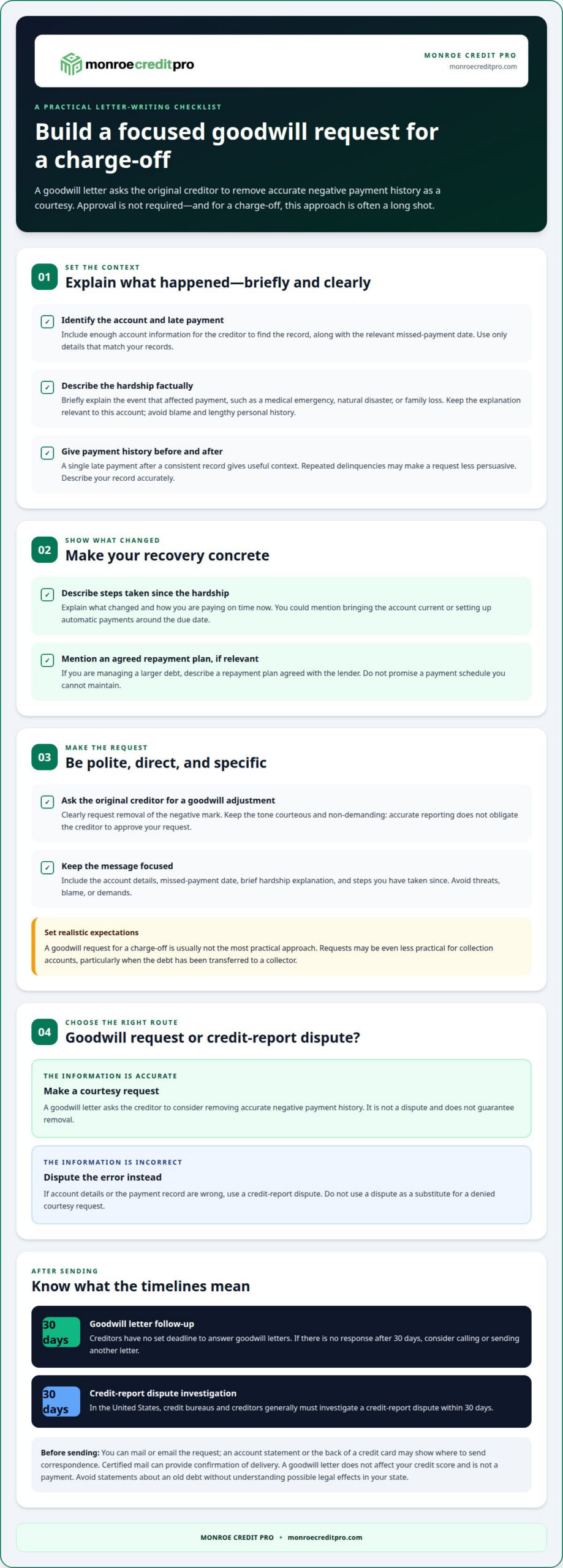
A goodwill letter asks a creditor to remove accurate negative payment history as a courtesy. Before deciding how to write a goodwill letter for a charge-off, distinguish a courtesy request from a dispute about incorrect credit information.
-
Summarize Hardship and Payment History
Explain the missed payment and the circumstances behind it, such as a natural disaster or medical emergency. Then describe your payment history before and after the event. A single late payment after a previously consistent record gives the creditor useful context; repeated delinquencies may make a request less persuasive. Keep your explanation factual, brief, and free of blame.
-
Mention Repayment Efforts
Describe what changed after the hardship and how you’re paying on time now. For example, you could explain that you brought the account current and set up automatic payments around the due date. If you’re managing a larger debt, mention a repayment plan agreed with the lender. Don’t promise a payment schedule you can’t maintain.
-
Request Removal of the Charge-Off
Identify the account and missed-payment date, explain the circumstances, and clearly ask the original creditor to remove the negative mark as a goodwill adjustment. If you’re considering how to write a goodwill letter for a charge-off, keep the request polite and non-demanding; accurate reporting doesn’t obligate a creditor to approve it. Creditors have no set deadline to answer goodwill letters. If there’s no response after 30 days, consider calling or sending another letter.
-
Distinguish Goodwill from a Dispute
Use a goodwill request when the charge-off or late payment is accurate. If a report contains incorrect information, dispute the error instead. In the United States, credit bureaus and creditors generally must investigate a credit-report dispute within 30 days, according to the Office of the Law Revision Counsel, U.S. House of Representatives.
Sending a goodwill letter does not affect your credit score, and it is not a payment. Avoid promising to pay or making statements about an old debt without understanding the possible legal effects in your state.
Circumstances for requesting removal of a negative mark
Build your request around the reason for the negative entry, your financial circumstances, and what has changed since. A concise, respectful message focused on relevant details is easier for the creditor to review.
-
Assess the Circumstances
Identify an unusual event that disrupted your ability to pay, such as a family loss or another serious hardship. Explain how it affected the specific account without recounting every financial difficulty. Review the credit report entry and your payment history for context. A goodwill request concerns accurate information; use a credit dispute if the account details or payment record are wrong.
-
Choose When to Send the Request
Consider sending the letter after paying the charge-off and allowing the account information to reflect the payment. Your request may be more persuasive if you can describe how your circumstances have changed and show subsequent on-time payments. Include the relevant payment date and enough account information for the creditor to locate the record. In the United States, charge-offs generally remain on a credit report for seven years, so a focused request can address the issue directly.
-
Send the Goodwill Request
Write a short, courteous letter to the original creditor. Identify the account, explain the hardship in a few sentences, summarize your efforts to pay, and ask for a goodwill adjustment. Avoid threats, blame, or demands. Send it by mail or email; an account statement or the back of a credit card may show where to send correspondence. Certified mail can provide confirmation of delivery.
If the creditor rejects your request, keep the reply with your account records and ask about hardship programs. Depending on the program, the lender may discuss pausing payments, reducing monthly payments, or lowering the interest rate. Dispute the account only if its reporting is inaccurate, not as a substitute for a denied courtesy request.
Goodwill letter template
Use this structure to make your request easy for the lender to review. Replace each bracketed field with accurate account details and a brief, truthful explanation.
- Add identifying details. Write your full name, mailing address, and the date at the top. Address the letter to the lender’s customer relations or correspondence department. Include the account number, or just its final digits if you’re sending the letter through a less secure channel.
- Explain the specific event. Name the payment date and briefly describe what caused the late payment. For example, explain that a medical emergency disrupted your finances, then say what changed afterward. Avoid lengthy personal history, unsupported claims, or language suggesting accurate information is incorrect.
- Adapt this sample letter. Keep your request polite and direct. Replace the bracketed fields, then remove any sentence that doesn’t fit your circumstances.
[Date]
[Your name]
[Your mailing address][Lender name]
[Correspondence department]Subject: Goodwill adjustment request for account ending in [last digits]
Dear [Lender or department name],
I’m writing about my [credit card or loan] account ending in [last digits]. A late payment dated [date] occurred during [brief explanation of hardship]. I understand the payment was late, and I’m not disputing accurate reporting.
Since then, I have [describe steps taken, such as bringing the account current or arranging automatic payments]. My payment history has [brief, accurate description]. Please consider removing the late-payment mark as a goodwill adjustment. I appreciate your review.
Sincerely,
[Your name] - Review before sending. Confirm the account number, date, and explanation match your records. A goodwill letter asks the lender to consider changing accurate reporting; a dispute letter addresses incorrect information. Credit bureaus use reported information when calculating credit scores, so don’t describe an accurate entry as an error.
Goodwill letters for charge-offs and collections
Goodwill requests for accurate charge-offs can be difficult, and collections may be harder still. Choose your next step based on who reports the account and whether the information is accurate.
- Identify who reports the debt. Check whether the charge-off appears under the original creditor or a collection agency. A goodwill request to the original creditor is generally not a practical way to remove a charge-off. If the debt has transferred to a third-party collector, asking that company to remove accurate reporting may be even less likely to succeed.
- Separate a courtesy request from an error. Compare the account details, balance, dates, and payment history with your records. If the entry is inaccurate, file a dispute that describes the specific error and the correction you’re requesting. Don’t call accurate reporting an identity problem or dispute it simply because the negative mark affects a future application.
- Set a realistic goal for a paid collection. Some consumers ask a collector to delete an account in exchange for payment, a practice called pay-for-delete. Collectors may not agree to deletion. If you’re resolving the debt, a more realistic request may be to have the account reported as paid in full. Document any proposed arrangement clearly before paying.
- Choose another route when goodwill doesn’t fit. If you’re facing ongoing financial difficulty, discuss repayment or hardship options with the lender rather than relying on a deletion request. If the creditor denies your goodwill request, ask about programs that may pause payments, reduce monthly payments, or lower interest. For a federal student loan in default, rehabilitation may address default status, but not earlier reported late payments.
A careful review can help distinguish an inaccurate entry from a difficult but accurate one. Get help reviewing your credit report to identify the appropriate next step.
Monroe Credit Pro
Monroe Credit Pro can help you assess your next step when a goodwill request doesn’t resolve a charge-off concern. Its Credit Report Audit and Credit Correction services help review reported information and distinguish possible errors from accurate negative history. For accurate entries, Credit Counseling can help you consider practical ways to manage accounts and strengthen payment habits. Credit Restoration and Professional Credit Repair offer broader support as you work to rebuild your credit profile. A goodwill adjustment remains the creditor’s decision, so a careful review can help you focus on suitable actions. Contact Monroe Credit Pro to discuss your credit report and next steps.
Move Forward With a Clear Credit Plan
A past reporting problem can feel like the whole story, but your next financial decisions still matter. Knowing how to write a goodwill letter for a charge-off gives you a way to make a focused request, while a broader credit plan can help you decide what to address next. Keep your priorities clear, act on accurate information, and choose steps you can sustain. Progress depends on a consistent approach, not on letting one entry dictate every decision.
If you’re unsure how a charge-off fits into your wider credit picture, take time to consider what outcome you’re working toward and which questions remain unresolved. A measured review can help you move from uncertainty to a practical plan without losing sight of your longer-term goals. For support in deciding on your next steps, contact Monroe Credit Pro. Each informed action can help you build momentum toward greater financial confidence.
Frequently Asked Questions
What is a goodwill letter for a charge-off?
A goodwill letter is a personal request asking a creditor to make a courtesy change to accurate negative account information. It explains the circumstances behind the financial setback and why you’re asking for consideration. It isn’t a formal credit dispute, a payment arrangement, or a way to require removal. For example, a borrower might ask the original lender to reconsider a charge-off after resolving the account and stabilizing payments.
Can a creditor remove an accurate charge-off as a goodwill adjustment?
A creditor may grant a goodwill adjustment, but it doesn’t have to remove accurate reporting. Charge-offs are serious negative entries, so a courtesy request may be difficult to obtain. A stronger request explains what happened, what changed, and why you’re asking for consideration. If the entry is inaccurate, dispute the error rather than presenting it as a goodwill matter.
What details should a goodwill letter for a charge-off include?
Include your name, the date, the creditor’s name, and enough account information to identify the debt. State the charge-off or missed-payment date, briefly explain the circumstances, and describe what you’ve done since. Make one clear request, such as asking the creditor to reconsider the negative mark as a courtesy. Include supporting documents only when they directly clarify your explanation, and keep a copy of everything you send.
What is a goodwill letter template for a paid charge-off?
Use a short format such as: “Dear [Creditor], I’m writing about account ending in [digits], which I paid on [date]. A [brief circumstance] affected my payments at that time. Since then, I’ve [specific change]. Please consider a goodwill adjustment to the charge-off reporting. Thank you for reviewing my request. Sincerely, [Name].” Replace each bracket with truthful details, and don’t promise future actions you can’t sustain.
Where should I send a goodwill letter to a creditor or collection agency?
Send your request to the creditor’s correspondence or customer-service address, which may appear on an account statement or the back of a credit card. A collection agency may be less likely to remove accurate reporting, especially if it didn’t originate the account. If you contact a collector, identify the agency and account clearly, and keep the request separate from any dispute about inaccurate information.
What is the best way to send a goodwill letter: mail, email, or online portal?
Mail or email the request through a channel the creditor accepts for correspondence. Certified mail can provide confirmation of delivery, while email gives you a sent record to keep. Use an online portal only if it has a suitable option for sending this request. Whatever method you choose, save the letter, attachments, delivery details, and any reply with your account records.