



The best way to fix credit depends on what appears on your credit reports and what you can manage consistently. A clear, isolated error may be straightforward to dispute yourself. Several discrepancies across reports, or a complicated account history, can take more time to organize and track.
It’s understandable to want a fast, reliable solution, especially when inaccurate information could affect your plans. Credit repair can’t guarantee a score increase or remove accurate negative information. Start by reviewing your reports from all three major bureaus, available free weekly through AnnualCreditReport.com. Compare the account details and note any entry that may be inaccurate.
This guide compares self-directed disputes with professional support, explains what each approach can and can’t accomplish, and helps you choose a practical plan for your credit profile and goals. You’ll also learn how habits such as paying bills on time and managing balances fit into long-term rebuilding. Focus on concerns you can explain, keep records of your actions, and build a process you can sustain.
Key Takeaways
- The best way to fix credit depends on whether you’re addressing possible reporting errors, rebuilding after accurate negative history, or both.
- Compare DIY disputes with professional support by considering the complexity of the issues and how much time you can devote to follow-up.
- Use a situation-to-action plan to decide what to review, what to dispute, and which habits to maintain as you rebuild.
- Keep your process organized by reviewing reports, documenting potential inaccuracies, and checking progress.
- A three-bureau audit and personalized guidance can help structure dispute review and ongoing credit rebuilding.
What Is the Best Way to Fix Credit, and What Can Actually Change?
The best way to fix credit starts with identifying what needs attention. Credit repair means reviewing credit reports for potentially inaccurate information and addressing it through appropriate disputes. Credit rebuilding is different: it means developing responsible credit habits consistently over time. One focuses on report accuracy; the other focuses on how you manage credit going forward.
Both may matter, but not every credit file contains errors. For example, a late payment you recognize as accurate isn’t an item to dispute simply because it affects your score. Accurate negative information generally can’t be removed just because it’s damaging. Ask whether an entry is wrong, incomplete, or associated with the wrong person, rather than whether you’d prefer it not to appear.
Credit repair versus credit rebuilding: understand the difference
Repair starts with checking specific details: account ownership, payment status, balances, dates, and other reported information. If something appears inaccurate, gather relevant records and dispute that specific information with the appropriate reporting company or furnisher. Credit repair broadly describes efforts to address credit-report problems, but a sound process focuses on verifiable concerns rather than challenging every negative entry.
Rebuilding means practicing steady habits, such as paying current bills on time and using accounts responsibly. You may need both approaches if a report contains a possible error and your payment history also needs time to strengthen. If the information is accurate, focus on responsible account management instead of expecting a dispute to erase it.
Legitimate credit repair addresses potentially inaccurate reporting. It can’t guarantee a score increase or remove accurate negative information simply because it’s harmful.
Which factors shape a credit score?
Payment history and balances are influential in many credit-scoring approaches, but no single formula applies to every score or lending decision. A lender may use a particular scoring model and consider other parts of your application, too. The same credit file can therefore be evaluated differently depending on the model and the lender’s process.
- Payment history: Whether accounts are paid as agreed can matter. Keep current obligations on schedule where possible.
- Balances: How much credit you use relative to available limits may affect some scores. Review balances, but don’t assume one fixed target works for every profile.
These habits support long-term rebuilding, but no single action guarantees a specific point increase. Separate possible report errors from accurate history, then choose the appropriate response for each. That distinction creates a clearer foundation for comparing self-directed disputes with professional support.
DIY vs. Professional Credit Repair: Compare the Two Routes
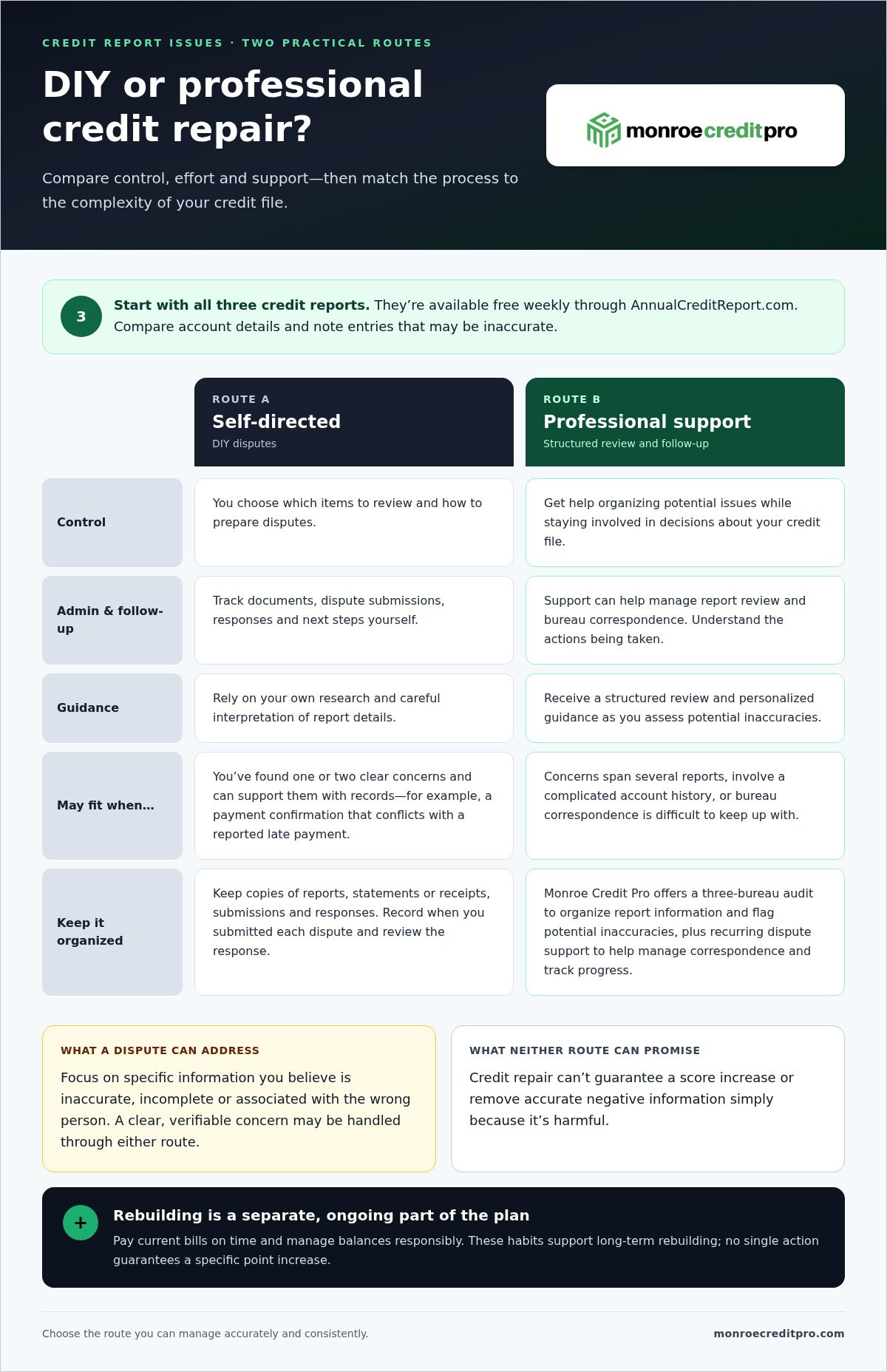
You can request your reports, review the entries, and dispute information you believe is wrong yourself. Professional support adds structured review and help managing correspondence, which can be useful when a file or follow-up is difficult to handle. Neither route can guarantee that accurate information will be removed or that your score will reach a particular result.
Control: DIY gives you direct control over which items to review and how to prepare disputes. With professional support, you get help organizing potential issues while staying involved in decisions about your credit file.
Administrative effort: Self-directed work requires you to track documents, responses, and next steps. Professional assistance can help manage report review and bureau correspondence, though you should still understand the actions being taken.
Guidance: DIY relies on your own research and careful interpretation of report details. Professional support can provide a structured review and personalized guidance as you assess potential inaccuracies.
Issue addressed: Either route may suit a clear, verifiable reporting concern. Professional review can be useful when concerns span multiple reports, involve a complex history, or are difficult to sort through.
The Consumer Financial Protection Bureau also offers guidance on credit habits such as paying bills on time and managing balances. These habits support rebuilding, while a dispute should focus on information you believe is inaccurate.
When a self-directed approach may fit
DIY may be practical if you’ve found one or two clear concerns and can support them with records, such as a payment confirmation that conflicts with a reported late payment. Keep copies of the reports you reviewed, relevant statements or receipts, dispute submissions, and responses. Record when you submitted each dispute and review the response before deciding what to do next.
When structured professional support may help
Several reports, a complicated account history, or difficulty keeping up with bureau correspondence can make the process harder to manage alone. Monroe Credit Pro provides a three-bureau audit to organize report information and flag potential inaccuracies for review. Its recurring dispute support helps manage correspondence and track progress. For more context on this kind of structured work, the article Comprehensive Credit Restoration Services: The 2026 Strategic Guide explores credit restoration in greater depth.
The best way to fix credit is the route you can manage accurately and consistently. If you want help organizing report review and potential disputes, Monroe Credit Pro’s credit report audit and review support provides a structured starting point.
Which Credit-Fixing Approach Fits Your Situation?
Choose your next step based on what the report shows, how complicated the issue is, and how much follow-up you can manage. A possible reporting error calls for a different response than an accurate late payment or collection. Compare the entry with your records and identify a realistic goal: correcting inaccurate details or strengthening credit habits over time.
One clear error with supporting records: Consider a self-directed dispute if you can explain the discrepancy and keep track of the process.
Several possible errors across reports: Organize the entries first. If comparing details and managing follow-up feels burdensome, structured professional review can help.
Accurate late payments or other negative history: Focus on current account habits and a sustainable rebuilding plan, rather than disputing information solely because it is unfavorable.
Unfamiliar account or uncertain details: Check the entry carefully and gather relevant records before deciding whether and how to dispute it.
The right route depends on report accuracy, issue complexity, and your capacity to follow through. You can handle a clear, well-documented concern yourself. A more involved file can benefit from organized review and dispute support.
If you find a possible error or unfamiliar account
Compare the entry across your reports. Check the account name, dates, balance, payment status, and other identifying details. A difference may be worth investigating, but it doesn’t by itself prove an error. Gather relevant statements, payment confirmations, or identity records before taking action. A careful Three-Bureau Credit Report Review: How to Audit Yours in 2026 can help you structure that comparison and identify questions to resolve.
Keep your dispute focused. Identify the specific detail you believe is wrong, explain why, and include supporting documentation when available. Avoid sending unrelated records or disputing entries you recognize as accurate. A clear explanation makes it easier to track what you raised and review the response.
If the negative information appears accurate
If a late payment or other negative entry reflects what happened, disputing it only because it lowers your score isn’t a dependable rebuilding strategy. Instead, protect your current payment record, review balances, and set a manageable routine for staying on top of accounts. Progress comes from consistent choices over time, not from expecting accurate history to disappear.
For a collection account, understand what the report says and gather the related account information before deciding on next steps. The article How to Remove Collections from Your Credit Report: A Practical Guide addresses collection-related questions without treating removal as a guaranteed outcome. The best way to fix credit is to match each concern with an appropriate action, then keep the plan realistic enough to maintain.
A Practical Credit-Fixing Plan: Take These Steps in Order
A manageable plan separates report corrections from habits that support long-term rebuilding. Start with the information in your file, act only on concerns you can explain, and keep a record of each step. The best way to fix credit is a process you can follow consistently, not a rush to dispute every negative entry or try every available tactic.
- Review reports from all three nationwide credit reporting companies. Compare account names, balances, payment statuses, dates, and other details. An entry that differs across reports may deserve a closer look, but a difference alone doesn’t establish that the information is inaccurate.
- Sort concerns by evidence and priority. Separate possible errors from accurate negative history and routine rebuilding goals. Note what appears wrong, why it may be wrong, and which records could help support your understanding.
- Address documented inaccuracies. Keep any dispute focused on specific information you believe is inaccurate. Save copies of relevant supporting documents and the materials you submit so you can compare the response with your original concern.
- Maintain current accounts responsibly. Set a sustainable payment routine and monitor balances. Avoid taking on new credit without a clear reason. There’s no single utilization target or tactic that works identically across every scoring model and credit profile.
- Check progress periodically. Review report updates, note changes, and decide what needs attention next. Reporting schedules and score changes vary, so use your records and report details to guide your next step rather than expecting an exact result by a set date.
Start with reports, priorities, and documentation
Make one secure folder, digital or physical, for report copies, account statements, payment records, dispute submissions, responses, and follow-up dates. A simple tracking note can include the account, the detail you’re reviewing, the date you acted, what you sent, the response received, and your next action. This makes it easier to stay focused, avoid repeating work, and notice when a response needs attention.
Build habits and review progress consistently
Choose payment reminders or a recurring account check that fits your routine. Review balances regularly, but don’t treat a particular percentage as a universal score formula. As you check reports over time, distinguish changes in reported information from score movement. If an item remains unclear or follow-up feels difficult to coordinate, a structured review can help organize your questions and track progress.
For support putting report review, potential inaccuracies, and follow-up into an organized process, explore Monroe Credit Pro’s credit report audit support.
How Monroe Credit Pro Supports a Structured Credit Repair Plan
Once you’ve compared self-directed disputes with professional support and mapped out your next steps, consider which approach will help you stay organized. Monroe Credit Pro reviews credit reports, identifies potential inaccuracies, and manages dispute follow-up. Its support focuses on report accuracy and informed rebuilding, not a promised score increase or automatic removal of negative entries.
What professional support can include
Monroe Credit Pro’s three-bureau credit report audit brings report details together for an organized review. Personalized guidance helps you distinguish entries that may warrant closer attention from information that appears accurate, so potential disputes stay focused and relevant. You remain involved by sharing pertinent records and making informed decisions about your credit file.
- Report analysis: Review information across the three major bureaus and identify potential inaccuracies for further consideration.
- Dispute support: Get help with recurring dispute cycles and bureau correspondence focused on the information under review.
- Progress tracking: Track dispute activity and credit-file updates to understand what has been addressed and what may need attention next.
- Rebuilding guidance: Connect report review with sustainable credit habits, including responsible account management over time.
This structure is useful if reviewing multiple reports, preparing correspondence, or tracking responses feels difficult to manage alone. It doesn’t replace your role in the process. Clear records and accurate information from you help keep the review grounded in the specific details of your file.
Move forward with realistic expectations
Professional support can organize the work, but it can’t make accurate negative information disappear simply because it affects your credit. Disputes should address potential inaccuracies, and no service can guarantee a particular score result. The best way to fix credit depends on your report, your rebuilding priorities, and whether structured guidance and follow-through would make the process more manageable.
To decide whether to handle disputes independently or get help coordinating report review and correspondence, consider how much information is involved and how much time you can devote to tracking it. A structured review can help you understand which entries merit closer attention while keeping longer-term credit habits in view.
For organized assistance with report review, potential inaccuracies, dispute correspondence, and progress tracking, explore Monroe Credit Pro’s credit repair services.
Choose a Next Step You Can Sustain
Credit progress is built through steady attention, not a perfect plan completed all at once. Choose one useful action to begin: set a payment reminder, organize your records, or decide when you’ll review your credit reports again. A small step you can repeat gives you a clearer path forward than trying to change everything at once.
The best way to fix credit is the approach that fits your circumstances and keeps you moving with realistic expectations. If you’d like organized guidance as you work toward your goals, explore structured credit repair support with Monroe Credit Pro.
Start where you are, take the next practical step, and keep building from there.
Frequently Asked Questions
Does checking my own credit report lower my credit score?
No. Checking your own credit report is generally a soft inquiry, which doesn’t lower your score. Some applications for new credit can result in a hard inquiry, which may affect a score. Review reports through an official access route, such as AnnualCreditReport.com. A credit report shows account information, while a score is calculated separately using a scoring model.
Can I fix my credit if I do not have a credit card?
Yes. A credit card isn’t the only way to build a credit history. Scoring models can evaluate the accounts and payment information in your credit file, so first check which accounts are being reported. Consider a new credit product only if it fits your budget and you can manage it responsibly. Opening an account isn’t required for everyone and doesn’t guarantee a score increase.
Will paying a collection account automatically improve my credit score?
No. Paying a collection may address the debt, but it doesn’t guarantee a particular score change or automatic removal of accurate reporting. The result can depend on how the account is reported, the scoring model used, and other details in your file. Before acting, verify the account information and understand the terms. Don’t dispute a valid account solely to try to have it removed.
How long does it take for a credit report dispute to be reviewed?
There isn’t one completion date that applies to every dispute. Review time can depend on the process, the information submitted, and applicable requirements. Keep a copy of what you sent, note when you submitted it, and save each response so you can track follow-up. If you’re addressing several entries or reports, a simple log can help you see what’s pending and what needs attention.
Can a credit repair company remove accurate negative information from my report?
No company can legitimately promise to erase accurate, current information just because it’s negative. Credit repair should focus on potentially inaccurate or unverifiable reporting and lawful rebuilding practices. Be cautious of promises to guarantee deletions or score increases. Before enrolling in a service, understand what work it covers, what your responsibilities are, and how the process will be communicated.
Does paying off a credit card guarantee a higher credit score?
No. Paying down a balance may change the balance reported and could help some credit profiles, but it doesn’t guarantee a specific score result. Scores reflect multiple details, and scoring models can assess a file differently. Keep making payments on time and manage balances in a way that works for your finances. The best way to fix credit isn’t to rely on a promised point increase from one payment.
Ready for a more organized review of your credit reports and potential inaccuracies? Explore Monroe Credit Pro’s credit repair services.