



Marriage doesn’t merge two credit histories, but spouses can make progress together. Repairing credit as a couple means understanding which accounts affect one or both partners, then matching the plan to each person’s credit profile. A joint account can affect both credit files, while an individual account generally remains tied to its owner.
It’s understandable to think one spouse’s credit automatically determines the other’s, especially when you’re planning a major purchase together. The key is to distinguish individual accounts from shared ones. You’ll learn how a spouse’s credit can affect joint borrowing, why different credit profiles call for different strategies, and how a professional credit review can help identify inaccurate information and organize next steps. With a clearer picture of both credit files, you can work toward shared goals without treating your histories as identical.
Key Takeaways
- Marriage doesn’t combine credit histories, so progress starts with understanding each spouse’s individual credit profile.
- Learn which shared accounts can affect both partners and why one spouse’s individual debt usually doesn’t transfer to the other.
- See how professional guidance can help couples avoid unnecessary credit applications while preparing for major borrowing goals.
- Explore how strategies can be tailored to each partner’s credit needs, from correcting report errors to addressing shared balances.
1. Can Married Couples Repair Credit Together?
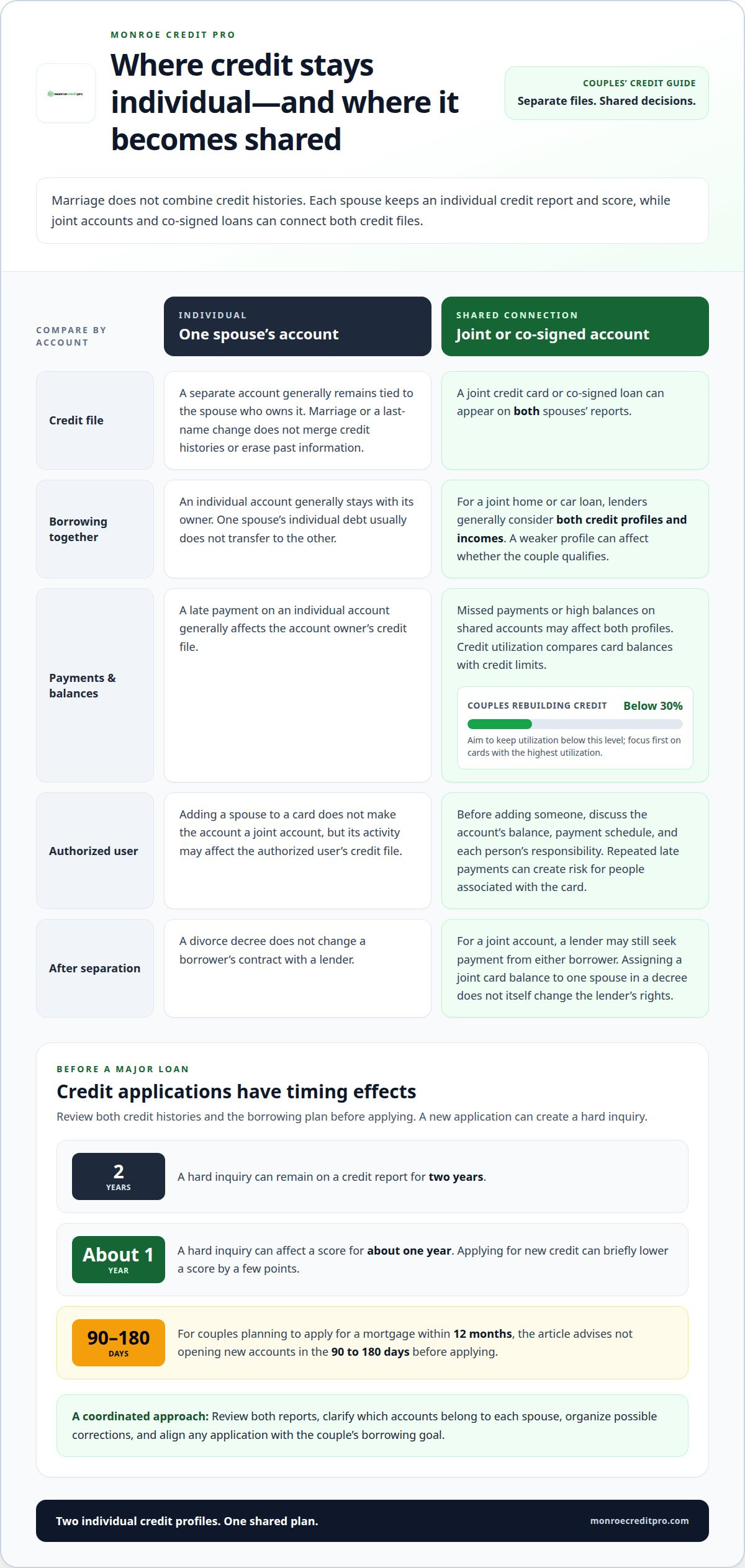
Yes. Spouses can coordinate credit repair, but each partner keeps an individual credit report and score. Marriage doesn’t combine credit histories, and changing a last name doesn’t erase past information. Joint accounts and co-signed loans can appear on both reports, while separate accounts generally remain on the account owner’s file.
Negative information can remain for years. According to the Consumer Financial Protection Bureau, late-payment marks can remain on a United States credit report for 7 years. According to the U.S. Congress, Office of the Law Revision Counsel, a Chapter 7 bankruptcy filing can remain on each filing spouse’s report for 10 years; a Chapter 13 filing can remain for 7 years.
A professional can review both reports, identify possible errors, and help organize disputes involving inaccurate accounts or collections. The Consumer Financial Protection Bureau says the Fair Credit Reporting Act generally requires credit bureaus to investigate disputes within 30 days. Credit monitoring can help partners follow changes to their individual files. A professional can also assess whether eligible bill information may support a credit profile, without assuming every bill is reportable.
Know the protections. The Credit Repair Organizations Act prohibits credit-repair companies from promising guaranteed results, so treat guaranteed score increases as a warning sign. Credit repair costs depend on the case and are given after a quote request; the work involved and the issues reviewed affect the cost. Professional help may be useful when errors or complex collections need organized attention, but no company can guarantee a particular outcome.
Separation doesn’t automatically remove shared obligations. A divorce decree doesn’t change borrowers’ contracts with lenders, so a lender may still seek payment from either borrower on a joint account. For example, assigning a joint card balance to one spouse in the decree doesn’t itself change the lender’s rights under the account.
2. How a spouse’s credit affects the other spouse
A spouse’s credit can shape shared borrowing without merging individual credit histories. When partners apply together for a home or car loan, lenders generally consider both credit profiles and incomes. A weaker profile can affect whether the couple qualifies, even if the other spouse has stronger credit. For example, a lender reviewing a joint application considers both applicants, not just the higher score. Before applying, understand how each partner’s credit history and income may influence the decision.
Shared accounts create a more direct connection. A joint credit card or co-signed loan can appear on both credit reports, so missed payments or high balances may affect both profiles. Credit utilization compares card balances with credit limits. If a shared card has a high balance relative to its limit, both partners’ files may feel the effect. Couples rebuilding credit are advised to keep utilization below 30%, and to focus first on cards with the highest utilization.
Authorized-user status also matters. If one spouse is added to the other’s card, the account activity may affect the authorized user’s credit file. Discuss the account’s balance, payment schedule, and responsibility before making that choice. For instance, repeated late payments on a card can create risk for the people associated with it. Shared access works best when both partners understand how the account is managed.
Keep household planning distinct from individual responsibility. Spouses can coordinate payments and savings goals while maintaining accounts in their own names. That approach preserves each person’s access to funds and supports an individual credit history. Set a regular time to review shared balances, upcoming bills, and account responsibilities together. Clear communication helps prevent one partner from assuming the other has handled a payment. It also lets couples address a rising balance before it becomes a larger obstacle to borrowing. For couples who are also coordinating long-term financial and retirement healthcare decisions, resources such as medicarementors.com provide guidance on navigating Medicare options together.
How a credit repair professional can help couples avoid unnecessary credit applications
Each new credit application can create a hard inquiry, so timing matters. A professional can review both partners’ credit histories and upcoming borrowing plans before either applies. That review helps distinguish applications that serve a clear goal from those that add an inquiry without addressing a current need. For example, opening another credit card may be poorly timed if the couple plans to seek a mortgage soon.
Hard inquiries can remain on a credit report for two years and affect a score for about one year. Applying for new credit can briefly lower a score by a few points. Those effects may be modest, but repeated applications can complicate preparation for a major loan. A professional can help couples consider existing accounts, report errors, and borrowing priorities before deciding whether an application fits their plan.
Mortgage timing calls for particular care. Couples planning to apply within 12 months are advised not to open new accounts in the 90 to 180 days before applying. A credit review can help identify which partner’s profile needs attention and whether an application could create an avoidable inquiry during that period. It can also help organize questions about account activity and late payments before the couple approaches a lender.
Use a structured review rather than applying out of uncertainty. A professional can examine the reports, clarify which accounts belong to each spouse, and help prioritize corrections before new credit is considered. The couple can then align application timing with its borrowing goal, instead of adding accounts without a coordinated reason. A professional review of both credit histories can help bring those details into one clear plan.
How a credit repair professional develops strategies for couples with different credit profiles
A shared goal doesn’t mean identical credit plans. A professional reviews each credit file separately, then identifies which factors shape each partner’s profile. One spouse may need help disputing inaccurate entries, while the other may need a plan for high card balances. This distinction keeps the stronger partner’s foundation intact while directing attention to the issues affecting the weaker profile. It also helps couples understand which accounts appear on both reports and which belong to one person.
Next, the professional can organize priorities around the couple’s borrowing goal. If a mortgage application is planned, the weaker spouse’s credit may need focused attention before applying jointly. The recommended period for repairing that profile before a joint mortgage application is 6 to 18 months. During that time, the professional can help address report errors and review the accounts most relevant to the applicant’s profile. The stronger spouse can avoid unnecessary changes that might disrupt an established credit history.
Shared accounts need a coordinated plan. Missed payments or high balances on a shared credit card can harm both account holders’ profiles. When partners co-sign, the guidance recommends paying the card balance in full every month. A professional can help the couple identify which shared obligations need close attention while keeping separate-account issues distinct. This allows each spouse to understand their responsibility without assuming one plan fits both credit files.
Build in a review cycle. A credit audit once a quarter can help couples track corrections, account changes, and balances against their shared goal. For example, a professional can reassess whether a disputed item was corrected and whether the next priority should shift to a shared account or one spouse’s individual file. The takeaway is simple: coordinate the destination, but tailor the steps to each profile. Request a tailored credit strategy for both partners.
Monroe Credit Pro: Professional Credit Repair
Monroe Credit Pro provides Professional Credit Repair for couples who need help addressing credit-report concerns and organizing next steps. When spouses have different credit profiles, a coordinated review can clarify which issues affect each person and where Credit Correction or Credit Counseling may fit. Credit Restoration can support a broader effort to rebuild credit while keeping each partner’s circumstances in view.
Consider professional support when inaccurate information, collections, or differing account histories make it difficult to decide what to address first. A clear understanding of both profiles can help couples approach shared financial goals with an organized plan, without assuming one strategy fits both spouses.
Contact Monroe Credit Pro to discuss professional credit repair for your situation.
Build a Clear Path Toward Shared Goals
Choose a next step that gives both partners a role in the process. Agree on the financial goal you’re working toward, identify the questions each of you wants answered, and ground decisions in your separate credit situations. That shared approach can make repairing credit as a couple more organized without expecting both credit profiles to change in the same way. If your household’s broader financial goals also extend to asset building and wealth preservation, guidance from Tax Partners can help clarify the tax implications of different investments.
Professional guidance can help turn uncertainty into a structured plan. Monroe Credit Pro begins with a free initial consultation, followed by a three-bureau audit and dispute strategy. A focused conversation can clarify which concerns need attention and how each partner’s priorities fit the household’s broader plans. Progress comes from informed decisions and consistent follow-through, not pressure to move faster than your circumstances allow.
Contact Monroe Credit Pro to discuss a practical next step for your credit goals. Move forward together, with a plan that respects both partners’ starting points.
Frequently Asked Questions
Can Married Couples Repair Credit Together?
Yes. Spouses can coordinate credit repair while keeping responsibility for individual accounts clear. Repairing credit as a couple can mean agreeing on shared financial goals while addressing an error on only one partner’s file. A professional can help organize issues by account owner and household priorities, so joint planning doesn’t mean treating both credit situations as identical.
Can you even merge your credit scores?
No. Credit scores remain individual, even when spouses share finances or apply for credit together. A lender may review both partners’ scores during a joint application, but it doesn’t combine them into one score. For example, a couple may have different scores because their reports show different accounts, payment records, or balances. Each person’s profile continues to be evaluated separately.
How does your spouse’s credit affect yours?
Your spouse’s credit history generally affects your profile through accounts you share or co-sign, not simply through marriage. If you both hold a card, its payment history and balance can affect both reports. By contrast, a spouse’s separate account usually stays on that person’s file. Before taking on shared credit, understand who is named on the account and who is responsible for repayment.
How can a credit repair professional help couples choose between separate or joint accounts to build credit?
A professional can review each partner’s credit profile and explain how a proposed account may affect both people. For couples repairing credit as a couple, the review can clarify whether shared access fits their circumstances. For example, if one spouse has established credit and the other has limited history, consider the account’s balance and payment record before adding the second person. The couple can decide based on its financial boundaries.
What If One Spouse Has Been Hiding Credit Problems?
Start with a calm, specific conversation about the household’s financial goals and outstanding obligations. Ask to review statements and credit reports together, then separate verified account details from assumptions. If trust or communication is difficult, a credit counselor can help structure a discussion around balances, payment responsibilities, and next steps. Focus on creating an accurate shared picture, not assigning blame for past problems.
How can a credit repair professional help couples check and compare their credit reports and scores?
A professional can review both partners’ reports, compare how accounts and balances appear, and identify differences that may need follow-up. Monroe Credit Pro’s process begins with a free initial consultation, followed by a three-bureau audit and dispute strategy. Each partner can provide their reports for review. The comparison helps distinguish individual issues from shared-account concerns and directs attention to information that may be inaccurate.