



A credit score is a financial fact, not a measure of your worth as a partner. Explaining bad credit to a partner starts with honesty: describe what led to the situation, share what you’re doing about it, and invite a practical conversation about next steps. In the United States, spouses keep individual credit scores after marriage, so one partner’s score doesn’t become the other’s.
It’s understandable to worry about judgment, trust, or what a low score could mean for shared plans. Address those concerns without assigning blame: focus on the facts, listen to each other’s questions, and agree on what you’ll handle together.
This article will help you prepare for the discussion, review credit histories and household finances together, and set shared goals with regular check-ins. You’ll also learn how to identify the source of a credit challenge and when credit counseling or a credit report audit may help you make a clearer plan.
Key Takeaways
- Choose a shared financial goal and schedule regular check-ins to notice progress and raise concerns before they build.
- Replace blame with curiosity: understanding the source of money fears can make a difficult conversation feel more constructive.
- Prepare a clear account of what happened, what remains to address, and the next step you’re ready to take together.
- Review credit histories and household records side by side; the Federal Trade Commission says each person is entitled to a free credit report from each major bureau once every 12 months.
1. Setting shared financial goals and regular check-ins
Start with a shared priority, such as preparing for a future home application or reducing stress around household bills. Break it into actions each partner can influence. One person might track payment dates while the other organizes the monthly budget. Agree on what progress looks like and write the plan somewhere both partners can review.
Should couples keep finances separate if one partner has bad credit? They can maintain individual accounts while agreeing on shared goals and responsibilities. Marriage does not combine spouses’ credit histories, so discuss how each person will manage individual debts and any joint expenses.
Schedule regular check-ins instead of waiting for a missed payment or a new financial worry. Choose a time that suits both partners, bring the same records, and discuss what has changed since the last conversation. If one partner feels overwhelmed, narrow the discussion to one issue, such as payment timing or a disputed account.
How can I make a realistic plan to improve bad credit? First identify the cause, such as missed payments, high balances, or limited credit history, then choose an action that addresses it. If payments were missed, for example, decide how to track upcoming due dates. Set a manageable goal, assign responsibility, and review progress at each check-in.
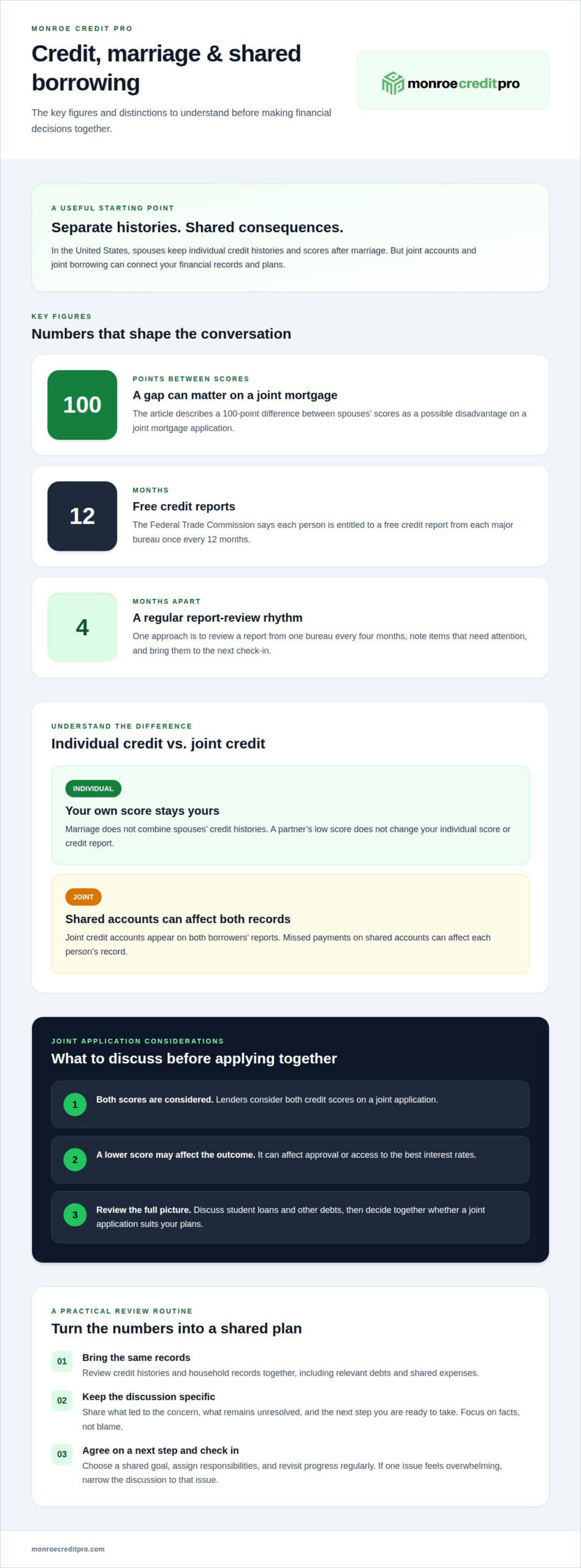
Credit reports can help couples track changes to the information behind a score. One approach is to review a report from one bureau every four months, creating a regular opportunity to check for updates. Record the date and any item that needs attention, then bring it to the next check-in. Keep the conversation focused on decisions, not blame.
At each meeting, confirm the next step and who will take it. If a goal no longer fits the household budget, revise it together instead of treating the change as failure. A written plan makes explaining bad credit to a partner part of an ongoing, practical conversation rather than a single high-pressure disclosure.
2. Fear, shame, and cultural barriers to discussing money
Fear can make a credit conversation feel like a test of trust. You may worry your partner will judge past choices, question shared plans, or expect an immediate solution. Separate facts from predictions before talking. Write down what happened, what remains unresolved, and what you’re ready to discuss. Preparing this way can prevent one difficult account from becoming a judgment about your entire relationship.
Shame can grow when someone treats debt as a personal failure rather than a financial situation. Replace labels such as “irresponsible” with specific language: “I missed payments after my income changed, and I want to explain the next steps.” This accepts responsibility without reducing a person to a score. If the conversation becomes tense, pause and agree on when to continue rather than forcing a decision during an argument.
Family and cultural expectations can shape what feels private, respectful, or appropriate to share. One partner may have grown up discussing household spending openly, while another learned to keep debt confidential. Neither experience has to dictate the couple’s approach. Ask what money conversations looked like in each household, then agree which details affect shared decisions. For instance, an individual balance matters to a joint budget if it changes available income.
Start calmly and make a clear request. Try: “I feel anxious discussing my credit, but I want us to make decisions with the same information. Can we talk through the situation without interrupting?” Then listen for the concern beneath your partner’s first response. They may be worried about rent, a future mortgage, or whether bills will be paid. Repeat the concern in your own words before answering. If either person feels overwhelmed, set a specific time to resume and choose one topic to address first. A respectful conversation leaves room for accountability and questions while keeping blame out of the plan.
3. Having an open and honest conversation about credit
Choose a calm time to talk before making a shared financial commitment, such as applying for a mortgage or opening a joint account. Share your credit concern, relevant debts, what led to them, and what you’re doing next. Explaining bad credit to a partner is easier when you share the facts before an application raises questions.
Joint borrowing can connect both partners’ finances. Lenders consider both credit scores on a joint application, and a lower score can affect approval or access to the best interest rates. A 100-point difference between spouses’ scores may make a joint mortgage application a disadvantage. Discuss student loans and other debts, then decide together whether a joint application suits your plans.
A partner’s low score doesn’t change your individual credit score or report. Married people in the United States keep separate credit histories. However, joint credit accounts appear on both borrowers’ reports, so missed payments on shared accounts can affect each person’s record.
Keep debt discussions specific and nonjudgmental. Replace “You were careless” with “This account has missed payments; what circumstances led to that?” Share the relevant balance, payment status, and context, then ask what support would help. Agree on one next step, such as listing debts or reviewing the account together, instead of demanding an immediate solution.
If your partner reacts badly, pause instead of escalating the discussion. Say you’re willing to continue when both of you can speak respectfully, and set a clear time to revisit the facts. If communication continually breaks down, professional dispute resolution services such as Conflict Manager can help couples navigate sensitive disagreements constructively. If they need space, give it while clarifying any shared financial decisions that cannot wait. Keep your own account information available, and avoid agreeing to co-sign or take on debt under pressure. Return to the conversation with one concrete question and a practical proposal.
4. Reviewing credit histories, bank statements, and bills together
Set aside an hour to examine records side by side. According to the Federal Trade Commission, each person in the United States is entitled to a free credit report from each major credit bureau once every 12 months. Compare report entries with bank statements and bills, noting unfamiliar accounts, missed payments, and balances that need explanation.
Keep the review organized. Start with each person’s credit history, then compare recurring bills with bank transactions. If a utility payment appears overdue, check the bill date and matching bank statement before concluding it was missed. Record questions separately from confirmed errors. This helps prevent a confusing entry from becoming an accusation.
The reporting period for a negative credit report entry depends on the type of information and its circumstances. Identify the specific entry and its date before drawing conclusions. If a report contains inaccurate information, note the bureau and item, then submit a dispute to the credit bureau.
Explain the cause concisely: what happened, how it affected payments, and what has changed since. For example, describe how a period of reduced income led to late bills, whether those bills remain unpaid, and what steps you’re taking now. Distinguish a difficult period from an ongoing issue. Your partner needs enough context to understand the financial picture, not a defense of every past decision.
End by agreeing on who will handle each next step. One partner might gather a missing bill while the other records a report error for follow-up. Keep relevant statements and correspondence together so the next discussion can focus on updates rather than searching for documents.
For a more structured assessment of report entries, get help reviewing your credit report.
A shared review can clarify what a joint application may involve. When spouses apply for a loan together, lenders consider both credit scores. A poor score can affect the application, including by preventing the couple from qualifying for the best interest rates or leading to denial. When partners apply jointly for a home, both must submit financial information for consideration.
Before helping a partner rebuild credit, identify whether a low score stems from having no credit history or from missed bill payments. Keep checking reports for accuracy and signs of fraud, and dispute errors with the credit bureaus.
Monroe Credit Pro
Monroe Credit Pro can help you turn credit concerns into a clearer, practical plan. If you and your partner need help understanding report issues or deciding what to address first, Credit Counseling can support your next steps. Credit Restoration, Professional Credit Repair, and Credit Correction provide focused support for credit challenges. These services may help when reviewing your records leaves questions unanswered or you want structured guidance before setting shared financial goals. Discuss the situation openly, then schedule a free credit consultation to decide whether professional support fits your needs.
Contact Monroe Credit Pro to discuss a path forward.
Build trust through the next step
Trust grows through what happens after a difficult disclosure: whether both people can speak honestly, make choices with shared understanding, and revisit plans as circumstances change. You don’t have to resolve every financial concern in one conversation. A steady, respectful approach gives both partners room to decide without turning past credit trouble into a permanent label.
Explaining bad credit to a partner can create greater clarity, but progress depends on what happens next. Focus on one decision you can make together, and keep each person’s responsibilities clear. Move at a pace that keeps the conversation respectful and grounded in choices you both understand.
If you want guidance assessing credit concerns and considering a practical way forward, contact Monroe Credit Pro. One honest step can make the next conversation easier to begin.
Frequently Asked Questions
How should I tell my partner I have bad credit?
Tell your partner plainly, and connect the credit issue to the decision it could affect. If you’re planning to rent together, for example, explain what you know about your credit and what questions remain. Don’t minimize the issue or promise a specific score. Give your partner time to respond, then agree on what information to discuss next.
How can I check my credit reports and scores before talking to my partner?
Review your credit reports and scores separately: a report shows account details, while a score summarizes credit information using a scoring model. Note the source and date for each score, along with any accounts or payment details you want to explain. If the report and score seem inconsistent, focus on the underlying account information rather than treating one number as the whole picture.