



An accurate late payment generally can’t be removed, but a payment reported in error can be disputed. In the United States, creditors don’t report an account as late to credit bureaus until it’s 30 days past due. If you need to dispute wrongful late payments, the key is to establish what was actually due and when, especially if your account was in forbearance or deferment.
A late mark can feel final, especially when your records tell a different story. Account statements, payment confirmations, and written notices about a hardship arrangement can help show whether the reported history matches your account terms.
Learn how a credit repair professional compares credit reports with your records, organizes supporting evidence, submits a focused dispute, and tracks the results. You’ll also see how to assess a late payment reported during forbearance or deferment, and what options may remain if the information is accurate.
Key Takeaways
- Match the reported payment dates and status against statements, payment confirmations, and account terms to identify specific discrepancies.
- For a dispute involving forbearance or deferment, organize the agreement and related communications to show which payment terms applied.
- Submit a clear explanation with relevant supporting documents, then track the investigation and review the results for any needed follow-up.
- Check reports from Equifax, Experian, and TransUnion because a late payment may appear differently across bureaus.
How a professional compares reported payment history with personal records
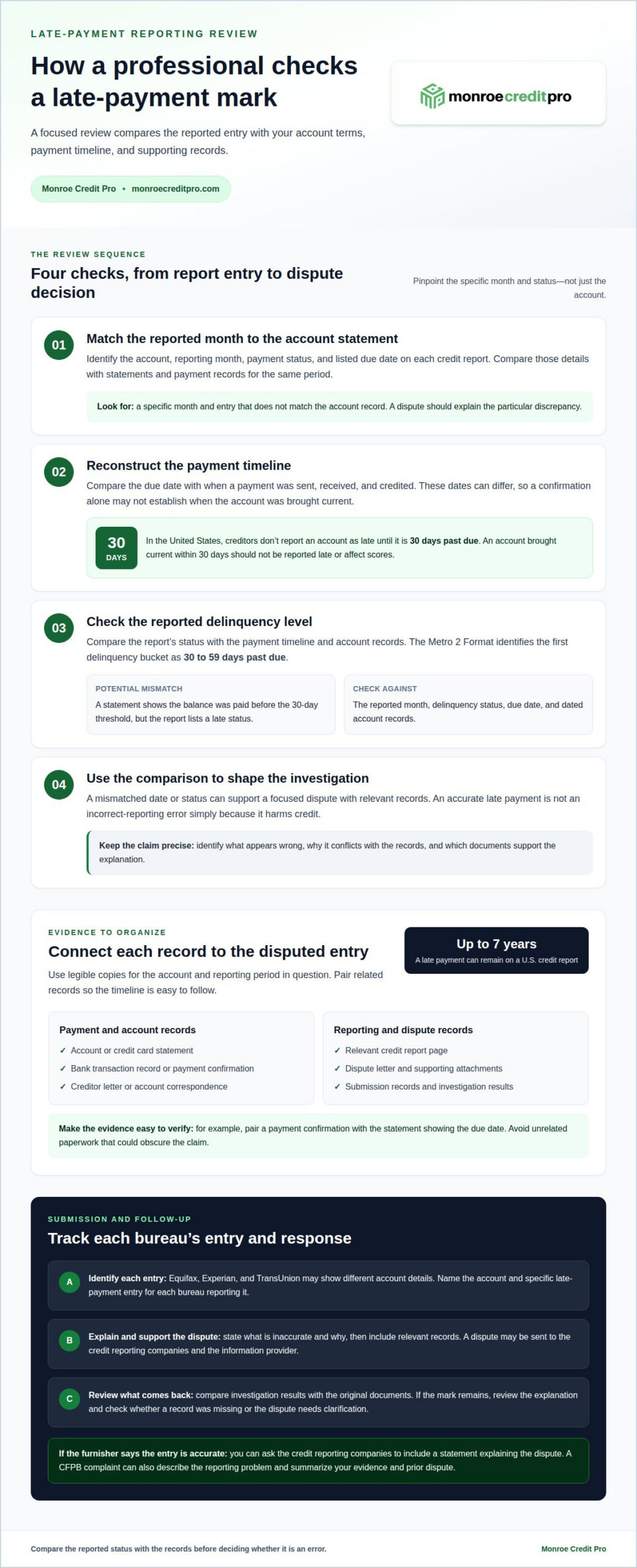
A late payment can remain on a U.S. credit report for up to seven years from the missed payment date, according to United States Congress. A reported late mark can affect credit scores, while an account brought current within 30 days should not be reported late or affect scores.
- Match the reported month to the account statement. A professional identifies the account, reporting month, payment status, and listed due date on each credit report. Then they compare those details with statements and payment records for the same period. To dispute wrongful late payments, the review must pinpoint the specific month and entry, not challenge an entire account without explanation.
- Reconstruct the payment timeline. The professional compares the due date with the date a payment was sent, received, and credited. These dates can differ, so a confirmation alone may not establish when the account was brought current. In the United States, creditors do not report an account as late until it is 30 days past due. A payment credited within that period should not be reported as late.
- Check the reported delinquency level. The Consumer Data Industry Association’s Metro 2 Format identifies the first delinquency bucket as 30 to 59 days past due. A professional checks whether the report’s status matches the timeline and account records. To dispute wrongful late payments accurately, they can use a statement showing the balance was paid before the 30-day threshold to identify a specific reporting discrepancy.
- Use the comparison to shape the investigation. A late payment that was accurate is not an incorrect-reporting error simply because it harms credit. But a mismatched date or status can support a focused dispute with relevant records. Inaccurate reporting may affect credit decisions and scores while it remains. A detailed dispute also helps identify what the investigation must address, rather than challenging an entire account without explaining the disputed entry.
Evidence a professional may need to support a dispute
A professional can submit a focused dispute to Equifax, Experian, and TransUnion, identifying the account and specific late-payment entry. Useful evidence includes statements, payment confirmations, and account correspondence. The dispute should explain what appears incorrect, why it is wrong, and which documents support your claim.
-
Gather Payment and Reporting Evidence
Provide records for the account and reporting period in question. A credit card statement, bank transaction record, payment confirmation, or creditor letter can help establish the amount, due date, and date the payment was received. Include the relevant credit report page so the disputed account and late-payment notation are clear.
Keep copies legible and connect each record to the specific claim. For example, pair a payment confirmation with the statement showing the due date. Avoid sending unrelated paperwork that could obscure the evidence.
-
Add a Dispute Statement or CFPB Complaint
Ask the professional to explain which information is inaccurate and why, then include copies of supporting evidence. A concise letter might identify the account, the month reported late, and a payment record that conflicts with that status. The professional can send the dispute to the credit reporting companies and the information provider.
If the furnisher says the entry is accurate, you can ask the credit reporting companies to include a statement explaining the dispute. A CFPB complaint can also describe the reporting problem and summarize your evidence and prior dispute. Keep the complaint factual and consistent with your records.
-
Organize the Submission and Track the Response
Have the professional keep a copy of the letter, attachments, and submission records for each bureau. Equifax, Experian, and TransUnion may show different account details, so identify each disputed entry separately rather than relying on one general claim.
After the investigation, compare the results with the original documents. If the late mark remains, review the explanation and identify whether a record was missing or the dispute needs clarification. Credit correction support can help organize this process.
Late-payment errors during forbearance or deferment
- Establish when the arrangement took effect. A professional reviews the original forbearance or deferment approval, including its effective date and covered account. The key question is whether the reported missed payment falls within the period described in the agreement. For example, if the arrangement began after the payment became overdue, it may not explain an earlier late mark.
- Compare the agreement with the reported status. The review checks what the account terms required during each disputed month, including whether a payment was paused, reduced, or still due. A late mark for a month covered by an approved pause may indicate a mismatch. The professional identifies the specific bureau entry and explains how it conflicts with the documented terms.
- Collect confirmation and account records. Useful evidence may include the approval notice, later changes to the arrangement, payment receipts, account statements, and messages from the creditor. A confirmation should connect the arrangement to the account and relevant period. If a payment remained due, its date and amount help distinguish an accurate late entry from a reporting error.
- Submit a precise dispute and assess the outcome. A professional can send the dispute to the bureau reporting the error and to the company that supplied the information. The explanation should identify the account, disputed month, and relevant arrangement terms. TransUnion, for example, may show a different status from another bureau, so each entry needs its own review. An accurate late payment is not an inaccurate entry simply because forbearance or deferment was requested.
- Match the investigation result to the evidence. After the investigation, compare the response with the original approval and account records. If the entry remains, check whether the response addresses the arrangement’s effective date and the disputed month. This keeps the next step focused: clarify missing evidence or challenge a specific inconsistency, rather than disputing every account detail.
How can a credit repair professional check which credit bureaus are reporting a late payment?
Review the credit reports from Equifax, Experian, and TransUnion separately. Comparing each bureau’s entry shows where the late payment appears and whether the details differ.
- Collect reports from all three bureaus. The professional reviews reports covering Equifax, Experian, and TransUnion, rather than assuming one report reflects all three. Consumers can access free weekly credit reports. AnnualCreditReport.com also provides a free report from each of the three major credit reporting agencies every twelve months. Reports from each bureau establish a clear starting point for the review.
- Locate each late-payment entry. For every report, the professional notes the creditor, account identifier, payment month, status, and reporting date. One bureau may show a late payment while another does not, or the same account may display different statuses. Recording each entry separately prevents a dispute from overlooking a bureau-specific discrepancy.
- Compare the entries with account records. The professional matches the reported month and status against statements, payment confirmations, and relevant account correspondence. For example, a report showing a missed payment for one month can be compared with the payment history for that same month. This comparison helps identify which bureau’s entry conflicts with the available records.
- Prepare bureau-specific disputes and track results. The professional identifies the exact information disputed with each reporting company and includes evidence relevant to that entry. A dispute sent to one bureau does not establish that the others received or corrected the same information. The professional records each submission and reviews every investigation result against the original reports and supporting documents.
Get help reviewing your credit reports to identify bureau-specific errors and organize supporting evidence.
Monroe Credit Pro
Monroe Credit Pro can help when a late payment appears inconsistent with your account records, including records related to forbearance or deferment. Professional Credit Repair and Credit Correction can include reviewing reported information, organizing relevant evidence, and supporting a clear dispute. Credit Counseling can also help you understand the reporting issue and consider practical next steps.
Bring the credit report entry and records related to the account, such as statements, payment confirmations, or arrangement notices. These materials help establish what information is being challenged and why. If you want professional guidance with a disputed late payment, contact Monroe Credit Pro.
Move Forward With a Clear Credit Record
A disputed entry is a reason to take a deliberate approach to your credit records. Focus on accuracy, keep supporting documents organized, and make sure each next step responds to the information in your reports. A careful process to dispute wrongful late payments can help address errors without confusing them with accurate account history.
For professional guidance, Monroe Credit Pro offers Credit Restoration, Professional Credit Repair, and Credit Correction. These services support a structured review of credit concerns and help you consider how to proceed with a disputed payment entry. The right next step depends on your records and the reporting issue, so bring the relevant account documents to your consultation.
Contact Monroe Credit Pro to discuss support with your credit reporting concerns. Take the next step with care and keep building toward stronger financial stability.
Frequently Asked Questions
Can You Remove Accurate Late Payments?
An accurately reported late payment generally can’t be removed through an accuracy dispute. Disputes address incorrect information, such as a payment recorded late despite being credited on time. If the late mark is accurate and your account is now current after extenuating circumstances, you can ask the creditor to consider removing it as a goodwill gesture. That request seeks discretion, not correction of an error.
Should I send a goodwill letter or a dispute?
Send a dispute when you believe the reported payment history is factually wrong. For example, a payment confirmation may contradict a late status for that month. Use a goodwill letter when the late payment was accurate, your account is now current, and extenuating circumstances contributed to the missed payment. A goodwill request asks the creditor to consider removing the mark; it doesn’t claim the reporting was inaccurate.
What if the late payment was reported during a forbearance or deferment?
Review whether the arrangement applied to the account and covered the month reported late. If its terms paused or changed the payment due, an entry showing a missed payment may conflict with the agreement. To dispute wrongful late payments in this situation, identify the arrangement’s effective date and explain how its terms relate to the reported month.
What qualifies as an inaccurate or wrongful late payment on a credit report?
An entry may be inaccurate if it assigns a late status to the wrong month, shows a payment as missed when it was credited, or reports an account that isn’t yours. To dispute wrongful late payments, connect the specific error to the account’s actual history. Credit repair is protected under the Fair Credit Reporting Act, and disputes address inaccurate, outdated, or unverifiable information.
How long do credit bureaus and creditors have to investigate a late-payment dispute under the Fair Credit Reporting Act?
Credit reporting companies generally have 30 days to investigate a dispute. A creditor’s investigation may take up to 30 days under the Fair Credit Reporting Act, according to United States Congress. If you send additional information after the initial dispute, a bureau may have up to 45 days to complete a reinvestigation. Keep submission records to track responses for each dispute.
Can I sue or seek damages for a creditor’s or credit bureau’s failure to correct a wrongful late payment?
You may have an FCRA claim if you directly disputed the inaccurate information with a credit reporting agency, the error was not resolved, and it caused financial harm; disputing only with the creditor is not sufficient for an FCRA claim. A negligent violation may allow actual damages, while a willful violation may allow statutory damages of $100 to $1,000 and punitive damages. Similarly, for those dealing with unresolved financial or commercial disputes under UK jurisdiction, North East Barristers Chambers offers direct access legal representation to help navigate formal claims.