



A credit score can affect access to financial opportunities, but it does not measure a person’s worth. The relationship between credit score and social status is real: a score reflects credit information, not someone’s character, income, or full financial circumstances. It can influence how lenders and other decision-makers assess applications, while the data used in credit scoring can reflect broader inequalities.
It’s understandable to see a score as a personal judgment when it affects access to resources. But understanding what goes into a score can help separate its practical effects from the identity people attach to it. This article explains how credit rankings can influence behavior, opportunities, and perceptions; how racial disparities in credit access and scoring arise; and how social networks may affect financial standing. You’ll also see where credit scores differ from broader social rankings, and why a score should be understood as one limited measure, not a complete account of a person’s circumstances.
Key Takeaways
- Understand what credit rankings measure, and separate a score’s practical effects from your personal worth.
- See how unequal access to credit and other structural conditions contribute to racial disparities in scoring.
- Recognize how rankings can shape access to housing and financial resources, while remaining only one part of a broader decision.
- Learn how social networks influence financial opportunity and when credit counseling or report correction may help address concerns.
Effects of rankings on behavior and identity
A credit score is a lending risk measure, not a complete profile of financial responsibility. Scores are designed to predict whether a borrower will become 90 days late on a credit obligation. That narrow purpose can blur when lenders, landlords, or consumers treat a ranking as a judgment of character. The connection between credit score and social status can shape how people see themselves, even though a score cannot determine a person’s worth.
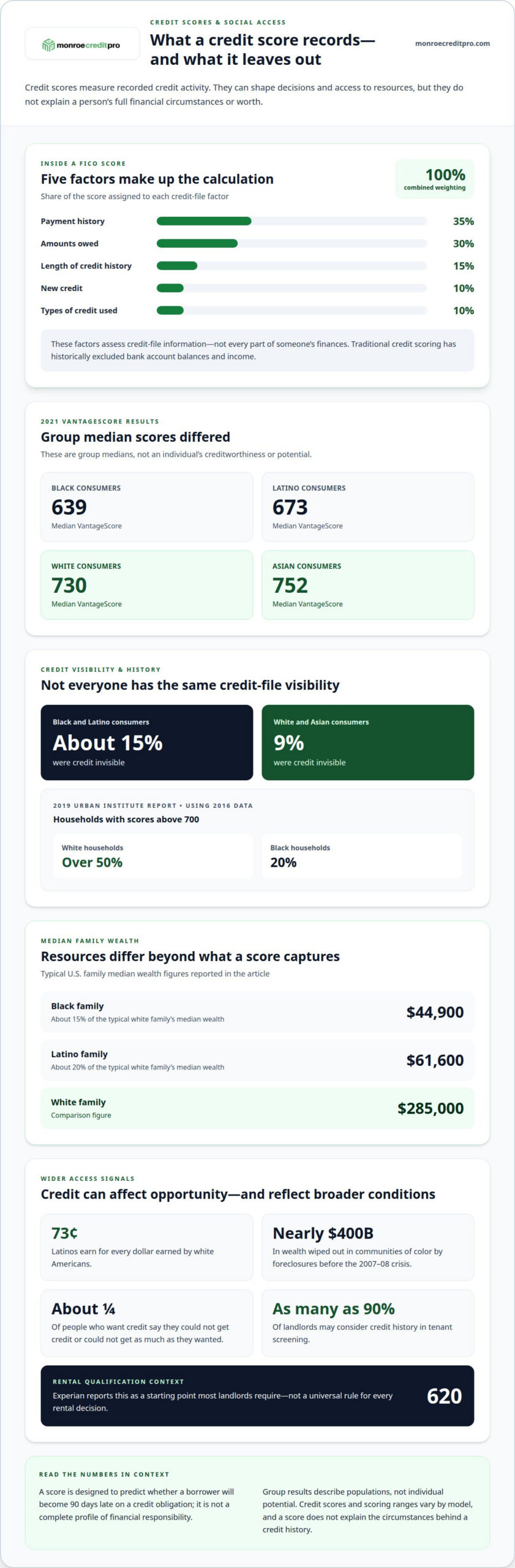
FICO’s calculation gives payment history the largest share, at 35%. Amounts owed account for 30%, while length of credit history accounts for 15%. New credit and types of credit used each contribute 10%. These algorithms assess credit-file information, not every part of someone’s finances. Traditional credit scoring has historically excluded bank account balances and income. A person with steady earnings but limited borrowing history may therefore appear different on a score than their broader finances suggest.
Rankings can also influence behavior. People may monitor balances closely or avoid applying for credit because they worry about changing a score. Consumers in top credit-score ranges typically use less than 5% of available credit limits. That pattern describes credit use, not a requirement or a measure of virtue. Carrying a card balance is not necessary to demonstrate responsibility; the score reflects recorded credit behavior rather than personal sacrifice.
The risks of using credit scores to judge financial responsibility or social worth include mistaking a limited record for a person’s full circumstances. That can reinforce shame, encourage unnecessary borrowing choices, or cause decision-makers to overlook relevant context. Treat a score as one financial indicator, not a moral ranking. For a clearer picture, consumers can request one copy of their credit report from each of the three major credit bureaus every year, according to the Consumer Financial Protection Bureau. Reviewing those records can help identify what information contributes to a ranking and whether it reflects the consumer’s credit history accurately.
Racial disparities in U.S. credit scores
Credit scoring differences reflect more than individual payment choices. In 2021, median VantageScore results were 639 for Black consumers, 673 for Latino consumers, 730 for white consumers, and 752 for Asian consumers. These figures describe group medians, not an individual’s creditworthiness or potential.
Credit visibility also differs. About 15% of Black and Latino consumers were credit invisible, compared with 9% of white and Asian consumers. Without enough information in a credit file, scoring models may be unable to generate a score. That can make it harder to demonstrate credit history through conventional records, even when someone manages other financial obligations responsibly.
A 2019 Urban Institute report using 2016 data found that over 50% of white households had scores above 700, compared with 20% of Black households. The gap is consistent with broader differences in access to credit and financial resources. A credit score reflects recorded credit activity; it does not explain why consumers have different opportunities to build that history.
Landlords may consider credit history in tenant screening, and as many as 90% do. Whether a landlord or employer may obtain or use a report depends on the screening context and applicable law. Credit scoring ranges also vary by model, so there is no single set of numeric cutoffs that defines poor, fair, good, and excellent across every U.S. score.
U.S. scoring models weigh credit-file factors such as payment history, amounts owed, history length, new credit, and credit types. FICO assigns 35% to payment history, 30% to amounts owed, 15% to history length, and 10% each to new credit and credit types. Consumers can dispute information they believe is inaccurate by identifying the specific entry and providing relevant supporting details.
For a focused review of possible report inaccuracies, use a structured credit report review to clarify which entries may need attention.
Social ranking and access to resources
Credit scores don’t directly determine a person’s social class or status. They can affect access to resources when lenders or landlords consider credit history in their decisions. For example, credit information may affect a rental application, even though a person’s broader income, assets, and circumstances aren’t captured in the score itself.
Wealth gaps show why access cannot be reduced to individual payment behavior. The typical Black family in the United States had median wealth of $44,900, about 15% of the typical white family’s $285,000. The typical Latino family had median wealth of $61,600, about 20% of the typical white family’s $285,000. Differences in available resources can affect how people manage financial shocks and build credit histories.
Income disparities also shape financial flexibility. Latinos earn 73 cents for every dollar earned by white Americans. Foreclosures before the 2007-08 crisis wiped out nearly $400 billion of wealth in communities of color. These conditions can limit savings and increase the difficulty of absorbing missed work, unexpected bills, or housing costs. A credit ranking may record payment outcomes without capturing the circumstances behind them.
Access to credit can then influence access to other opportunities. About a quarter of people who want credit say they couldn’t get credit or couldn’t get as much as they wanted. Experian reports that 620 is the starting point most landlords require for apartment qualification. That figure is a reported starting point, not a universal rule for every rental decision.
Social media can intensify perceptions of status by displaying purchases without showing debts, savings, or payment obligations. A vacation photo, for instance, doesn’t reveal whether the trip was paid for in cash or financed. Treat online displays and credit scores as incomplete signals, not reliable measures of someone’s overall financial position. Distinguishing visible status from documented credit information helps show how access to resources and social perceptions can interact without being the same thing.
Traditional financial credit and social networks
A traditional scoring system evaluates information in a consumer’s credit file. It doesn’t represent every resource, relationship, or financial obligation a person has. For example, a relative might help someone manage an unexpected expense, but that support does not automatically appear in a credit record.
Social networks can still affect financial access through shared knowledge, referrals, and practical support. A family member might explain how to compare loan terms, while a trusted friend could share budgeting strategies. These connections can help people make informed choices, but they don’t replace the payment history and account information used in conventional credit scoring.
Some everyday payments may not appear in standard credit files. Rent and utility payments aren’t systematically reported to credit bureaus, although delinquent or unpaid bills may show up as negative information. As a result, someone may pay rent consistently without building the same documented history as a person whose payments are regularly reported.
A lender’s assessment of credit risk can affect interest rates and borrowing costs. A score may inform that assessment, along with factors such as the loan type and application details. The score alone doesn’t set a universal rate. Carrying a credit card balance doesn’t help your score, so borrowing just to create activity can add costs without improving it.
Credit reporting also operates at a broad scale. Agencies collect lending and payment data on 220 million Americans, and consumers cannot opt out of the reporting system or select a competing reporting company. If your concern is whether credit-file information is accurate, a credit report audit can help organize a review of the recorded details. Request an audit when you want a structured assessment of information that may affect how lenders view your credit profile.
The U.S. House Committee on Financial Services held a hearing titled “Bringing Consumer Protection Back: A Semi-Annual Review of the Consumer Financial Protection Bureau” on October 27, 2021.
Monroe Credit Pro
Monroe Credit Pro helps people address credit-report concerns without treating a score as a measure of personal worth. If you believe your report contains inaccurate information, the Credit Report Audit and Credit Correction services can help review it and identify items to dispute. Credit Counseling can clarify how credit factors relate to your financial goals, while Credit Restoration and Professional Credit Repair offer structured support for addressing credit-report inaccuracies.
Consider these services if your report is confusing, an entry appears inaccurate, or you want structured guidance on your credit profile. The aim is to understand the information and identify appropriate next steps, not to promise a particular score or outcome.
Contact Monroe Credit Pro to discuss your credit concerns.
Choose a Clear Next Step
The connection between credit score and social status can feel personal, but your next steps can stay practical. Start by understanding the information in your credit profile and choosing a response that fits your circumstances. A clear review can help turn uncertainty into an organized plan without treating a ranking as a verdict on your identity.
Monroe Credit Pro offers Credit Restoration, Professional Credit Repair, and Credit Correction for people seeking help with credit concerns. A useful starting point is the issue you want to address, such as understanding your report or disputing inaccurate information. The process begins with a free credit consultation, followed by a three-bureau audit and a dispute strategy.
Contact Monroe Credit Pro to discuss a practical next step. Your financial history is part of your story, not the measure of your potential.
Frequently Asked Questions
How do credit scores affect access to housing, jobs, loans, and utilities?
Credit information can influence housing and loan decisions, but it doesn’t guarantee approval or explain every outcome. For example, a lender may consider a credit profile alongside the loan application, while a landlord may review credit history during rental screening. Employer and utility practices vary. A score alone doesn’t determine someone’s qualifications, ability to pay, or suitability for a job or home.
How do income, race, age, and neighborhood relate to credit scores?
These factors can affect credit outcomes through differences in access to credit and opportunities to build a recorded history. Income isn’t part of traditional credit scoring, but it can affect someone’s financial flexibility. A young adult with few credit accounts may have a limited file. Neighborhood-level differences can reflect broader gaps in resources and access, not an individual’s habits or potential.
How can someone check and improve their credit score in the United States?
Review your credit reports for unfamiliar accounts, incorrect balances, or payment details that seem wrong. Compare reports because information can differ between bureaus. If you find an inaccuracy, dispute the specific item with the relevant bureau and provide supporting documents. To build stronger credit habits, pay on time, avoid unnecessary applications, and keep card balances manageable. Credit improvement takes consistent attention, not a quick fix.