



What if a credit alert is a prompt to investigate, not a verdict on your financial progress? A new account or balance change can be unsettling when you’re unsure whether it’s an error, a routine update, or something that needs attention. Credit monitoring and repair serve different purposes: monitoring brings report changes to your attention, but it doesn’t correct inaccurate information.
It’s understandable to expect an alert to come with a solution. In practice, monitoring helps you stay aware, while credit repair involves reviewing report details and addressing eligible inaccuracies through disputes. Accurate, current negative information can’t simply be removed, but past credit challenges don’t prevent you from taking practical steps forward.
This guide explains what monitoring can reveal, what repair can address, and how to respond when an unfamiliar change appears. You’ll also learn how reviewing your reports, tracking progress, and building steady credit habits can work together in a manageable plan.
Key Takeaways
- Learn how credit monitoring and repair work together, and why an alert is a signal to review rather than an automatic correction.
- Identify report changes worth checking and how reporting schedules can affect when updates appear.
- Choose a practical response based on whether you’re reviewing reports yourself, using monitoring, or seeking structured repair support.
- Follow a repeatable routine for checking report details, addressing suspected errors, and tracking what happens next.
- See how report analysis, authorized disputes, and progress tracking can bring structure to credit rebuilding.
Credit Monitoring and Repair: What Each One Does for Your Credit
You don’t have to choose between monitoring and repair as if they do the same job. Monitoring helps you notice changes in the information reported about you. Repair involves examining that information and addressing eligible inaccuracies. An alert can raise a question, but it doesn’t explain why a change occurred or resolve it for you.
Monitoring watches for changes in your credit reports; repair investigates and challenges information that may be inaccurate. These services are useful at different points in a review process: first notice a change, then check the underlying report and decide whether it calls for action.
What credit monitoring can show you
Depending on a service’s coverage, an alert may flag a change such as a credit inquiry or a newly reported account. These notices can help you spot something unfamiliar sooner, but monitoring services differ in which bureaus and report details they cover. A service that tracks one bureau may not show the same information as one that tracks multiple bureaus. The general overview of credit monitoring also describes how coverage can vary.
Treat an alert as a signal to review the report, not a conclusion. An unfamiliar account could reflect an error, possible identity theft, or an account you recognize under a different name. A balance change may reflect updated reporting rather than a problem. The alert itself doesn’t prove fraud, establish that a record is wrong, or confirm that your score improved. It also doesn’t prevent identity theft or correct a report entry.
What credit repair can and cannot address
Repair starts with reviewing report information and identifying entries that may be inaccurate. Check details such as account ownership, balances, payment history, and whether an account appears more than once against your own records. An item that looks unfamiliar deserves attention, but investigate it before assuming it’s an error.
If the information appears inaccurate, incomplete, or unverifiable, a dispute can ask the relevant reporting bureau or information furnisher to review it. Keep the report entry and supporting records together so the concern is clear and specific. The dispute process addresses the information in question; it doesn’t erase accurate details simply because they’re unwelcome.
Credit repair can’t guarantee a particular score change or remove accurate, current negative information just because you request it. Its purpose is to examine report concerns and pursue correction where there’s a valid basis. If no inaccuracy is found, the entry may remain. Monitoring can help you stay aware of later updates, while consistent credit habits support rebuilding over time.
How Credit Monitoring Turns Report Changes into Useful Signals
An alert is most useful when it starts a careful review. Monitoring can bring a reported change to your attention, but it doesn’t explain the change, verify that it’s accurate, or correct it. In credit monitoring and repair, the practical value of an alert is the opportunity to compare the report with what you know and decide whether follow-up makes sense.
Monitoring reports changes within the service’s coverage, not every form of identity misuse. A notification may point to a new account or inquiry, for example, but activity that doesn’t appear in the monitored credit file may not trigger an alert. Treat each notice as a prompt to check the details, not as a complete picture of your identity or credit history.
What happens after a monitoring alert
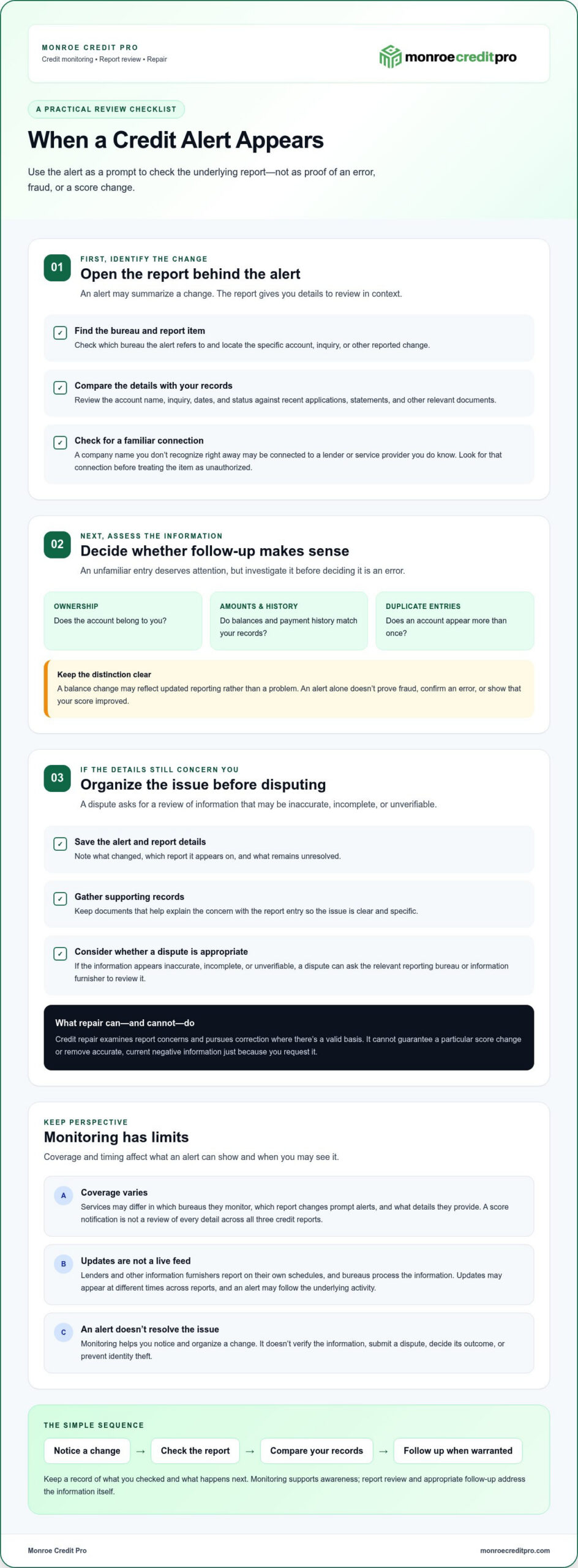
Start with the alert. Identify which bureau and report item it refers to, then open the underlying report when available. A notification may summarize a change, while the report provides context to help you assess it. Use the Consumer Financial Protection Bureau’s credit report resources to better understand how reports and scores differ.
Next, compare the listed information with your own records. Check the account name, inquiry, dates, and status against recent applications, statements, and other relevant documents. A company name you don’t immediately recognize may relate to a lender or service provider you do know, so look for a connection before treating the item as unauthorized. If the information still seems unfamiliar, review the report from the bureau involved and use official bureau and identity-theft resources to determine appropriate next steps.
Keep a simple record of what you checked and what remains unresolved. Save the alert, note the report details, and gather records that help explain the concern. If your review suggests inaccurate information, consider whether a dispute is appropriate. Monitoring helps you notice and organize the issue; it doesn’t submit a dispute or decide its outcome.
Why monitoring may not show every change immediately
Credit reports don’t necessarily update as soon as an account changes. Lenders and other information furnishers send data on their own schedules, and bureaus need to process reported information. As a result, an account update may appear at different times across reports, and an alert may follow the underlying activity rather than coincide with it. Monitoring is useful for awareness, but it isn’t a live feed.
Coverage also matters. Services can differ in the bureaus they monitor, the report changes that prompt an alert, and the information they make available. A score notification is not the same as a review of every detail across all three credit reports. If a decision depends on a particular report entry, review the report itself rather than relying on a score change alone.
When report changes become difficult to sort through, structured credit report analysis can help organize the review and identify concerns that may warrant further attention.
Credit Monitoring vs. Credit Repair: Choose the Right Tool for the Issue
The best starting point depends on what you’re trying to do. If you want to notice report changes, monitoring may help. If you’ve found a specific entry you believe is wrong, review its details and decide whether there’s a reason to challenge it. Self-review, monitoring services, and professional repair can complement one another, but no single approach is necessary for everyone.
Use this comparison to match the task to the tool:
| Approach | Purpose | Action | Limitation |
|---|---|---|---|
| Self-review | Understand what appears on your reports | Compare report entries with your records and applications | Requires time and a consistent review routine |
| Monitoring service | Notice changes within its coverage | Review an alert and check the related report information | Doesn’t investigate or dispute entries automatically; coverage varies |
| Professional repair | Organize review and assistance with report concerns | Analyze report details and support eligible disputes | Can’t guarantee removal or a particular outcome |
Keep the distinction clear: an alert identifies a change, while a dispute needs a specific, reasoned concern about report information. A score notification may help you follow general trends, but it doesn’t establish whether a particular account or payment entry is accurate.
When self-monitoring may be a practical starting point
If you can set a regular time to review your reports and keep your records organized, self-monitoring may be enough to begin. Consumers can request free credit reports through AnnualCreditReport.com, the federally authorized source. Compare reports with account statements, payment records, and applications. Routine score awareness can help you track a general trend, but investigating a specific unfamiliar entry requires looking at the report detail, not just the score.
Reviewing reports from all three nationwide bureaus can help you see whether an entry appears consistently or differs across files. If you spot a discrepancy, record which report contains it and gather relevant documents before deciding whether to dispute. This separates a broad review from a targeted challenge.
When structured repair support may help
Recurring or complicated concerns can take more organization: several entries to review, differences across reports, or correspondence that needs careful tracking. Professional support can help structure that work, from report analysis to dispute follow-up. It’s assistance with the process, not a promise that disputed information will be removed. Accurate, current negative information isn’t automatically erased through repair.
For some consumers, credit monitoring and repair fit together as separate parts of a plan: monitoring supports awareness, while repair support helps organize a review and address eligible concerns. If you’re weighing what structured assistance involves, a credit restoration services guide can offer additional context alongside a careful review of your own reports.
A Practical Routine for Monitoring, Disputes, and Credit Rebuilding
A repeatable routine keeps a report alert from becoming a source of guesswork. Review the report, identify what needs attention, document your findings, and follow up. Keep suspected identity theft separate from a possible reporting error, because each calls for a different response.
Review, document, and dispute a suspected inaccuracy
When an entry seems wrong, save the alert and check the report it refers to. Record the bureau, account or inquiry, relevant dates, current status, and the specific reason you believe the information is inaccurate or incomplete. Gather relevant statements, payment records, or other documents that support your understanding. A clear record makes it easier to explain the issue without relying on memory.
Submit a focused dispute through the current process of the bureau reporting the item or the information furnisher. State which detail you believe is wrong and why, and include copies of relevant supporting records. Keep a copy of what you send and note when you submitted it. Processes and timelines can change, so consult current official guidance rather than relying on an assumed deadline.
Then track correspondence and review the investigation results. Check whether the report changed and whether the specific concern was addressed. If information remains and you still believe it’s inaccurate, review the response and available official guidance to determine an appropriate next step. Don’t treat every unfamiliar item as a routine reporting error. If you suspect identity theft, use the Federal Trade Commission’s IdentityTheft.gov resource and the affected bureau’s official instructions for identity-related concerns.
For a collection account, focus first on verifying the account details and the basis for your concern. A dispute should address a specific potential inaccuracy, not simply the fact that the account is negative.
Build habits while monitoring progress
Set a recurring time to review reports and compare them with your previous notes. Look for meaningful account or status changes, not just every score fluctuation. Reports can update on different schedules, so keep that in mind when monitoring changes. A simple log of dates, report details, and follow-up helps you see what changed and what still needs attention.
Keep positive habits going alongside report review. Aim to make payments on time, and use available revolving credit responsibly in a way that fits your circumstances. These practices support credit rebuilding, but they don’t erase accurate history immediately.
Report accuracy addresses what’s recorded; positive financial habits shape how you manage credit going forward. Both deserve attention, but they solve different problems. For organized help reviewing reports and tracking dispute progress, explore structured credit report support.
How Monroe Credit Pro Connects Monitoring with Structured Credit Repair
Once you understand what an alert can show and what a dispute can address, the next question is how to keep the work organized over time. Monroe Credit Pro brings report analysis, dispute support, monitoring, and credit rebuilding coaching into a structured process. Monitoring helps track report developments; review and dispute work focuses on specific information that may be inaccurate.
This approach can be useful when several report entries need attention or when reviewing reports and managing bureau correspondence feels difficult to handle alone. It doesn’t assume that every negative item is an error. Each concern is assessed on its details, and accurate information isn’t removed simply because a dispute is submitted.
What structured credit repair support involves
The process begins with reviewing credit reports, including reports from all three bureaus, and assessing the information in context. The review helps identify items that may be inaccurate and organize the questions or supporting records relevant to each concern. A potential issue is not treated as a confirmed error before it has been examined.
Where a dispute is appropriate, Monroe Credit Pro handles dispute cycles and bureau correspondence on clients’ behalf with their authorization. Recurring cycles create a framework for tracking correspondence, reviewing responses, and following up on report developments. The purpose is to keep the work systematic, not to promise that a particular entry will be changed or removed. Results depend on the facts and the review of the information.
Monitoring supports that process by helping maintain awareness of report changes, while progress tracking keeps developments in view over time. These functions don’t replace the investigation behind a dispute. An alert may draw attention to a change, but the report still needs to be reviewed and any concern evaluated on its own merits.
Take a steady next step with Monroe Credit Pro
Credit monitoring and repair can work together as parts of a measured plan: monitoring helps you stay aware, and structured repair support helps organize the review and dispute process when report concerns call for it. Credit rebuilding coaching adds a practical focus on habits and progress, without presenting a score change as guaranteed or treating an alert as proof of improvement.
You can expect a process centered on report analysis, identifying potential inaccuracies, authorized dispute support, and tracking developments through recurring service cycles. That structure can make complex correspondence easier to follow, while preserving a clear distinction between challenging a specific report issue and building positive habits going forward.
If you want support reviewing report concerns and keeping monitoring and dispute work organized, explore credit monitoring and repair support. A steady, well-documented process can help you understand what has changed and what steps may be appropriate next.
Make Your Next Credit Step a Steady One
Progress doesn’t depend on reacting to every alert or making a major change all at once. Choose a manageable review routine, keep useful records together, and give yourself time to act on verified concerns. A practical approach to credit monitoring and repair grows through informed decisions repeated consistently, not pressure to fix everything at once.
If keeping report reviews and follow-up organized feels like a lot to manage, Monroe Credit Pro can provide a three-bureau review with a personalized assessment, recurring dispute cycles, bureau correspondence, and progress tracking. These steps bring structure to the process, while each report concern is assessed on its own facts and no specific outcome is guaranteed.
Explore credit monitoring and repair support to consider a structured next step. Your past credit challenges don’t define what you can work toward now. Start with a clear plan, follow it at a pace you can maintain, and keep moving forward.
Frequently Asked Questions
Does checking my own credit report lower my credit score?
No. Checking your own credit report is generally treated as a soft inquiry and doesn’t lower your credit score. A lender’s hard inquiry after you apply for credit can affect a score, though scoring models may treat inquiries differently. Review reports without fear of harming your score, and use an authorized source. If you’re preparing for an application, checking beforehand can help you spot unfamiliar accounts or details to clarify.
Can credit monitoring stop identity theft?
No. Credit monitoring may alert you to certain changes appearing in the reports it covers, but it can’t prevent identity theft or detect every misuse of personal information. If you notice activity you don’t recognize, investigate promptly and use official resources such as IdentityTheft.gov. Depending on the situation, you may consider a fraud alert or security freeze. These safeguards can help, but they don’t guarantee that all misuse will be prevented.
How often should I review my credit reports?
Set a consistent review routine, then check again after a major financial change or an unfamiliar alert. Choose a schedule you can maintain, and use reminders so report reviews don’t depend on memory. Monitoring notices aren’t a substitute for inspecting report details, and services cover different information. Compare account names, dates, and statuses with your own records; don’t treat every score movement as evidence that something is wrong.
What should I do if a monitoring alert shows an account I do not recognize?
First, verify which bureau reported the item and check the account name, dates, status, and any inquiry details. Compare them with recent applications and your records before deciding what happened. If the activity remains unfamiliar, contact the bureau or information furnisher through its official channel and consult IdentityTheft.gov if identity theft is a concern. Keep copies of alerts and communications. An alert merits investigation, but it doesn’t prove fraud or confirm a reporting error.
Does credit repair remove accurate negative information from my report?
Not simply because the information is unfavorable. A dispute is intended for information you believe is inaccurate, incomplete, or unverifiable; accurate negative information may remain under applicable reporting rules. Be cautious of promises guaranteeing deletions or score increases. You can still make constructive progress by addressing genuine report errors and maintaining responsible credit habits, such as paying accounts on time. Credit monitoring and repair support different parts of that process, but neither changes accurate history on demand.
Is credit monitoring the same as identity theft protection?
No. Credit monitoring focuses on changes appearing in the credit reports covered by a service. Identity-theft protection may include other features, depending on the provider, but neither service should be treated as complete prevention or detection of every type of misuse. Review what information a service monitors and what it doesn’t. If you suspect your personal information has been compromised, use official identity-theft resources and consider safeguards suited to your circumstances.