



What if a better path to credit starts with correcting report errors, not chasing a promised score? If you’re considering credit repair for bad credit, it’s understandable to wonder which negative items can be challenged and whether professional help is worthwhile. The right approach depends on what your reports show, not on a one-size-fits-all promise.
This guide explains what credit repair can address, how to compare self-directed disputes with professional support, and what realistic progress can look like. Inaccurate, incomplete, or unverifiable information may warrant a dispute. Accurate negative information generally can’t be removed just because it affects your score.
You’ll learn how to review your reports, choose a practical next step, and spot claims that deserve caution, including guaranteed score increases or promises to erase accurate information. Monroe Credit Pro provides personalized reviews of three-bureau reports, recurring dispute support, credit counseling, rebuilding coaching, and ongoing monitoring. These services can add structure to the process, while steady credit rebuilding remains a separate part of the work.
Key Takeaways
- Credit repair for bad credit starts with identifying information that may be inaccurate, incomplete, or unverifiable.
- Follow an orderly process: review your reports, document concerns, dispute supportable errors, and track responses.
- Compare self-directed disputes, credit counseling, and professional repair based on the work involved and the support you want.
- Set realistic expectations: professional help can organize report analysis and disputes, but it can’t guarantee a score increase or removal of accurate negative information.
- Monroe Credit Pro combines three-bureau report reviews and dispute support with progress tracking, counseling, coaching, and monitoring.
Credit Repair for Bad Credit: Identify the Problem Before Choosing a Solution
A low credit score describes your current credit profile, not your future potential. Start by identifying what is affecting the profile. Credit repair for bad credit may involve correcting report errors, building stronger habits, or addressing both at the same time. The right starting point depends on what your reports show.
Credit repair means reviewing credit reports and addressing information that may be inaccurate, incomplete, or unverifiable. That work is different from rebuilding credit over time. Correcting an error addresses a reporting problem; habits such as making payments on time and managing balances can help shape future credit history. Neither guarantees a particular score or lending decision. Scoring models vary, and lenders may use different criteria when evaluating applications.
A general overview of Credit Repair describes common practices and the role of credit reports. For your own situation, first compare reported information with your account records and history.
Separate report inaccuracies from accurate negative history
A dispute is appropriate when a detail appears inaccurate or incomplete, not simply because it is unfavorable. For example, check whether a reported balance matches your records or whether a payment status conflicts with your history. Gather relevant statements or correspondence to explain the discrepancy. If the negative information is accurate, disputing it won’t automatically make it removable; rebuilding habits may be the more relevant next step.
Set a useful starting point for a bad-credit review
Review your reports from Equifax, Experian, and TransUnion. The information may differ among the three, so check each report separately before deciding what needs attention. A three-bureau credit report review guide can help you compare them systematically.
As you review, record details that will make each concern easier to assess:
- Account details: Note the creditor or account name and whether you recognize it.
- Dates and status: Compare the reported payment status and dates with your records.
- Balances and differences: Record balances and any inconsistencies between reports or supporting documents.
Be specific. “This account looks wrong” is less useful than identifying the balance, date, or status that appears inconsistent and explaining why. Separate clear discrepancies from entries you simply wish were no longer there. That distinction helps you choose a realistic next step: dispute a supportable reporting concern, focus on rebuilding habits, or get structured help reviewing your reports.
How Credit Repair for Bad Credit Works: Review, Dispute, and Rebuild
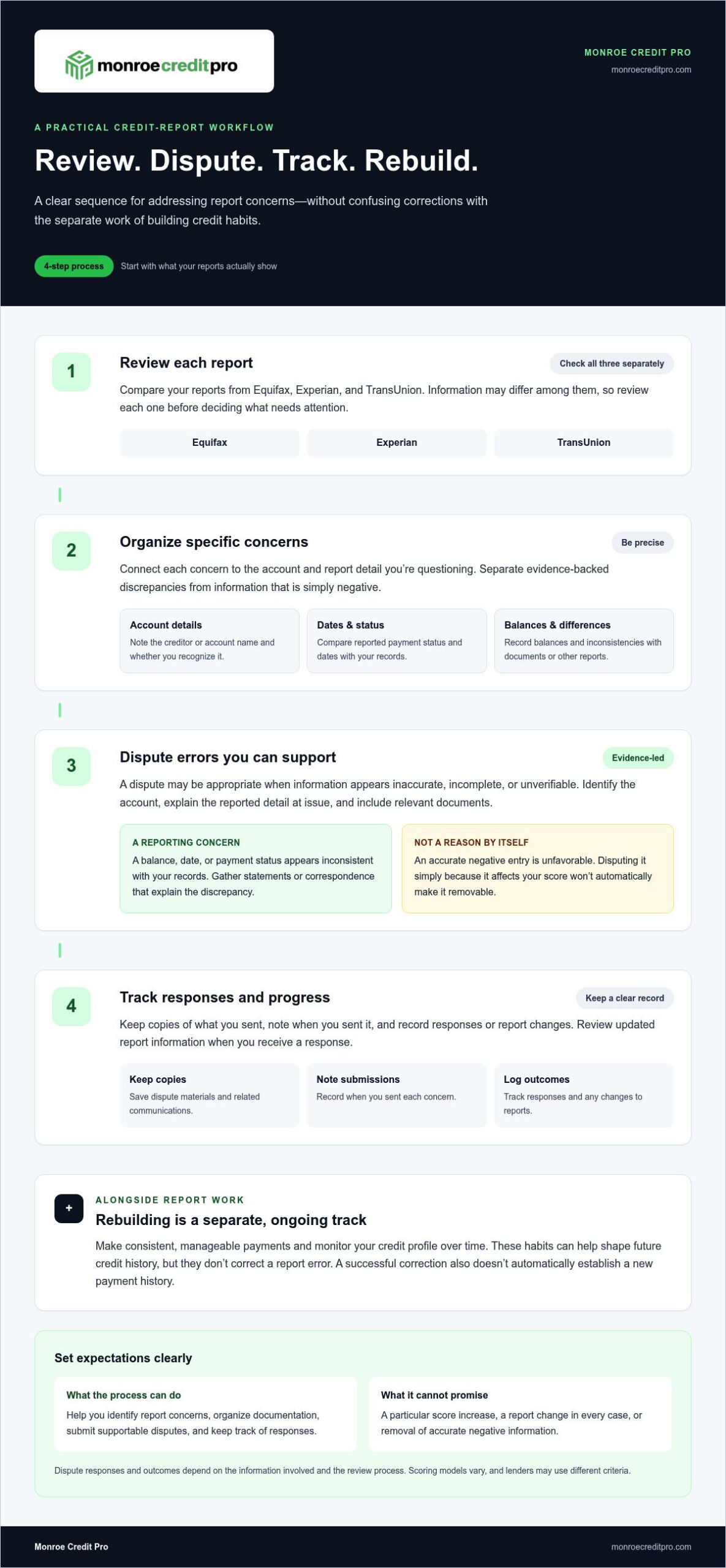
A useful process turns a confusing credit file into manageable tasks. Credit repair for bad credit isn’t a single action or a promise of a particular score. It follows a sequence: review your reports, organize concerns, dispute information you can support, and track what happens next. Sustainable financial habits can help shape the credit history you build alongside this work.
Correcting credit report information addresses errors in the record; rebuilding credit develops stronger credit habits over time. The two can happen in parallel, but one doesn’t replace the other. Paying accounts consistently won’t correct an inaccurate status by itself, and a successful correction doesn’t automatically establish a new payment history.
- Review each report. Compare account information and flag details that appear incorrect, incomplete, or inconsistent.
- Organize specific concerns. Connect each concern to the account and report detail you’re questioning. Separate evidence-backed discrepancies from information that is simply negative.
- Dispute supportable errors. Provide accurate information and relevant documents so the concern can be understood and reviewed.
- Track responses and progress. Keep copies of what you sent, note when you sent it, and record responses or changes to the reports.
Organize a dispute around specific report details
Make each concern clear and focused. Identify the account, describe the reported detail at issue, and explain how it differs from your records. If you’re questioning a balance, for example, gather account statements that show the figures you’re relying on. Keep copies of those documents and related communications together. Don’t dispute an entry simply because it affects your score. A specific explanation keeps the review focused on the reporting concern.
Responses and outcomes depend on the information involved and the review process. Don’t assume every dispute will change a report or that all cases will move at the same pace. Keep the correspondence and review updated report information when you receive a response. If the entry concerns a collection account, use a focused resource such as this guide to removing collections from a credit report to understand the issues to review.
Pair report work with sustainable rebuilding
Keep rebuilding practical. Make consistent, manageable payments on your accounts and monitor your credit profile over time. These habits support future credit history; they don’t substitute for correcting a report error. Likewise, a single score movement may not tell the whole story because scores can vary by model and lenders use different criteria. Look at the information being reported and the habits you can sustain.
For structured help reviewing reports and tracking dispute work, Monroe Credit Pro provides three-bureau report reviews, bureau correspondence, and credit progress tracking. Explore professional credit report support to bring organization to the process while keeping expectations grounded in the details of your credit profile.
Compare Credit Repair Options for Bad Credit by the Work You Need
The right option depends on the task in front of you. A clear, limited reporting concern may be manageable on your own. Broader financial planning calls for different support than reviewing and disputing report information. Use this comparison to match credit repair for bad credit to the work you need, rather than choosing based on a promised score outcome.
| Option | Main task | May suit you if | Your involvement and realistic scope |
|---|---|---|---|
| Self-directed disputes | Review reports and challenge specific information you believe is inaccurate or incomplete. | You’ve found a clear, limited concern and feel comfortable organizing documents and correspondence. | You handle the review, dispute communication, and follow-up. A dispute addresses report information, not accurate negative history or every factor affecting your score. |
| Credit counseling | Support financial planning and consider how payment routines and account management fit your situation. | You want guidance with broader financial habits or a plan for managing obligations. | You participate in planning and apply steps that work for your circumstances. Counseling isn’t a substitute for disputing inaccurate report details. |
| Professional credit repair | Review reports, identify potential inaccuracies, and support disputes and follow-up. | You want structured help assessing multiple report items or tracking correspondence and progress. | You provide accurate information and remain involved in decisions. Support can organize report work, but it can’t guarantee deletion of accurate items or a specific score change. |
When self-directed credit work may fit
If you’re organized and the concern is straightforward, handling a dispute yourself may be practical. Compare the report entry with your records, prepare a focused explanation, and keep track of the response. This route takes time and attention, but it can work well for a simple issue. Whatever dispute method you choose, sustainable rebuilding habits remain your responsibility.
When structured professional support may fit
Several items across reports can make it harder to prioritize concerns and follow each response. Professional support can add structure to that review. Monroe Credit Pro provides personalized three-bureau report reviews, identifies potential inaccuracies, and disputes erroneous items. Recurring dispute cycles include bureau correspondence and credit progress tracking, helping you follow the work without treating any particular deletion or score outcome as certain.
Choose based on the gap you need to address. If you mainly need help organizing your finances, counseling may be the closer fit. If you’ve identified a specific report concern and can manage the follow-up, self-directed work may be enough. If you want structured report analysis and ongoing dispute tracking, explore structured credit repair support. Whichever path you take, continue monitoring your habits and credit profile over time.
Evaluating Credit Repair for Bad Credit Safely
Professional support can make report review and dispute tracking more structured, but it can’t guarantee a particular score or the removal of an item. A company can help identify and challenge information that may be inaccurate; it can’t make accurate information inaccurate. Treat claims of guaranteed score increases or guaranteed removal of accurate negative information as warning signs.
Before starting credit repair for bad credit, understand what the service will do, how communication works, and what progress tracking covers. Clear expectations help you judge whether the support matches your report concerns.
Recognize claims that deserve caution
Be wary of promises about outcomes no company can control, such as a guaranteed score increase or deletion of accurate negative information. Look for a plain-language description of the work performed in each service cycle: which reports are reviewed, how potential inaccuracies are addressed, and how correspondence and progress are documented.
The federal Credit Repair Organizations Act (CROA) sets consumer protections for credit repair services. Under CROA, a credit repair organization must provide a written contract explaining the services, total cost, and cancellation rights, and consumers have three business days to cancel without penalty. Companies can’t charge for services before they’ve been fully performed. The Federal Trade Commission (FTC) provides consumer guidance on credit repair; read current guidance and the contract carefully so you understand the terms before agreeing.
Assess whether the service matches your goals
Start with the outcome you need. If your main concern is a reporting detail that appears wrong, report review and dispute support may fit. If your priority is budgeting or managing obligations, credit counseling may be more relevant. These needs can overlap, but they aren’t interchangeable. Broader context on credit restoration services can help clarify the kinds of support involved.
Use this checklist to assess scope before you begin:
- Work covered: Is it clear whether the service includes report analysis, dispute support, correspondence, or additional guidance?
- Communication: Do you understand how updates and bureau responses will be shared?
- Recurring work: If support continues in cycles, can you tell what is reviewed or handled in each one?
- Progress tracking: Can you follow dispute activity and changes in your credit profile without treating a score shift as the only measure of progress?
- Your role: Do you know what information and documents you’ll need to provide?
A service’s scope should be clear before you commit. Monroe Credit Pro reviews three-bureau reports, identifies potential inaccuracies, and disputes erroneous items, with bureau correspondence and credit progress tracking as part of recurring dispute cycles. If structured report analysis aligns with your goals, explore professional credit repair support.
Start a Structured Credit Repair Plan With Monroe Credit Pro
Once you’ve identified the kind of support you need, choose a process that fits your concerns. Monroe Credit Pro provides professional credit repair focused on reviewing reports, identifying potential inaccuracies, and disputing erroneous items. This structured approach can help organize report concerns and follow-up, while keeping expectations grounded: no service can promise a particular score or the removal of accurate information.
What professional support can include
A personalized review of reports from all three bureaus brings account information and potential discrepancies into one organized picture. That gives you a clearer basis for deciding which concerns may warrant dispute support. Dispute work focuses on erroneous items, not on removing accurate negative information simply because it affects your credit profile.
Support can continue through recurring monthly dispute cycles, bureau correspondence, and credit progress tracking. These components help organize the work and make it easier to follow communications and observe changes over time. Tracking monitors activity and developments; it doesn’t promise that a report or score will change by a particular date.
Credit repair for bad credit may also involve work beyond disputes. Monroe Credit Pro offers credit counseling and rebuilding coaching to support ongoing credit-profile work, along with credit monitoring. These services complement report analysis: dispute assistance addresses potential reporting errors, while counseling and coaching can help you focus on habits that shape future credit history. Choose the support that aligns with your priorities rather than expecting one action to resolve every credit concern.
- Report review: Organize information across three-bureau reports and identify potential inaccuracies.
- Dispute support: Address erroneous report items through recurring cycles and bureau correspondence.
- Progress tracking: Follow dispute activity and credit-profile changes over time.
- Ongoing guidance: Pair report work with counseling, rebuilding coaching, and monitoring.
Take the next step with clear expectations
Consider whether structured dispute support matches your current needs. If you have report concerns that need careful review or want help organizing correspondence and tracking progress, this approach can provide structure. If your main priority is changing financial habits, rebuilding remains an ongoing effort that requires consistency. Neither support nor monitoring is a quick fix, and neither guarantees a specific score result.
Start with a clear understanding of the work: report analysis, potential inaccuracies, dispute support, and ongoing progress review. That gives you a practical basis for deciding whether professional help fits your situation. Explore credit repair support and take an informed next step at a pace that works for you.
Make Your Next Credit Step a Clear One
Your credit profile doesn’t have to be resolved all at once. Choose a practical priority for the next stage, then give yourself room to follow through consistently. Credit repair for bad credit is most useful when the work matches your needs and your expectations stay realistic. Progress may come from addressing a report concern, strengthening financial habits, or doing both over time.
If you want structured support for report-related work, Monroe Credit Pro offers three-bureau credit report review and analysis, recurring dispute cycles with bureau correspondence and progress tracking, plus credit counseling, rebuilding coaching, and ongoing credit monitoring. These services can help organize your next steps, but they don’t guarantee a particular score or the removal of accurate information.
Move forward with a clear view of what you want help managing and what ongoing effort you’re prepared to make. Explore structured credit repair support and choose a next step that fits your situation. A steady plan can make the path ahead more manageable.
Frequently Asked Questions
Can credit repair for bad credit remove accurate negative information?
No. Credit repair for bad credit can help challenge information that’s inaccurate, incomplete, or unverifiable, but a dispute doesn’t make accurate negative history removable. For example, if an account balance is correctly reported, dissatisfaction with that entry alone isn’t a reason to expect its removal. Compare the report with your account records and focus a dispute on a specific mismatch, such as a payment status that conflicts with your statements.
Will credit repair guarantee a higher credit score?
No reputable service can promise a specific score increase. A report correction may affect a credit profile, but the result depends on the information involved and how scoring models evaluate it. Lenders may also use different criteria. Judge support by the work it performs, such as reviewing report details or tracking correspondence, rather than by an advertised score target. Monitor your broader credit habits instead of relying on one score reading.
How long does credit repair for bad credit take?
There isn’t one reliable timeline for every case. The time involved can depend on the number and type of report concerns, the records available, and how the review proceeds. A straightforward discrepancy may require less follow-up than several complex items. Be cautious of anyone promising a fixed completion date or score result before reviewing your situation. Understand how updates are communicated and what information you’ll receive as the work progresses.
Can I repair my credit myself instead of hiring a company?
Yes. You can review your own reports, identify a specific error, and submit a dispute without hiring a credit repair company. This may suit you if the concern is limited and you’re comfortable organizing documents and following up. For example, compare a statement with the balance shown on your report, then keep copies of the records and communications. Regardless of who handles a dispute, consistent account management remains your responsibility.
Does disputing a credit report item lower your credit score?
Submitting a dispute by itself generally doesn’t lower your score. The reported information and the details used by a scoring model matter more than the act of questioning an entry. If an investigation changes account information, a score could change as a result, though the direction and amount aren’t guaranteed. Keep a copy of the report before the dispute so you can compare the details afterward and understand what changed.
How can I check my credit reports from all three bureaus?
Request your reports from Equifax, Experian, and TransUnion through AnnualCreditReport.com, the federally authorized source for free credit reports. Review each report separately because account details may differ between bureaus. Check your identifying information, open and closed accounts, balances, and payment statuses. If you spot a possible error, save a copy of the relevant report and note the exact entry before deciding what to do next.
Is credit counseling the same as credit repair?
No. Credit counseling focuses on financial planning and how to manage money and account obligations. Credit repair focuses on reviewing credit report information and addressing potential inaccuracies. Someone concerned about budgeting may benefit more from counseling, while a person who has found a reporting discrepancy may need dispute support. These forms of help can complement each other, but counseling doesn’t itself correct a report entry, and a dispute service doesn’t replace ongoing financial planning.
What should I do if a credit repair company promises to erase all negative items?
Treat that promise as a serious warning sign. Accurate negative information can’t be made inaccurate simply by disputing it, and no company can guarantee that every unfavorable entry will disappear. Don’t provide false information or sign based only on a verbal claim. Save any advertisement or message making the promise, review the written service terms carefully, and consult current Federal Trade Commission guidance on credit repair before deciding how to proceed.