



What if the fastest way forward isn’t a quick fix, but finding what can actually be corrected? If you’re searching for how to repair my credit fast, promises of instant score increases can make it hard to know where to start. A careful review helps you distinguish information that may be inaccurate, outdated, or incomplete from negative information that is accurate.
It’s understandable to want results now, especially if you’re worried an error is holding you back. This guide explains what you can do immediately, what takes consistent effort, and how to avoid tactics that can create more problems. You’ll learn why correcting report errors is different from rebuilding credit, and why accurate negative information generally can’t be removed simply because it’s unfavorable.
Start by reviewing your reports systematically. Note specific concerns, gather relevant records, and make focused disputes where appropriate. Then continue building steady credit habits. If reviewing reports and managing bureau correspondence feels difficult to handle alone, a three-bureau credit report audit and ongoing dispute support can add structure and progress tracking, without promising a particular score or removal.
Key Takeaways
- To understand how to repair my credit fast, start with an accurate report review, not promises of instant score changes.
- Compare your Equifax, Experian, and TransUnion reports, document discrepancies, and make disputes specific to information you believe is inaccurate.
- Separate correction from rebuilding: a genuine reporting error may be disputed, while accurate negative information generally can’t be removed simply because it’s unfavorable.
- Build steady credit habits alongside report review. Progress depends on consistency, not a guaranteed timeline.
- A three-bureau audit and organized dispute support can help you track report reviews, bureau correspondence, and progress.
How to Repair My Credit Fast: What Can Change and What Cannot
Wanting progress quickly is understandable, especially when a credit issue affects an important financial goal. But no particular speed is guaranteed. If you’re asking how to repair my credit fast, separate the actions you can take now from outcomes that depend on a review, reporting updates, and your overall credit file.
Credit repair means addressing information that’s inaccurate or incomplete and building healthier credit habits over time. A Credit Report records account and payment history, while a credit score is calculated from information in a file using a particular scoring model. You can review information and submit a focused dispute promptly, but the review outcome and any score change may take longer, and neither is assured.
Begin with what you can control: understand what appears in your reports, keep relevant records, and identify details you believe are wrong. Separately, support long-term rebuilding by making payments on time and managing credit responsibly. These steps have different purposes. A dispute addresses a reporting concern; consistent habits support how your credit profile develops over time.
Myth: Every Negative Item Can Be Removed Quickly
A negative entry isn’t automatically an error. Disputes are for information that is inaccurate, incomplete, or otherwise eligible for review, not simply entries that are frustrating or harmful. For example, if a payment is marked late but you believe the record is wrong, that specific detail may warrant a dispute. If the late payment is accurate, paying the account doesn’t erase its valid payment history.
Reality: Quick Action Is Not the Same as a Quick Score Increase
You can begin reviewing your reports or submit a dispute without knowing the outcome. If information is corrected, the effect on your score depends on the rest of your file and the scoring model used. A correction may affect one person’s score differently from another’s. Treat fast action as a way to address a possible issue, not as a promise of points, timing, or a particular result.
Use this distinction to prioritize your next move:
- Act now: Review your reports and organize records related to information you believe is wrong.
- Allow for review: A bureau or information provider may need to assess the dispute before a report changes.
- Build consistently: Maintain responsible payment and credit habits, knowing their effects depend on your circumstances.
Be cautious of claims that every negative item can be erased or that your score will rise by a set amount. A reliable plan distinguishes correctable reporting problems from accurate history and focuses on steps you can support with evidence. That approach may not produce an instant score change, but it helps you pursue corrections responsibly while rebuilding on a sounder foundation.
Start With Your Credit Reports: Find Errors Worth Disputing
A focused report review gives you a clearer starting point than guessing which actions might help. Compare reports from Equifax, Experian, and TransUnion because the information in each file can differ. An account may appear on one report but not another, or details such as a balance or payment status may not match. Review each report separately rather than assuming one bureau’s version represents them all.
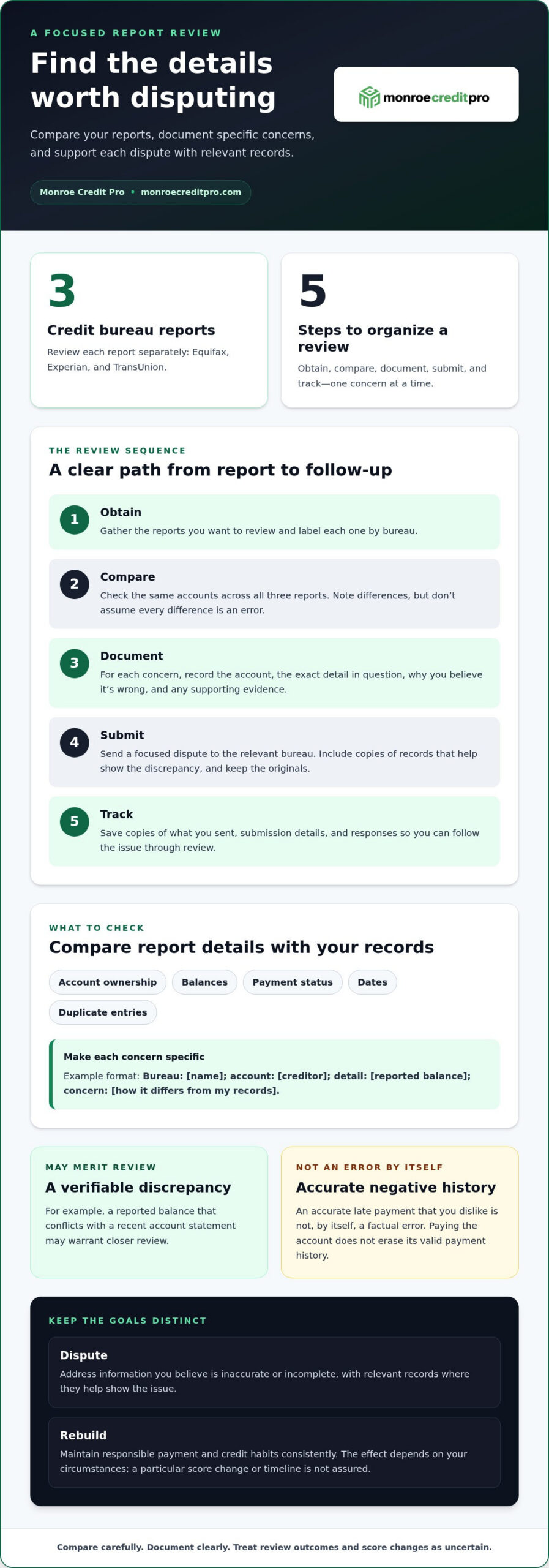
Use a simple sequence: obtain your reports, compare the entries, document specific discrepancies, and submit a focused dispute for information you believe is inaccurate. A three-bureau credit report review guide can help you work through the process systematically. Keep a copy of each report and record each concern separately. This makes a large review easier to manage and track.
How to Spot a Report Issue That May Merit Review
Check details you can compare with your own records: account ownership, balances, payment status, dates, and duplicate entries. A balance that conflicts with a recent statement may merit closer review; an accurate late payment that you dislike is not, by itself, a factual error. For each concern, record the bureau, account, exact detail in question, and why you believe it’s wrong.
Use a simple tracking table or note, with one entry per concern. For example: “Bureau: [name]; account: [creditor]; detail: [reported balance]; concern: [how it differs from my records].” That specificity helps you focus each dispute on one entry instead of sending a broad, unclear request about an entire report.
How to Make a Clear, Documented Dispute
Describe the information you’re challenging and explain why it appears inaccurate or incomplete. Include copies of relevant supporting records, such as an account statement or payment confirmation, when they help show the discrepancy. Keep the originals. Save a copy of everything you send, along with submission details and any response, so you can track the issue through review.
- Obtain: Gather the reports you want to review and label each one by bureau.
- Compare: Check the same accounts across all three reports. Note differences without assuming every difference is an error.
- Document: Record the account, disputed detail, reason, and supporting evidence for each concern.
- Submit: Send a focused dispute to the relevant bureau and keep a copy of the submission and attachments.
- Track: Review the response when it arrives and record the outcome.
Organization matters. If you’re researching how to repair my credit fast, a careful review helps you focus on specific, supportable concerns instead of disputing accurate information indiscriminately. Monroe Credit Pro’s three-bureau credit report audit provides structured report review and consulting when sorting through entries and documentation feels difficult to manage alone.
Fast Credit Repair Methods vs. Quick-Fix Myths
Useful credit actions target a specific issue or support better account management. They don’t all work the same way, and none guarantees an immediate score change. If you’re weighing how to repair my credit fast, consider what each step can address and what it cannot promise.
| Legitimate action | What it can address | What it cannot promise |
|---|---|---|
| Dispute a documented error | Incorrect account details, balances, payment status, or other report information | Removal of accurate negative history or a particular score increase |
| Contact a creditor about account status | Clarification of what the creditor records or reports about an account | That accurate past reporting will be erased |
| Pay down revolving balances | Lower balances relative to available credit as part of credit management | A fixed or immediate score effect |
| Open a new credit account | A possible change to your credit profile over time | A fast improvement; new credit can add uncertainty |
Correcting an error and changing accurate account history are different outcomes. A dispute asks for inaccurate information to be reviewed. Paying an overdue account or reducing a balance may address current account management, but payment alone doesn’t make accurate past reporting disappear. Before acting, be clear about the purpose of each step.
Actions That May Address a Specific, Current Credit Issue
If a report detail conflicts with your records, make a focused dispute supported by relevant documents. If you’re unsure how an account is currently being handled or reported, contacting the creditor may clarify its status. Paying down revolving balances can also be a sound account-management step when it fits your finances. The score effect of these actions depends on your file and the scoring model.
Shortcuts That Can Mislead or Create Additional Problems
Be wary of anyone who guarantees a score or promises to remove accurate information. Disputing every entry without a specific reason isn’t a substitute for careful review. Never knowingly submit false identity or account details to challenge a record. Opening new credit solely to seek a quick score change can also add uncertainty, since an application and a new account may affect how your profile is assessed.
Choose actions you can explain and support. A documented error calls for a precise review; an accurate negative entry calls for realistic expectations and responsible account management. Be especially cautious of claims that ask you to misrepresent facts or promise the same result for every credit file.
A Safe, Prioritized Credit Repair Plan You Can Begin Now
A clear sequence helps you use your effort well without treating a score change as a deadline. If you’re wondering how to repair my credit fast, start with the information that needs review, then build habits that support progress while a review is underway. Hold off on optional credit products until you understand what’s already in your file and what issue you’re trying to address.
Begin With the Steps That Clarify Your Credit File
Gather reports from Equifax, Experian, and TransUnion, then keep your notes and records together. A single discrepancy list makes it easier to prioritize factual issues, connect each concern to supporting documents, and track what happens after you submit information for review.
- Gather and compare: Obtain reports from all three bureaus and review each account. Note differences in account ownership, balance, payment status, dates, or duplicate entries.
- Prioritize supportable concerns: List details that appear factually wrong. Set aside entries that are accurate but unwelcome, and gather relevant records for each potential dispute.
- Submit focused disputes: Explain the specific detail you believe is inaccurate and why. Keep copies of your submission and supporting documents rather than relying on memory.
- Track responses: Record the bureau, account, date submitted, documents included, and response when it arrives. Update your notes as the review proceeds.
- Review before adding products: Once you understand your reports and current accounts, consider whether an optional credit product serves a clear need. Don’t open an account solely in the hope of a quick score change.
Build Steady Habits While Reviews Are Underway
Report review and rebuilding habits serve different purposes, so work on both without expecting identical results. Make a practical plan for upcoming payments, and use reminders if they help you stay organized. Review revolving balances and consider what sustainable management looks like for your budget. Monitor report updates, but don’t assume each change affects every scoring model in the same way.
Keep the plan manageable. If a payment date is easy to overlook, add a calendar reminder. If a balance feels difficult to manage, review your spending and payment options before taking on new credit. Consistent, realistic actions are more useful than a rushed move that creates another obligation or distracts from a documented report issue.
Structured support can make report review, dispute correspondence, and progress tracking easier to manage. Explore Monroe Credit Pro’s credit support for organized guidance, including credit report audits, counseling, rebuilding support, and recurring dispute services. The focus is a systematic process, not a promised score increase or removal.
When Structured Credit Repair Support Can Help
Reviewing several reports, organizing records, and following bureau correspondence can feel like a project of its own. Structured credit repair support can help bring order to those tasks, especially when you’re unsure which entries need attention or how to track follow-up. It doesn’t replace your judgment or make accurate account information disappear. It helps you approach report concerns methodically.
For someone researching how to repair my credit fast, professional support offers organization, not a shortcut to a promised score. You remain in control of your financial decisions and the information you provide. A responsible process focuses on specific report concerns, tracks what happens next, and keeps rebuilding guidance separate from dispute work.
What a Structured Review and Dispute Process Can Include
A three-bureau audit and consulting can review reports from Equifax, Experian, and TransUnion to identify potential inaccuracies. Dispute correspondence can then address specific concerns rather than making broad claims about an entire file. Progress tracking keeps a record of the issue, correspondence, and developments so you can follow the process without losing important details.
At Monroe Credit Pro, the process includes report review, identifying potential inaccuracies, handling bureau correspondence, and tracking progress through recurring dispute cycles. This structure can be useful when multiple report entries need attention or follow-up feels difficult to coordinate. It supports a careful review, but it doesn’t guarantee that a bureau will change an entry or that a particular score outcome will follow.
How to Set Expectations for Support
Every review depends on the facts, the records available, and how the information is reported. Professional support can help organize and address a concern, but it can’t promise a deletion, a fixed score increase, or a completion date. Accurate negative information remains distinct from a genuine reporting error, and support should respect that difference.
Keep your own copies of reports, documents, and correspondence, and make informed decisions about your accounts. Rebuilding guidance and credit monitoring can complement report review by helping you stay aware of developments and maintain attention on ongoing credit health. The goal is a clearer, more organized process, not a guaranteed result.
If a structured review would help you manage report concerns and follow-up, Explore credit restoration support from Monroe Credit Pro. A systematic process can make the work easier to track while keeping expectations grounded in the details of your credit file.
Take the Next Step With a Clear Plan
You don’t need to solve every credit concern at once. Choose one practical next step: bring your reports and records together, note the questions you want answered, and decide whether support organizing the review would help. Asking how to repair my credit fast can be the start of a focused plan, not a reason to rush into promises that can’t be guaranteed.
Monroe Credit Pro offers a three-bureau credit report audit and consulting, along with recurring dispute cycles that include bureau correspondence and credit progress tracking. These services provide structure for reviewing concerns and following developments, while outcomes remain tied to the facts in your file.
Explore Monroe Credit Pro’s credit support to take a measured step toward a clearer understanding of your credit. Progress starts with a process you can follow, and each thoughtful action can help you move forward with greater confidence.
Frequently Asked Questions
Does checking my own credit report lower my credit score?
No. Reviewing your own credit report is generally treated as a soft inquiry and doesn’t lower your score. A lender’s hard inquiry is different and may affect some scoring models. Review reports from Equifax, Experian, and TransUnion because account details may differ across bureaus. Use an authorized source, and focus on the underlying entries, not only a score estimate that may differ from a lender’s version.
Can I repair my credit without opening a new credit card?
Yes. If you’re researching how to repair my credit fast, opening a card isn’t a required first step. You can review your reports, dispute information you believe is inaccurate, pay current obligations on time, and manage existing balances. For example, setting a reminder for a due date may help you make consistent payments without adding an account. Don’t take on debt solely because someone promises a new card will quickly raise your score.
What happens if I find an account I don’t recognize on my credit report?
First, check whether the account could appear under a lender or company name you recognize. If it still seems unfamiliar, note which bureau reports it and save the account details. Follow that bureau’s identity-theft and dispute instructions, and consider using federal identity-theft resources for guidance. Don’t claim an account is fraudulent unless you have a reasonable basis, and keep copies of all forms and correspondence.
Does paying an old collection automatically remove it from my credit report?
No. Paying a collection doesn’t automatically require its removal from your report. The account status may be updated, but how it’s reported depends on the circumstances and applicable rules. Before paying, review the entry and keep records of any payment or communication. If a factual detail is wrong, address that specific error through the appropriate dispute process instead of relying on a promise that payment will erase accurate history.
How often should I review my credit reports while repairing my credit?
Review your reports when you begin, then check again after relevant dispute responses or account updates. Continue monitoring for unfamiliar activity, adjusting how often you check to your circumstances and access to reports. Keep a simple log with the date, bureau, and changes you notice. For example, if an account’s status changes on one report, note whether the other bureaus show the same update instead of assuming all files changed together.
Can a credit dispute temporarily change my credit score?
A dispute doesn’t guarantee a score change, temporary or otherwise. If an entry is corrected, removed, or updated, your score may change based on the details in your file and the scoring model; it may also stay similar. Different bureaus and models can produce different results. Track the report’s actual outcome first, then consider any score movement in context rather than treating it as proof of a lasting effect.
Is credit repair guaranteed to remove negative information?
No. Be cautious of anyone promising to remove accurate negative information or deliver a specific score increase. A dispute should address information that’s inaccurate or otherwise eligible for review, not simply an entry you’d prefer to be gone. Avoid services that pressure you to misrepresent facts or claim instant results. A grounded next step is to identify the exact concern, keep relevant records, and understand what the review can and cannot address.