



A credit score can shape more than a loan application; it can influence borrowing options and housing decisions. FICO® Score and VantageScore® models generally range from 300 to 850 points, and payment history, credit balances, account history, credit mix, and new credit all help determine the result. Understanding those factors is a practical first step toward building financial confidence with a better credit score.
If your credit score feels confusing, you’re not alone. Understanding what affects it can make it easier to choose practical next steps. Everyday habits, especially paying bills on time and managing card balances, can support stronger credit over time.
This guide explains how credit scores work, which factors matter, and how paying down balances may help. You’ll also learn how credit can affect borrowing and housing, so you can make informed choices and take steady steps toward greater financial flexibility.
Key Takeaways
- Understand what a credit score represents so you can make informed choices as you plan to borrow.
- Prioritize on-time payments and steady account management, two habits that support a stronger credit profile.
- Compare card balances with available limits and make a plan to reduce high utilization.
- Consider how credit may affect borrowing and housing decisions, then review your reports for information that could influence them.
1. How do credit scores work?
FICO® Score and VantageScore® models generally range from 300 to 850 points, according to FICO and VantageScore Solutions. Lenders use scores to assess credit risk, while a credit report provides account-level details. It can show payment history, credit cards, balances, inquiries, and other reported information.
Common U.S. score ranges are poor, 300–579; fair, 580–669; good, 670–739; very good, 740–799; and excellent, 800–850. Lenders may use different scoring models, so the same consumer can see different scores.
To check reports for free, request them from Equifax, Experian, and TransUnion through AnnualCreditReport.com. The three bureaus offer free weekly reports, available beginning September 2023. Checking your own credit score creates a soft inquiry and doesn’t affect it.
Review each report at least annually, or more often while addressing credit issues. Match account names, payment dates, balances, and inquiries against your records. Look for unfamiliar credit cards, addresses, or accounts that could signal identity theft.
Dispute incorrect information with the credit reporting agency and the company that supplied it. Identify the specific entry, explain the error, and include supporting records. According to the Consumer Financial Protection Bureau, contest a debt collection request in writing within 30 days of receiving information from the debt collector.
Credit report information can shape personalized credit-card offers, but an offer isn’t a lending decision. Review the account terms and the source before applying, since an application can trigger a hard inquiry.
Score movement may occur within 30–90 days after paying down high balances or correcting reporting errors. Consistent on-time payments and account management may produce measurable improvement after 3–6 months.
Watch for credit score scams that promise guaranteed results, claim they can erase accurate negative information, or pressure you to act immediately. Don’t share passwords or sensitive details with an unsolicited caller, and read any credit repair agreement before paying for a service.
2. Credit score factors and their relative importance
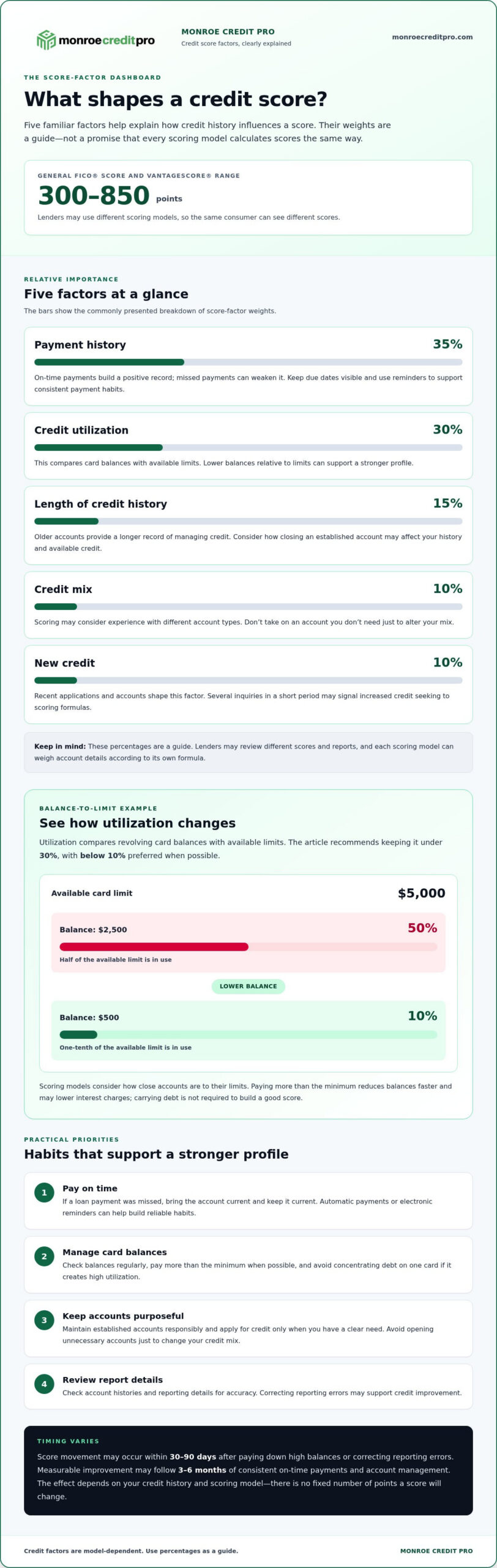
Scoring models weigh account information differently, but five familiar factors help explain how credit history influences a score. A commonly presented breakdown assigns payment history 35% and credit utilization 30%. Length of credit history contributes 15%, while credit mix and new credit each account for 10%.
- Payment history, 35%: On-time payments build a positive record; missed payments can weaken it. Keep due dates visible and use reminders to support consistent payment habits.
- Credit utilization, 30%: This compares card balances with available limits. Lower balances relative to limits can support a stronger profile.
- Credit history length, 15%: Older accounts provide a longer record of managing credit. Avoid closing an established account without considering how it may affect your history and available credit.
- Credit mix, 10%: Scoring may consider experience with different account types. Don’t take on an account you don’t need just to alter your mix.
- New credit, 10%: Recent applications and accounts shape this factor. Several inquiries in a short period may signal increased credit seeking to scoring formulas.
These percentages are a guide, not a promise that every scoring model calculates scores the same way. Lenders may review different scores and reports, and each model can weigh account details according to its own formula. As a result, a change in one factor may affect people differently depending on their broader credit history.
Start with actions tied to the largest weights: pay accounts on time and manage card balances. Then maintain established accounts responsibly, apply for credit only when you have a clear need, and review reports for accurate account details. These steady habits can support credit improvement without opening unnecessary accounts.
If account histories or reporting details are difficult to interpret, a structured credit profile review can help organize the issues and clarify practical next steps.
3. Credit utilization and paying down balances
Credit utilization compares revolving credit card balances with available limits. Keep utilization under 30%, with below 10% preferred when possible. For example, a $5,000 limit and $2,500 balance equal 50% utilization; reducing that balance to $500 brings it to 10%. Scoring models consider how close accounts are to their limits.
Paying more than the minimum reduces balances faster and may lower interest charges. Paying a credit card balance in full each month helps keep interest costs low; you don’t need to carry debt to build a good score. Check balances regularly, and avoid shifting most of your debt to one card if it results in high utilization.
Pay bills and loans on time. If you’ve missed a loan payment, bring the account current and keep it current. Automatic payments or electronic reminders can help you build reliable habits. On-time payments and lower card balances support credit health, but there’s no fixed number of points a score will change. The effect depends on your credit history and the scoring model.
If you’re establishing credit, a secured credit card requires a deposit, while a credit-builder loan can build a record of installment payments. Authorized-user status links you to another cardholder’s account. Its value depends on whether the account appears on your credit report and how the account is managed.
The fastest safe steps are to pay down high balances, make every payment on time, and correct reporting errors. Score movement may occur within 30–90 days after paying down balances or correcting errors; measurable progress often follows 3–6 months of consistent habits. Avoid quick-fix promises.
Build confidence with a repeatable routine: check balances, schedule payments before their due dates, and review account activity. Keep card balances well below limits, pay in full when possible, and apply for credit only when needed. These habits can support a stronger profile over time.
4. How credit scores affect borrowing, housing, and financial flexibility
A credit score can influence how lenders assess an application, but it’s only one part of the financial picture. Lenders also consider income, existing obligations, the amount requested, and payment history. A stronger credit profile can support more borrowing choices, while missed payments or high balances can narrow your options, leading those who face urgent expenses to explore options like easy loans for bad credit while they work to rebuild their financial profile.
Housing decisions can involve credit checks. A mortgage lender may review your credit report and score when assessing a home loan application. Landlords may use credit information during rental screening, where payment history and outstanding balances can help show how you’ve managed financial commitments. Screening practices vary, so review your report before applying.
Credit can shape everyday flexibility, too. A card with available credit can help manage planned expenses, but using too much of its limit can affect utilization and leave less room for unexpected costs. When major disruptions like accident-related expenses threaten your budget, working with a Personal Injury Attorney in Fort Lauderdale can help individuals pursue compensation and protect their broader financial stability. Paying down balances and keeping payments current supports a healthier credit profile and more predictable cash flow.
Before a major borrowing or housing application, review reports from Equifax, Experian, and TransUnion. Dispute errors that could misrepresent an account, and keep records of payments and disputes. A careful review helps you understand what lenders or housing screeners may see. A clear budget can help you decide what payment fits.
If inaccurate account information complicates your preparation, request a credit report audit to organize the items that need attention.
Monroe Credit Pro: Credit Restoration
Monroe Credit Pro offers Credit Restoration for people seeking structured help with credit concerns. If your report contains information you believe is inaccurate, or past credit difficulties make planning harder, a review of your credit situation can help identify appropriate next steps.
Credit Correction and Professional Credit Repair address credit-reporting concerns, while Credit Counseling can support clearer decisions about managing credit. These services complement practical habits such as paying on time and keeping balances manageable. They don’t replace your own review of account details or responsible credit use.
Consider getting support when you need help understanding credit-report concerns or organizing a path forward. Contact Monroe Credit Pro to discuss your credit restoration needs.
Take Your Next Step With Clarity
Choose a credit goal that supports a real priority, such as preparing for a future home application or making more room in your budget. Let that goal guide the habits you maintain and the questions you ask as your financial needs change. Building financial confidence with a better credit score takes informed decisions, not judgment about past setbacks.
If errors or difficult account history make your next steps unclear, organized guidance can help you understand what to address and how to proceed. Monroe Credit Pro offers Credit Restoration, Professional Credit Repair, and Credit Correction for people working through credit concerns.
Explore how Monroe Credit Pro can support your credit goals and choose a next step that fits your needs. Consistent, thoughtful action can help you move forward with greater clarity.
Frequently Asked Questions
How do credit scores work?
A credit score summarizes information in your credit file to estimate how you manage borrowed money. Scoring models analyze reported account activity and turn it into a number, generally ranging from 300 to 850. A lender may use a particular model or bureau report, so scores can differ. Treat a score as a snapshot of reported credit behavior, not a complete measure of your finances.
What goes into a score and how is it calculated?
Scoring models evaluate patterns such as whether accounts are paid as agreed, how much revolving credit you use, and how long accounts have been established. They may also consider account types and recent applications. Each model processes these details using its own formula, so there’s no universal equation for calculating every score. Focus on accurate reporting and consistent account management rather than chasing a single number.
What is a credit report and what’s on it?
A credit report is a record of credit-related information maintained by a reporting agency. It may include account names, balances, payment status, account opening dates, and requests to view your file. Reviewing these details helps you recognize accounts and activity that belong to you. If an entry seems unfamiliar, compare it with your statements and records before deciding whether to dispute it.
Why is credit so important?
Credit can affect choices beyond borrowing, including rental applications and other housing decisions. A lender may use credit information when reviewing an application, while a landlord may consider it during tenant screening. Credit can also affect borrowing terms. Understanding your history before applying helps you plan, compare obligations, and decide whether a new payment fits your budget.
How does a credit score affect financial confidence and access to credit?
A credit score can influence which options are available and the terms a lender offers, making it useful context for financial planning. It doesn’t define your overall financial ability or determine every application on its own. Building financial confidence with a better credit score starts with understanding what’s in your file, identifying your priorities, and choosing manageable commitments rather than applying without a clear purpose.
What factors affect FICO and VantageScore credit scores, and how much does each matter?
Commonly presented factor weights are payment history, 35%; credit utilization, 30%; length of credit history, 15%; credit mix, 10%; and new credit, 10%. These percentages offer a general framework, not a universal formula shared identically by every FICO and VantageScore model. The practical takeaway is to protect payment consistency, manage revolving balances, and avoid unnecessary applications while maintaining accounts responsibly.