



Bad credit can affect a job application, but it doesn’t automatically rule you out. Whether bad credit will affect your job application in 2026 depends on the role, the information in your report, and state restrictions. Under the Fair Credit Reporting Act, employers must get your written permission before accessing your credit report.
It’s understandable to worry that financial setbacks could overshadow your qualifications. But an employment credit check has clear limits: it doesn’t show your credit score, and an employer considering rejection based on a report must provide notice and an opportunity to address inaccurate information. This guide explains why employers review credit, what notices they must provide, and how state laws may limit the use of financial information in hiring. You’ll learn what an employer may consider and what steps to take if a report contains errors.
Key Takeaways
- Employers must get your written permission before accessing a credit report, and the report doesn’t include your credit score.
- If an employer rejects you based on a consumer report, you can request an additional free report from the reporting company within 60 days of the decision, according to the Federal Trade Commission.
- An employer relying on credit information must provide notice and give you a chance to dispute inaccurate details.
- State restrictions can limit how employers use financial information, so your location may affect what a hiring decision can consider.
Why do employers look at credit reports?
Employers may review credit reports for roles involving financial responsibility, cash, or valuable property. Under the Fair Credit Reporting Act (FCRA), they must obtain your written permission before accessing your report.
State and local laws may also limit employment credit checks or restrict how employers use financial information.
Industries Requiring Credit Checks
Credit checks are more common in financial-sector jobs and roles involving access to cash or valuables. For example, an employer hiring someone to handle company funds may consider financial information during screening. That doesn’t mean every applicant in these fields will face a credit check. Job duties can explain why an employer requests a report, while state and local restrictions may affect whether screening is permitted.
Information in Employment Background Checks
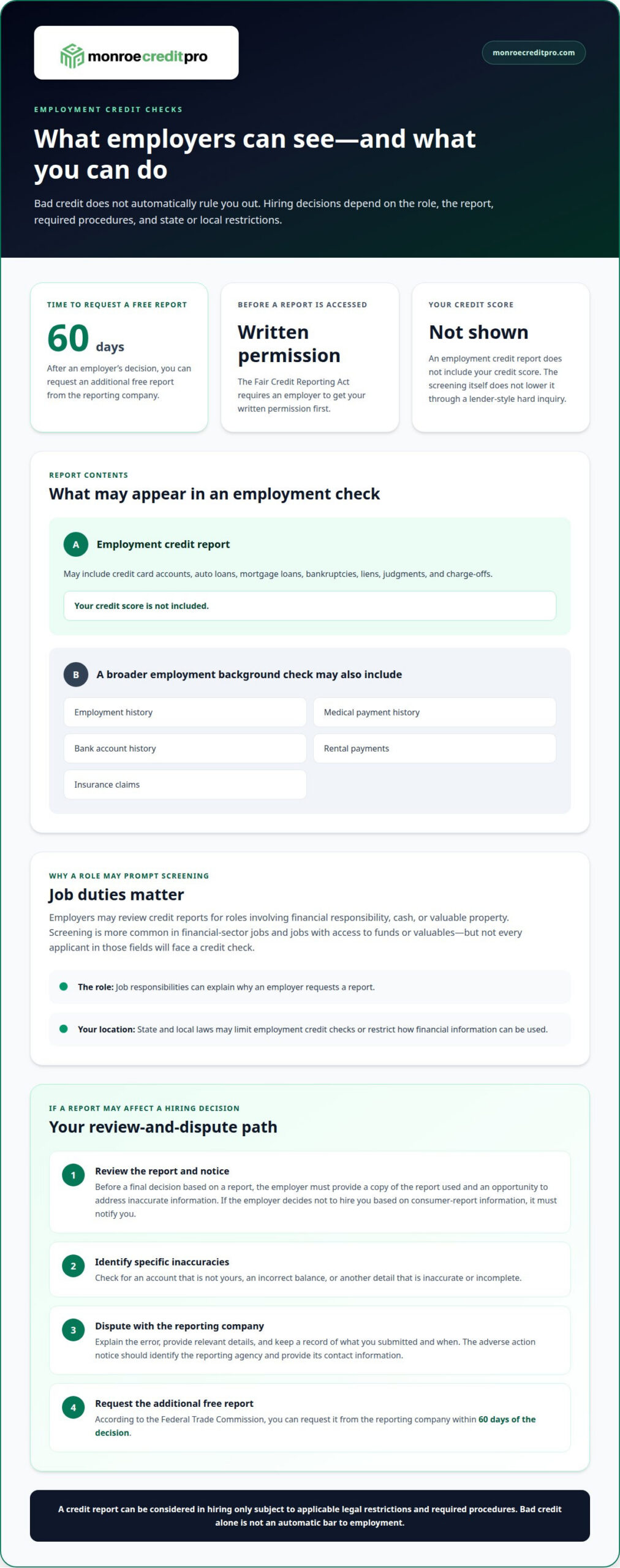
An employment credit report may include credit card accounts, auto loans, mortgage loans, bankruptcies, liens, judgments, and charge-offs. It doesn’t include your FICO Score, and employers don’t receive your credit score. A broader employment background check may also include employment history, medical payment history, bank account history, rental payments, and insurance claims. Knowing what these reports can contain helps you identify details that may need attention.
Credit Reports and Hiring Decisions
Yes. An employer may reject an applicant based on information in a credit profile, subject to applicable legal restrictions and required procedures. Bad credit isn’t an automatic bar to employment, and some state or local laws limit screening or its use in hiring decisions. If a report contains inaccurate or incomplete information, dispute the specific items with the consumer reporting company. The Federal Trade Commission says consumers can dispute the accuracy and completeness of report information.
If an employer rejects you because of consumer-report information, you can request an additional free report from the reporting company within 60 days of the decision, according to the Federal Trade Commission. Reviewing it can help you identify errors to dispute.
Employer obligations when denying employment based on a credit report
Fair credit reporting rules give applicants a chance to respond before a credit report drives a final hiring decision. If an employer is considering rejection based on your credit profile, it must provide a copy of the report used and allow you to address inaccurate information. This step matters because a mistaken account or outdated status could affect how your financial history appears.
Review the report promptly and identify specific inaccuracies, such as an account that isn’t yours or an incorrect balance. The Federal Trade Commission says consumers can dispute the accuracy and completeness of information in an employment consumer report. Send your dispute to the consumer reporting company, explain the error, and provide relevant details. Keep a record of what you submitted and when.
If an employer decides not to hire you based on consumer-report information, it must notify you and give you an opportunity to dispute inaccuracies. An adverse action notice explains that the decision relied on a consumer report and identifies the reporting agency. The next section covers the notice’s contents in more detail.
An employment credit screening doesn’t affect your credit score like a lender’s hard inquiry. The employer also doesn’t receive your credit score. The screening itself isn’t a new borrowing application, so it doesn’t lower your score through that kind of inquiry.
Credit history may be more relevant to positions involving financial responsibilities, cash, or valuable property. If an interviewer raises a specific concern, keep your explanation brief and factual. For example, you could describe a temporary financial setback and the steps you’re taking to manage your obligations. You don’t need to share more personal detail than the question requires. Focus on the context and your current approach, rather than treating past difficulties as a measure of your ability to do the job.
Adverse action notices when credit affects hiring
An adverse action notice tells you that an employer decided not to hire you based on information in a consumer report. It may arrive orally, in writing, or electronically. The notice should explain that the employment decision relied on a consumer report, helping you understand why the decision was made and identify the report involved.
Check the notice for the name and contact information of the consumer reporting agency that supplied the report. Contact that agency to review report details and dispute information you believe is inaccurate or incomplete. Keep the notice and related messages together so you can refer to the employer’s stated reason and the agency’s contact details.
The Fair Credit Reporting Act requires an employer that rejects an applicant based on a credit report to notify the applicant and provide an opportunity to dispute inaccurate information. The Federal Trade Commission says consumers have the right to dispute the accuracy and completeness of information in an employment consumer report. If an account, balance, or public record appears wrong, identify the specific item when contacting the reporting agency.
Use the notice as a practical starting point. Compare the employer’s stated basis with the report, mark the entries you believe are incorrect, and submit a focused dispute to the reporting agency. Keep copies of your dispute and supporting information. These steps can help distinguish a reporting error from information that accurately reflects your credit history.
If you apply for another position or reapply later, a prior notice doesn’t replace the process for a new application. A later employer’s decision must be considered separately, based on the report used and applicable rules. Addressing inaccurate details can help ensure future hiring decisions rely on a more accurate report. A concise explanation can also give an employer context for a genuine financial difficulty.
State restrictions on using financial information in hiring
Employment credit-check rules vary across the United States. Some states and local jurisdictions restrict employers from requesting credit reports, while others limit how financial information may influence hiring decisions. These protections may depend on the employer, the position, or the reason for considering credit information. A report’s presence doesn’t automatically mean an employer can use it without limits.
In some states, employment credit screening is severely limited. Employers in several jurisdictions may not make hiring decisions based solely on an applicant’s credit. Separate restrictions may apply to public employers, and local rules may prohibit employment credit checks altogether. These approaches differ: a law may restrict obtaining a report, relying on credit alone, or screening by certain employers. The specific rule depends on where the job is located and who is hiring.
- Some jurisdictions limit when employers may request employment credit reports.
- Some restrict hiring decisions based solely on an applicant’s credit.
- Some local rules prohibit employment credit checks.
When assessing a screening request, consider the job location and employer type. A restriction on using credit as the sole basis for a decision doesn’t necessarily prohibit every credit check. Similarly, a rule limiting access to a report may differ from one that limits how an employer weighs its information. Understanding the type of restriction that applies helps clarify what the employer may consider during hiring.
Improving report accuracy is a separate concern from understanding hiring protections. If you find questionable entries, a credit report audit and correction can help you address report issues. Treat these as distinct steps: location-based rules govern an employer’s use of financial information, while a report review focuses on whether the information itself is accurate.
Monroe Credit Pro
Monroe Credit Pro can help you address credit-report concerns that may arise during a job search. If you find inaccurate information, Credit Correction and a Credit Report Audit can support a closer review of your report. If financial setbacks have affected your credit, Credit Counseling can help you consider practical ways to manage your next steps. These services focus on your credit profile, not on influencing an employer’s hiring decision or replacing protections under employment laws. Consider this support when you want to better understand your report or work toward improving its accuracy. Your employment situation remains your own, and financial challenges don’t define your professional abilities. Contact Monroe Credit Pro to discuss support with your credit concerns.
Take a Practical Next Step
Whether bad credit will affect your job application in 2026 depends on the role, the report, and the rules where you’re applying. Your next move can focus on what you can address: understanding your credit profile and working through concerns that may need attention. A difficult financial period doesn’t define your skills or the value you bring to an employer.
Monroe Credit Pro offers Credit Restoration, Professional Credit Repair, and Credit Correction for people addressing credit-related concerns. These services focus on your credit profile; they don’t determine an employer’s decision. Choose support based on the issue you want to address, whether that means disputing report inaccuracies or taking a structured approach to credit improvement.
Contact Monroe Credit Pro to discuss your credit concerns and possible next steps. Keep moving forward with a clear plan and confidence in your professional strengths.
Frequently Asked Questions
Can you get a job with bad credit?
Yes, you can get a job with bad credit; a low credit profile isn’t a universal bar to employment. If you’re wondering, “will bad credit affect my job application 2026?”, the answer depends on the role, report information, and applicable restrictions. Apply based on your qualifications, and prepare a brief, factual explanation if an employer asks about a specific credit item.
Can Poor Credit Affect My Job Search?
Yes, poor credit can affect some job searches, particularly for roles involving financial responsibilities or access to cash or valuables. The concern behind “will bad credit affect my job application 2026” doesn’t mean every employer screens applicants or every application will be affected. Review your credit information before applying so you can prepare to address relevant concerns and avoid ruling yourself out without knowing the job’s requirements.
Can employers legally check your credit?
Yes. In the United States, employers must obtain your written permission before accessing a credit report for hiring. State and local restrictions may also affect whether screening is allowed or how employers use the information. Read the authorization before signing so you understand that a credit report is part of the background screening.
What information is included in a background check?
An employment background check may include credit accounts and public records, along with employment history, medical payment history, bank account history, rental payments, and insurance claims. The contents depend on the screening. For example, a report could show employment history alongside an auto loan or charge-off, rather than containing only financial information.
Which jobs are most likely to require a credit check?
Credit checks are more common for financial-sector positions and jobs involving access to cash or valuables. A role’s responsibilities can explain why screening may be requested. For example, a position handling company funds may prompt an employer to review financial information. Location-based restrictions can also affect whether a credit check is permitted.
Can employers check credit reports for job applicants in 2026?
Yes, employers can check applicants’ credit reports in 2026 when they follow applicable requirements, including obtaining written permission. State and local restrictions may limit screening or the use of report information. Rules vary by location, so the job’s location matters. An employment credit report doesn’t provide the applicant’s credit score.