



Marriage doesn’t merge credit scores, but shared financial choices can bring them into the same story. Understanding how a credit score affects relationships starts with this distinction: spouses generally keep separate credit histories, and getting married by itself doesn’t change either person’s score. A joint account or shared financing application can connect their credit outcomes, while a spouse’s poor credit doesn’t automatically appear on the other spouse’s report.
It’s understandable to worry that different credit histories could complicate plans or create tension. The practical answer is to talk openly about finances and decide together which accounts and commitments to share. This article explains how shared accounts can affect credit, how to discuss money at different relationship stages, what a lower score may mean for joint applications, and how financial differences can add stress without defining a relationship. With clear information and a shared plan, couples can make more confident choices.
Key Takeaways
- Separate credit histories can become connected through joint accounts, co-signing, or shared financing, so understand each person’s obligations before opening an account.
- Use calm, regular money conversations to align on debt, spending, bills, and major purchases at each stage of your relationship.
- A lower score may affect a joint application, so discuss borrowing plans and review the factors lenders may consider together.
- Credit differences can add pressure, but they don’t define your relationship; focus on transparent decisions and practical steps toward shared financial goals.
1. What Financial Decisions Affect Married Credit?
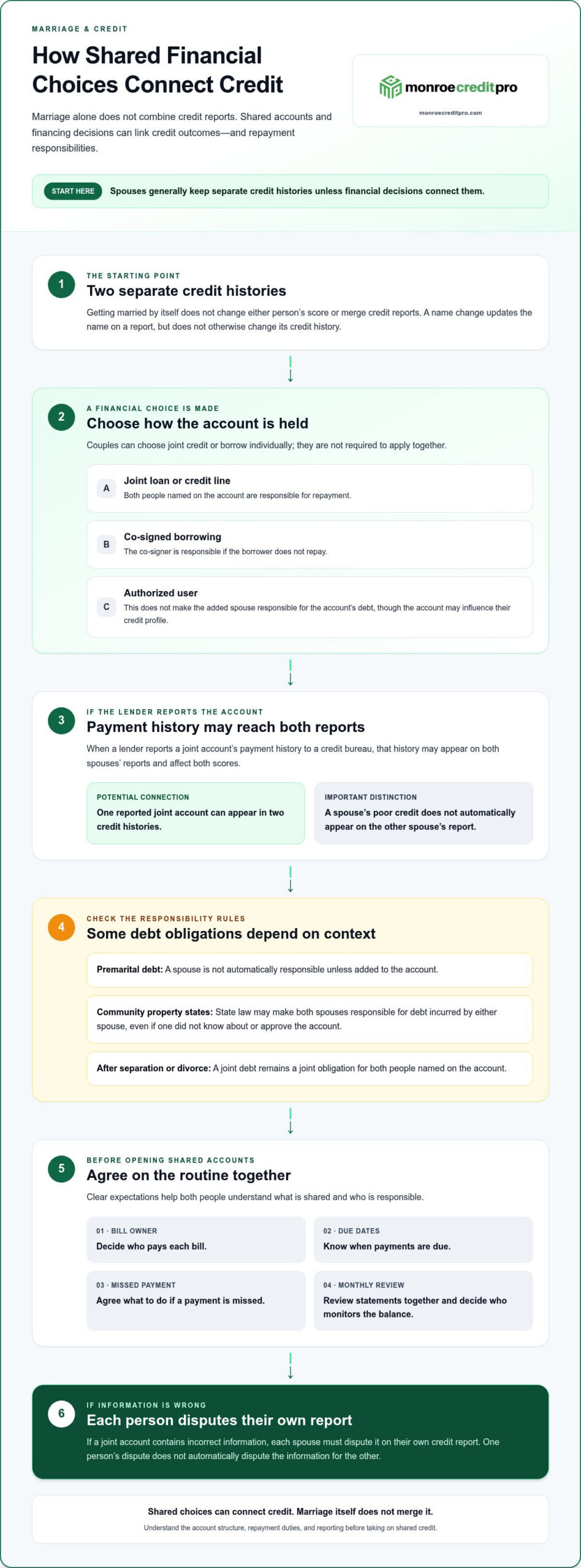
Getting married doesn’t combine spouses’ credit scores or reports in the United States. Credit scores belong to individuals, and spouses keep separate histories unless they share an account or one becomes an authorized user. A name change updates the name on a report but doesn’t otherwise change its credit history.
Shared accounts create a direct connection. If a lender reports a joint account’s payment history to a credit bureau, that history may appear on both spouses’ reports and affect both scores. Both people named on a joint loan or credit line are responsible for repayment. A co-signer is also responsible if the borrower doesn’t repay. Couples can choose joint credit or borrow individually; they aren’t required to apply together.
State law can also affect responsibility for a spouse’s debts. In community property states, spouses may both become responsible for debt incurred by either spouse, even if one didn’t know about or approve the account. A spouse isn’t automatically responsible for the other’s premarital debt unless added to the account.
Authorized-user status works differently from joint ownership. Adding a spouse as an authorized user doesn’t make that spouse responsible for the account’s debt, though the account may influence their credit profile. If a joint account contains incorrect information, each spouse must dispute it on their own report. One person’s dispute doesn’t automatically dispute the information for the other.
Set expectations before opening shared accounts. Agree on who pays each bill, when payments are due, and what you’ll do if a payment is missed. For example, review statements together each month and decide who monitors the balance. This routine makes responsibilities clear before a late payment affects both reports.
After separation or divorce, a shared debt doesn’t stop being a joint obligation simply because the relationship has changed. Both people named on a joint account remain responsible for repayment. After separation, average credit scores trend in parallel during the first four years, with no further convergence once financial responsibilities are no longer shared.
2. Discussing finances at different relationship stages
Start with curiosity, not a score comparison. Among Americans who have used a dating app, 66% say a partner having good credit matters. In a survey, 64% said they wouldn’t want to date someone with a lot of debt. These figures show why credit and debt can feel personal, but they don’t tell the whole story. Ask what a partner is working toward, rather than treating a score as a judgment of character.
While dating, discuss money as shared plans become more serious. Before signing a lease or planning a major purchase, talk about existing debt, spending habits, and how each person handles bills. If one partner carries a credit card balance, focus on the payment plan and whether it affects upcoming commitments. Reviewing a credit report can help each person explain their credit picture accurately.
Money conversations can stall because of embarrassment, fear of blame, or different expectations about privacy. Half of Americans who have used a dating app or are open to using one wish they could filter potential dates by financial status. Rather than using a score as a shortcut, agree on a respectful way to discuss practical concerns. Each person can share what’s relevant to a decision, then revisit the conversation as plans change.
As a relationship becomes committed, set aside time to review financial statements together. Discuss existing debt, accounts, spending habits, major purchases, bills, and household expenses. When moving toward marriage, decide which expenses to share and which accounts to keep separate. After marriage, schedule regular check-ins and assign clear responsibilities, such as tracking due dates or planning for a large purchase.
To manage different scores, compare goals and obligations, then make a written plan for shared bills and borrowing. If credit questions are making those discussions difficult, credit counseling can help organize the next steps.
3. A spouse’s poor credit and joint applications
A lower score can complicate a joint loan, even when the other applicant has strong credit. A spouse’s poor credit may lead to a declined application, including when the other spouse has an excellent score. For some joint financing applications, mortgage and other lenders may use the lower of the spouses’ middle credit scores. That score can affect approval and the interest rate offered.
Before applying, review both credit reports and identify issues that could affect a lender’s assessment. Check payment history, balances, and unfamiliar information, then decide whether to apply together or pursue an individual account. Married couples in the United States aren’t required to apply jointly, and either spouse may apply individually without the other co-signing. Applying alone means the lender assesses the applicant’s own credit and finances.
For a mortgage, one partner’s credit can affect the other’s ability to qualify if they apply together. The lower middle score may carry weight in the lender’s review, and a poor score can contribute to denial. Discuss the application structure before submitting it, and compare applying jointly with applying individually. Don’t assume that combining incomes will offset a weaker credit history.
Apartment applications work differently from mortgage underwriting. A landlord or property manager may use credit screening, so a poor score can complicate approval even if the other applicant has stronger credit. There’s no combined marital credit report; each applicant’s own history may be reviewed. Ask how the application evaluates multiple tenants, and prepare a clear account of income, rental history, and payment responsibilities.
Keep the discussion practical. Agree on who will apply, who will be legally responsible for payments, and how you’ll handle a denial or less favorable terms. A co-signer takes responsibility if the borrower fails to repay, so treat that choice as a real financial obligation, not a formality. Credit decisions affect the application, not either partner’s character.
4. Credit score differences and relationship stress
Credit differences can become a source of tension when partners interpret a score as a measure of responsibility. Research findings describe patterns, not proof that credit scores cause relationship outcomes. In a given year, people with the lowest scores are about 30 percent less likely to form a committed relationship than the highest-scoring singles. Couples with the lowest initial average scores are two or three times more likely to separate than couples with the highest average scores.
A Federal Reserve report found that couples with similar credit scores are more likely to stay together, while couples with larger score disparities are more likely to separate. Treat this as context, not a verdict on your relationship. A score reflects credit history, while income, expenses, health, and changing circumstances can also shape how partners manage money together.
Credit standings can change over time. After the first four years of a relationship, over one-third of couples experience a reversal in which partner has the higher score. That’s a reason to review financial roles periodically rather than assume one person will always manage credit or carry more responsibility.
Reduce friction with a practical routine. Set a monthly check-in, review bills and shared goals, and discuss concerns without assigning blame. For example, if one partner’s missed payment affects a shared plan, agree on who tracks due dates and how both partners will monitor progress. Keep personal accounts separate if that better fits your agreement, and define shared expenses clearly.
Compare financial goals, not personal worth. Each partner can name one credit-related goal, one concern, and one action for the coming month. If credit questions are creating conflict, explore credit counseling to help structure a constructive path forward.
Monroe Credit Pro: Credit Restoration
Monroe Credit Pro offers Credit Restoration for people seeking a structured way to address credit concerns that affect shared financial plans. If inaccurate information or unresolved credit issues are adding pressure, Credit Correction and Professional Credit Repair can help review the credit picture and dispute inaccurate, outdated, or unverifiable information. Credit Counseling can also help you organize questions, clarify priorities, and prepare for a constructive conversation about money with your partner.
Start by identifying the concern, such as an account entry you believe is incorrect or a credit history that complicates a shared goal. Understanding the issue can help you decide what to address and how to discuss next steps together. For support with credit concerns, contact Monroe Credit Pro.
Choose a Shared Financial Direction
If you’re still asking how a credit score affects relationships, consider what you and your partner want your financial decisions to support. A future home, greater financial independence, or simply fewer difficult conversations can each become a useful shared goal. Choose one priority, agree on a practical next step, and revisit it together as circumstances change. Progress starts with a clear plan, not blame or comparison.
When credit concerns need focused attention, Monroe Credit Pro offers Credit Restoration, Professional Credit Repair, and Credit Correction. These services can help you address credit issues while you and your partner work toward a more organized financial approach. Take the next step at a pace that feels considered and purposeful. Explore support from Monroe Credit Pro and move forward with greater clarity and confidence.
Frequently Asked Questions
What Financial Decisions Affect Married Credit?
Married credit is affected by decisions that create shared obligations or add one spouse to an account. Couples asking, “How does credit score affect relationships?” can start by identifying whose name will appear, who pays, and how both partners will track due dates. For example, agree that one person schedules payments while the other reviews statements. Record the arrangement in your household budget so responsibilities stay clear as income or expenses change.
What Happens if Your Spouse Has Bad Credit?
A spouse’s bad credit can make a joint application harder, but it doesn’t automatically damage the other spouse’s separate credit history. Before applying, compare a joint application with an individual one and consider whose income and credit profile the lender will assess. If the weaker report contains an error, the spouse named on that report should address it before applying.
Can a spouse’s poor credit score lower the other spouse’s score?
No, not solely because of marriage or a spouse’s individual score. The other person’s score may be affected if they share an account or become an authorized user and the lender reports that account to a credit bureau. Review each person’s reports separately and identify shared accounts. If an incorrect entry appears on both reports, each spouse should submit a separate dispute.
How do joint credit cards and co-signed loans affect both partners’ credit?
A joint credit card can affect both partners if the issuer reports its history under both names; both named account holders are responsible for repayment. A co-signed loan also makes the co-signer responsible if the borrower doesn’t repay. Before agreeing, decide who will make each payment, set reminders, and plan how to respond to a missed payment. The account’s history can affect both credit profiles.
What steps can couples take to improve credit before applying for a loan together?
Review both reports, address errors through individual disputes, and list debts, balances, and monthly obligations. If you’re asking, “How does credit score affect relationships?” a shared loan plan can make the answer practical: discuss each person’s credit concerns and agree on steps before applying. According to the Consumer Financial Protection Bureau, each spouse is entitled to one free credit report every 12 months from each of the three major credit bureaus. Pay bills on time and avoid unnecessary new credit.